
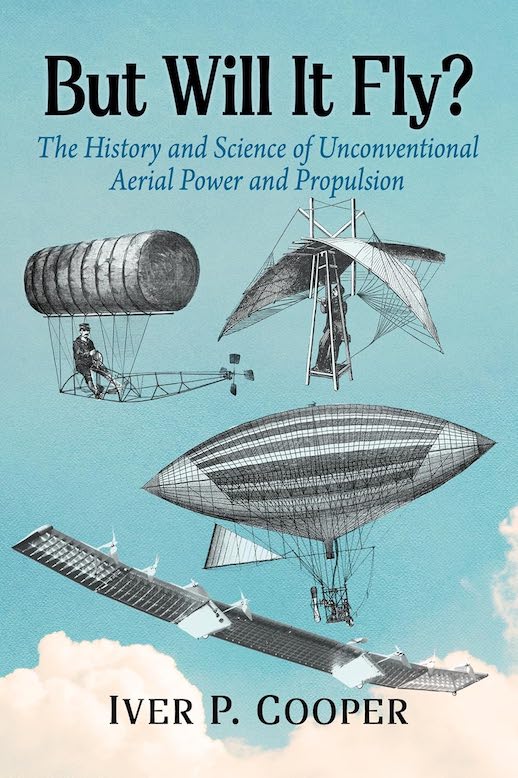
But Will It Fly?
The History and Science of Unconventional Aerial Power and Propulsion
 by Iver P. Cooper
“Portions of this book were previously published in . . . an online magazine [which] presented fiction set in nonfiction relating to the fictional literary universe. . . . The fictional aspects have been omitted from the present work!”
Heed the subtitle as this book’s catchy title and cover graphics don’t clearly convey what the book really is about or what it presents. The subtitle does make clear that the reader won’t be seeing and reading about a number of unusual shapes and designs for flying machines but rather of the science behind the various types of unconventional power and propulsion invented by various creators each of whom hoped his attempt or approach might be met with success.
The quote with which this commentary begins isn’t found until the very end of the book. That means by the time it’s found one has read the entire book and can attest that some of the power and propulsion inventions did seem (especially from today’s perspective) quite fanciful—even fictional. Your commentator, having recently read a book tracing the very earliest history of blown power, can say many of those earlier ones seemed quite fanciful too. But then, the learning curve is always steepest when even the basics governing whatever the technology being explored and developed are little understood.
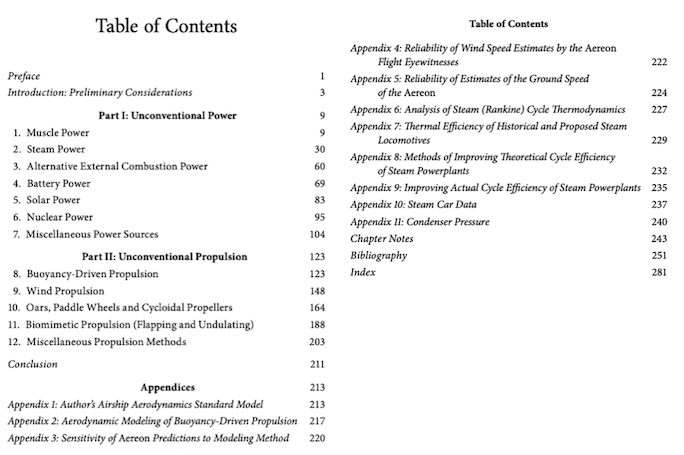
As the Table of Contents indicates, among the power sources author Iver Cooper writes of are human muscle, steam, batteries, nuclear reactors, and hydrogen fuel. Some of the propulsion devices are oars, flapping wings, rockets, and cycloidal propellers. The latter is described as a fluid propulsion device that converts shaft power into acceleration of a fluid using a rotating axis perpendicular to the direction of the fluid motion. A series of schematics showing cycloidal propulsion details are shown on the interior page reproduced below.
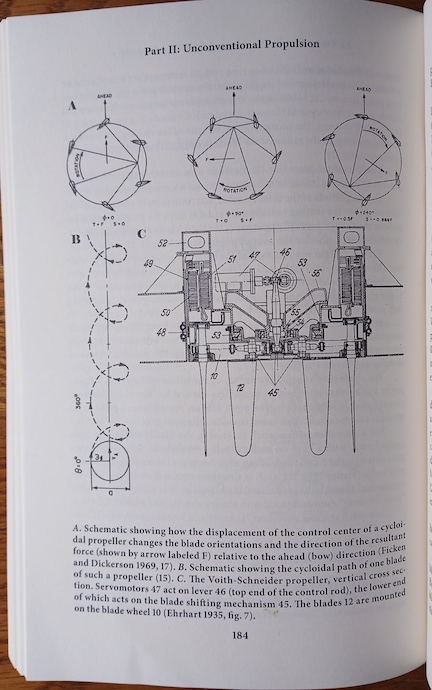 If you get the idea from the above that you’d be well-served to dust off those science principles skills and you find charts and graphs and the like intriguing and interesting, you’d be right. Even if you don’t want to delve that deeply into the technical in the chapters or the eleven appendices, there’s just enough of the history presented at the beginning of each chapter for you to follow Cooper’s narrative and discoveries.
The fourth chapter covering “Battery Power” brings home just how long mankind has been trying to make that form of electric power viably and practically applicable to mobile uses. Those earliest approaches date to 1881!
Of nuclear, Cooper writes in chapter six: “Nuclear propulsion systems use the heat generated by the nuclear reaction . . . thus coupled to either a steam (Rankine cycle) or Stirling or Brayton cycle hot gas engine. While no nuclear-powered airplane or airship has gone aloft, nuclear propulsion at sea may be considered conventional at least for submarines and aircraft carriers.”
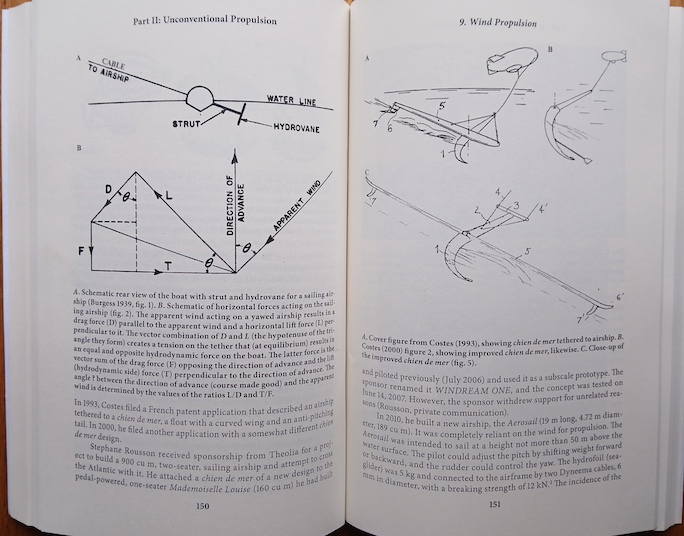
If there are any technologies or approaches you find particularly intriguing, Cooper’s 29-page Bibliography and an additional eight pages of chapter end notes will permit you to delve deeper into any that you wish. Cover to cover, you find all manner of the exotic and unusual in this book.
Copyright 2025 Helen V Hutchings (speedreaders.info)
 RSS Feed - Comments









































 Phone / Mail / Email
 RSS Feed
 Facebook
 Twitter
As an aviation and engineering professional I take a practical interest in seeing units of measure converted into a standard form. An example: one paragraph is in metric and the next in imperial. If Airship A has an envelope volume of 986 cubic METERS and airship B has an envelope volume of 867,429 cubic FEET, the reader is unable to make relevant comparisons. Cooper’s temperature labels were especially bad as one would be labeled F, the next K, followed by one in C. I’m sure he just picked the figures from his references without realizing what he was doing to the reader. But he really should have made the conversions himself.
—Mike Grimes