
SR-71 Blackbird: Stories, Tales, and Legends
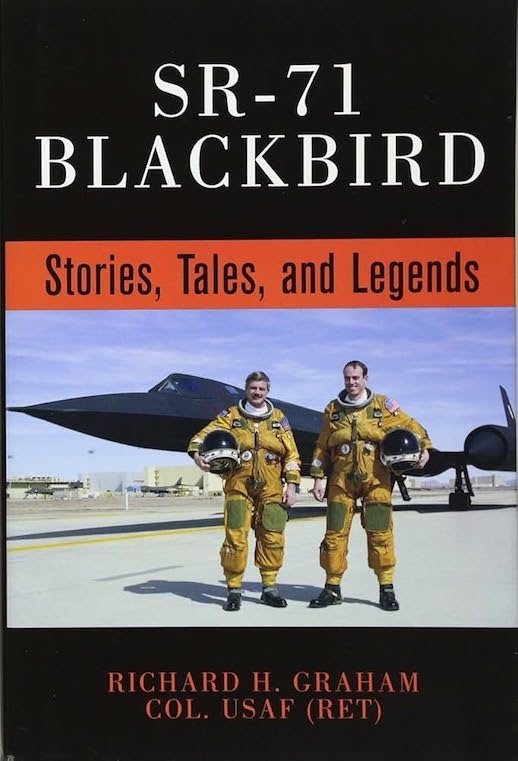 by Richard H. Graham
“As I walked around the SR-71 for the first time, it became immediately obvious to me that it wasn’t just a ‘machine.’ I had an uncanny sense of something animate, something alive, in the hunk of titanium that seemed to be eyeing me as much as I was staring at it. What came to mind was being up close to another living creature whose intelligence we sense, but don’t understand. I paced slowly in front, behind, under, and alongside the black beauty that seemed to absorb even what little sunlight that made its way through the open door of the hangar.”
Those words did not come from some novelist wallowing in anthropomorphism but a seasoned aviator who had just travelled 5000 miles to hand-deliver his application for the SR-71 program. The SR-71 at its core is all about hard numbers and stats, and there are plenty of books about just that, but this one is not.
Of course everyone has an abstract appreciation of an aircraft consisting of numerous parts that all have to be sourced from different makers and then put together in a prescribed and repeatable manner. But WHO writes that plan and oversees it? Read the book.
The Blackbird may be old (every SR-71 is a Blackbird but not every Blackbird is an SR-71) but stories about this unrivalled type of aircraft don’t get old. Well, in a literal sense the ones in this book are—because they were first published in 2002 as a hardcover and are now released again as a 2025 paperback. Both years seem to be quite random vis-à-vis the Blackbird timeline (and there is one of key events right in this book) except that 2002 came after 2001, the year the Pentagon seriously pondered if the aircraft ought to be unretired a second time, to answer the questions raised by the 9/11 attack on the US. It wasn’t. But maybe the book was meant to remind people of how unique the SR-71 was.
In its day, the Blackbird was so advanced that the design theory outpaced the state of available technology, down to the special rubber for the tires or the jet fuel or the cameras—these items probably being the most relatable to the general-interest reader. Most everything else in this book is way out there even for experts, be they flyers or scientists or people who mastermind procurement and logistics.
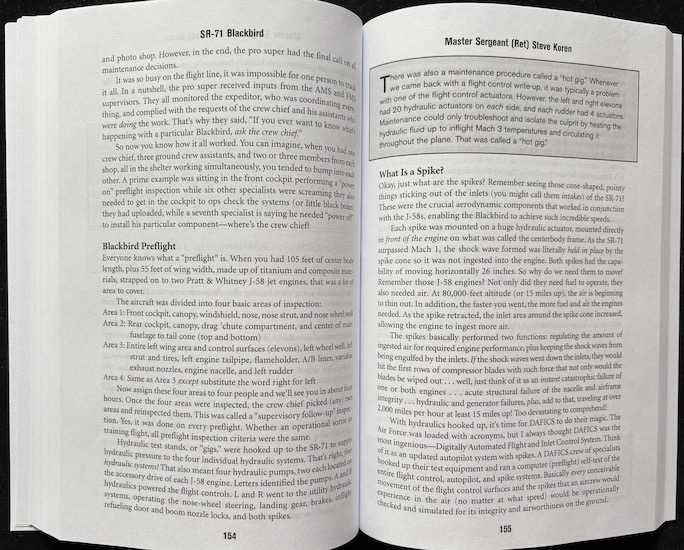
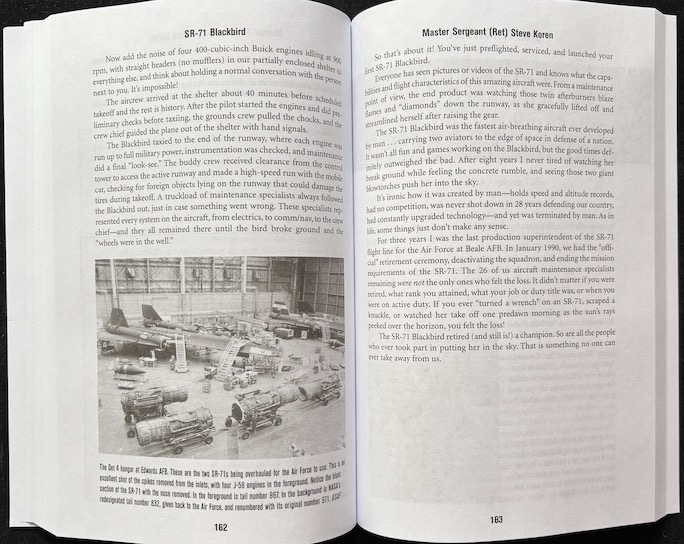
Sample topics: Preflight, or What is a Spike?
“Written through the eyes and perspective of many Habus who were willing to share their thoughts, emotions, and stories” this book takes you behind closed doors and gives you a direct view of processes and situations—flight line ops, fueling (on the ground and in the air, even dumping fuel) and inerting tanks, the role of the buddy crew, night flying and a hundred other things—that the techno-focused Blackbird books mention in passing at best. Of course the infamous engine unstarts are described here.
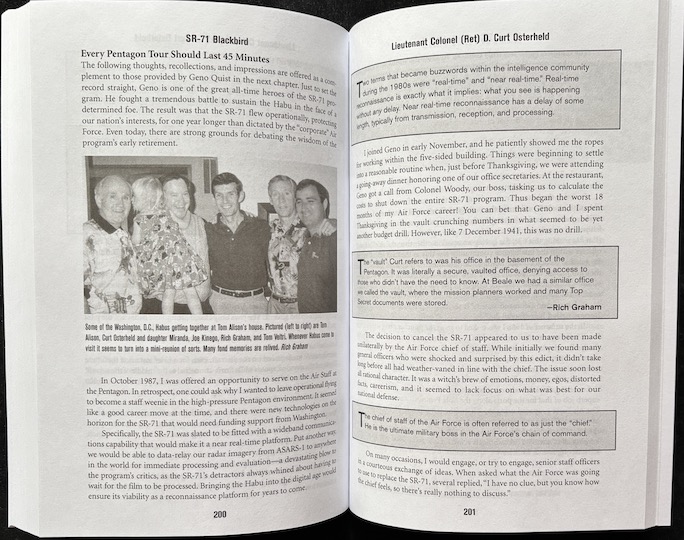
An example of the sidebars. The one on top lays out the difference between “real-time” and “near real-time.”
The 16 chapters are written by as many people, with an Epilogue by lead author Graham, a veteran of the Blackbird program who has written a number of excellent books about it. So excellent that in 2005 he was awarded the Kelly Johnson trophy by the Blackbird Association for his work to perpetuate, foster, and improve the SR-71. He also introduces each writer and penned various sidebars to further contextualize certain bits.
The Table of Contents only states the writer’s rank and name but no topic so it is critical that you then read Graham’s Introduction in which he offers a brief synopsis of what each person will cover. It also sets the scene by covering the U-2 as well as the A12 incl. M-21/D-21, and the YF-12. While the chapters are numbered, those numbers do not actually appear in the running heads on the respective pages so you do have some mental acrobatics to do. (The reprint really could have corrected this.)
There is an Index but only of people, places, and key events. Photos are few and of often mediocre quality and generic purpose—if the SR-71 is of serious interest to you, other books are required. Fortunately there are many but for the “Stories, Tales, and Legends” this is the one.
Copyright 2026, Sabu Advani (speedreaders.info)
 RSS Feed - Comments









































 Phone / Mail / Email
 RSS Feed
 Facebook
 Twitter