

The Enthusiast’s Guide to Collector Cars
A Journey Through Automotive History, Culture, and Passion
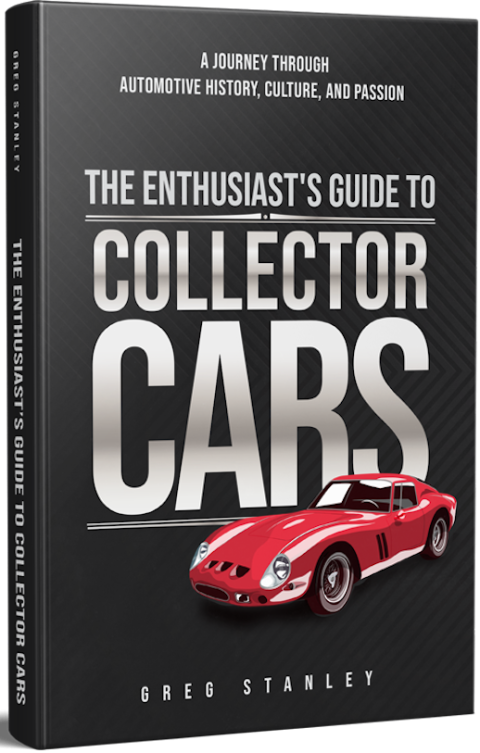 by Greg Stanley
“A collector car is more than a machine—it’s an artifact that carries stories, identity, and cultural memory. … Beyond their engines, chrome, and curves, collector cars represent something far deeper—a tangible link between people, eras, and emotions.”
By the time a reader has turned this book’s last page, s/he will have received a healthy dose of common sense suggestions, encouragement, and advice to help maximize his or her successful and enjoyable participation in the automotive hobby. It is written by a man who has navigated the world of collector cars on two levels: for his own personal enjoyment as an enthusiast and professionally.
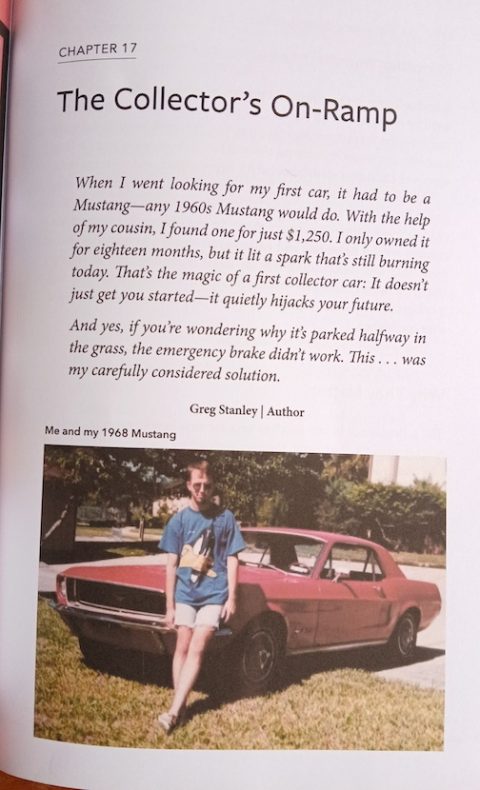
The author (a “few” years ago at age 17) with his first collector car, a 6-cylinder 1968 Mustang, parked creatively to compensate for a non-operating emergency parking brake.
From an early age, Greg Stanley recognized his strong attraction to all things automotive. He’s shown here with his first—but certainly not last—collector car. Today he describes himself as “a car specialist consultant with more than 25 years of insight and analytical experience.” He’s a recognized expert of Enzo-era Ferraris, first-generation Mustangs and Shelbys, as well as a respected and experienced judge at concours and other car shows. Greg was employed full time for a number of years by RM Sotheby’s as a car specialist and now consults in a similar capacity with them and others. He is the creator and voice of The Collector Car Podcast with over 400 episodes available on YouTube reaching and enjoyed by a global following.
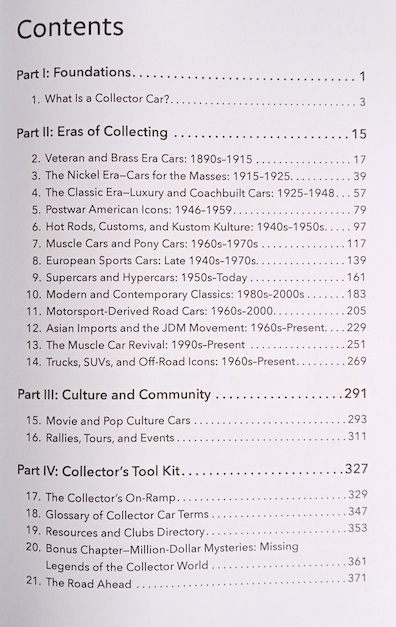 With that spectrum of experiences, it is not surprising that the advice he offers on the pages of his first book is solid and reasoned. What he writes and how he expresses himself is also an indication that he’s a keen observer of people. This first book can rightly be described as an overview of the hobby discussed by eras such as brass, nickel, Classic, postwar icons among others. Stanley intends to follow up with additional titles, each more narrowly focused. The broad-brush assessment of the world of collector cars is nicely produced and very reasonably priced.
You’ll notice from the interior pages of several of those era chapters that illustrate this, the writing is direct and to the point, often presented as short, snappy bullet points rather than longer, text-dense dissertations. Thus, even at 400 pages, reading goes quickly and Stanley’s main points are easily grasped.
One subhead section that is part of each of the 14 groups of collector cars which Stanley has identified is what he terms “The Collector’s Ladder.” This is where he projects prices or cost of a vehicle in that group on three levels—Entry, Middle Market, and Blue Chip. But he doesn’t explain how or where he arrived at those values. As Stanley has worked within the automotive auction realm it’s logical to think perhaps he’s using recent published auction results. Still with the lowest entry level price in any of the categories beginning at $10,000 and the rest of those entry level figures starting anywhere from $15,000 to $20,000 to even $40,000, it seems both a bit intimidating and apt to discourage certainly the more youthful who typically have less disposable income/resources available to spend on becoming part of the collector car hobby.
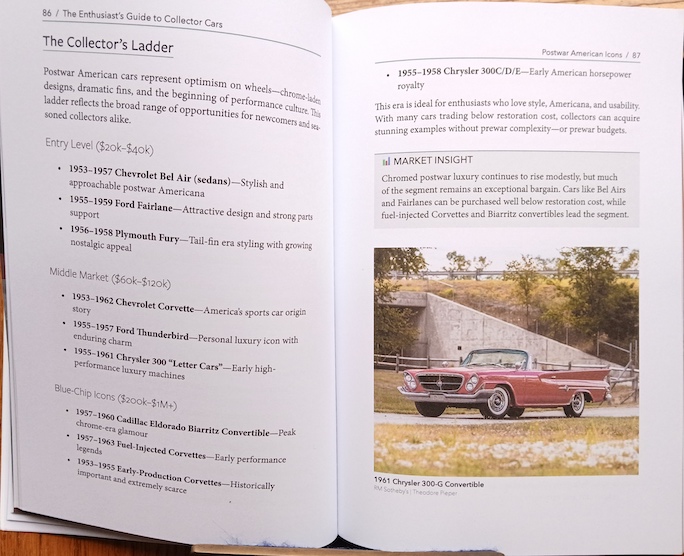
Pages in the “Postwar Icons” chapter showing a feature of every chapter, “The Collector’s Ladder” divided into sections by value and listing a few key examples.
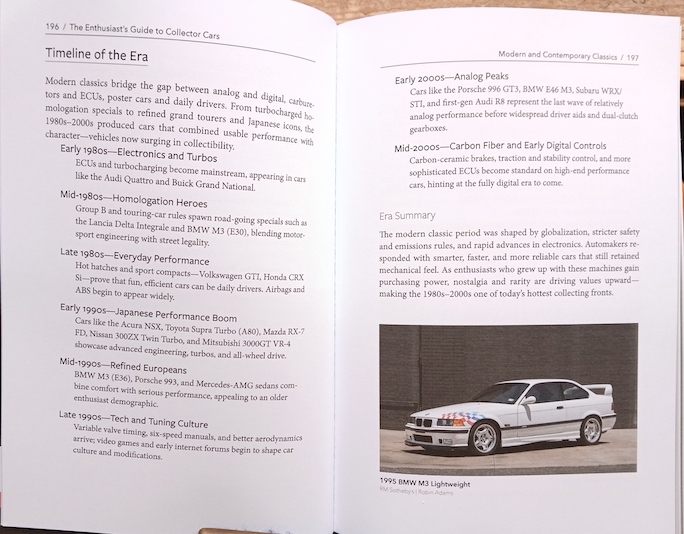
Pages in the “Contemporary and Modern Classics” chapter with a typical “Timeline of the Era.”
To close this first book Stanley offers five chapters grouped into Part IV which is headed “Collector’s Tool Kit.” In the “On-Ramp” he discusses the relevance of both preservation versus restoration and the importance of provenance, counseling not to let the excitement of finding a potential collector car lead to overlooking warning signs, adding, “Smart collectors know that walking away from a questionable car is often the best deal they’ll ever make.”
In another chapter Stanley praises the collector car community, citing the value of joining clubs and especially becoming an active participant, enumerating several in which he is a longtime active member. All in all, Greg Stanley’s book is a fine ambassador to the world of old cars whether you’re just curious what it’s all about and considering where to begin or a longtime participant.
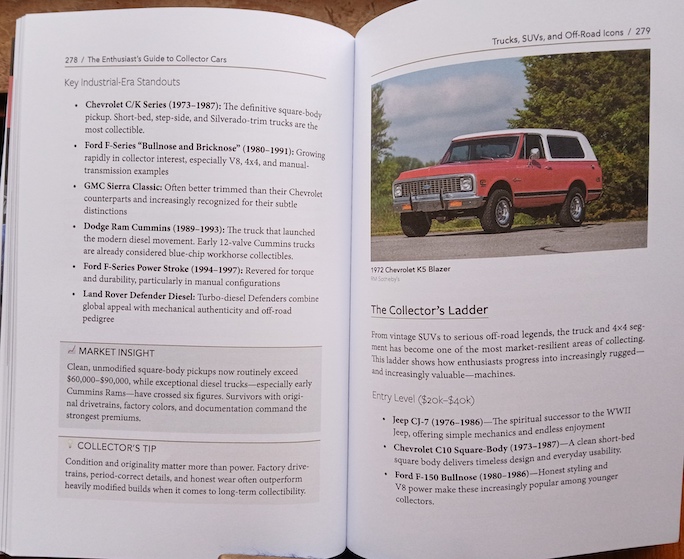
A 1972 K5 Chevrolet Blazer and more sections of a typical chapter; this in the “Trucks, SUVs, and Off-Road Icons” 14th chapter.
Copyright 2026 Helen V Hutchings (speedreaders.info)







































 Phone / Mail / Email
 RSS Feed
 Facebook
 Twitter