
20 Years of GT3 Racing, the Story of the World’s Leading GT Sportscar Category
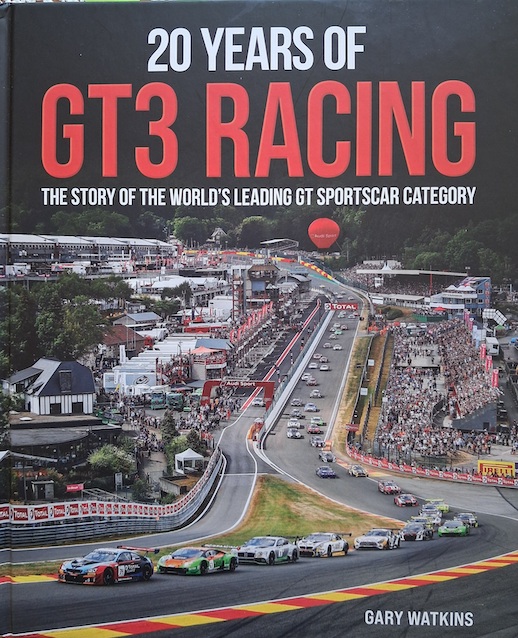 by Gary Watkins
“If GT racing collapses once, that’s bad luck, and if it collapses twice that’s careless. If it collapses a third time, someone should lose their job.”
—Max Mosley to Peter Wright
Have you heard? There’s a new Rolling Stones album, called Foreign Tongues. And, as has become compulsory to say about their last eleven albums, it’s a “triumph,” a “return to form,” and the “best since Exile on Main Street.” Which, let me remind you, was released in the same year, 1972, as Emerson Fittipaldi won his first World Drivers’ Championship.
Hold that thought, because reading this exhaustive work on GT3 racing triggered the same reaction I get every time I see Ronnie Wood with Jagger and Richards. There’s that new guy again, the parvenu, the arriviste who must still be on probation, surely? Then I remember that Wood joined the Glimmer Twins the same year as Niki Lauda’s first championship, in 1975.
And I also remember that GT3 has already been around four years longer than the Cosworth’s DFV winning streak, and has become the foundation of GT racing worldwide. Even nostalgia-addicted Goodwood now features older GT3 racers at the Members’ Meeting. Don’t tell His Grace, but I go every year, despite having given up membership in 2003.
Gary Watkins is synonymous with sports car and GT racing and this 224-page Evro heavyweight is testimony to the fact that Watkins is a Man Who Knows His Stuff. Unlike Formula One, whose made-for-TV popularity has stimulated new titles by authors whose F1 knowledge goes as far back as the week before last, sports car racing has always been for the connoisseur. It’s for those of us who are more interested in the car than the driver, and who know our Targa Florio from our Nürburgring 500 km.
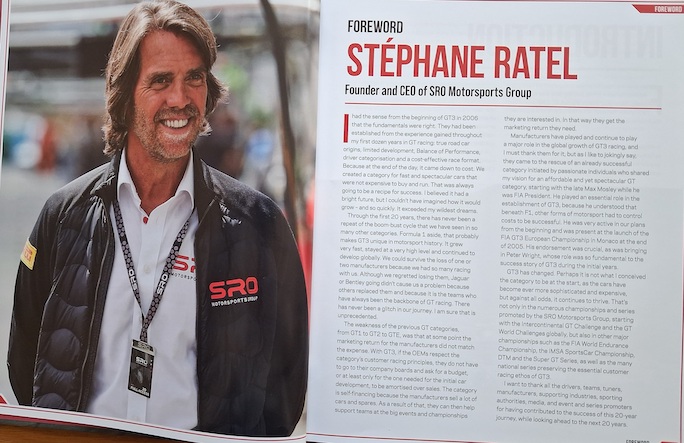
Watkins is a man who doesn’t skimp the small stuff (or any other narrative dimension) and this makes 20 Years of GT3 Racing more of a book of reference than a page turner. After a Foreword by GT3 architect Stéphane Ratel (which reads like a business plan) Part 1’s six chapters tell the story of GT3’s genesis, expansion, and eventual ubiquity. Part 2 describes the fortunes of GT3’s 23 manufacturers, from Ascari to Venturi, which have raced since the formula’s debut at Silverstone in 2006. Still hungry for more? Try the 8 pages of Appendices, from which I learned that, although just a single Maserati GranTurismo GT3 was made, no fewer than 200 Ferrari 296s and Lamborghini Huracans have already hit the track. Good heavens.
The early pages reminded me that one of the elements of GT3’s creation story was the Lamborghini Supertrophy, held between 1996 and 2003. How could have I imagined that the series I’d written off as weekend entertainment for rich Eurotrash would evolve into such a hugely popular formula? And if you think I’m being cynical, you didn’t see the slo-mo pantomime of driver after driver losing control of their ponderously absurd Diablos, at a drizzly Donington sometime in the Nineties. I wasn’t too surprised to hear that GT3 was met with a combination of indifference and outright hostility on its launch—conflict and protest have been motorsport’s lifeblood for more than a century. Predictably enough, the loudest dissenting voices spoke with Italian accents and, equally predictably, one of the most successful marques in GT3 racing has a Cavallino Rampante logo …
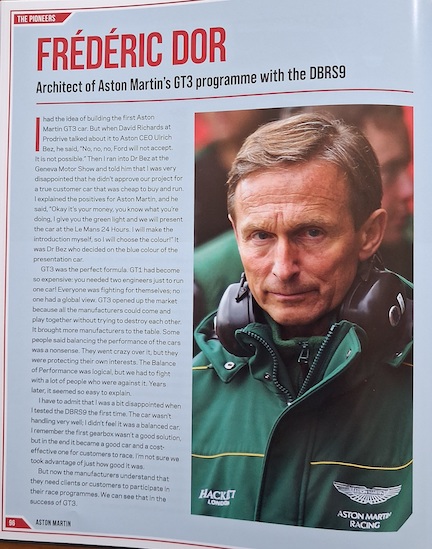
Frédéric Dor, the inspiration for Aston Martin in GT3.
Apart from Ratel, the two most important figures in the creation of GT3 were, perhaps surprisingly, Max Mosley and Peter Wright. The opening quotation was taken from a conversation about the problem that the “sledgehammer to crack a nut” Maserati MC12 presented. And Renaissance Man Wright cleverly avoided that risk by creating a workable Balance of Performance equation. History shows that it worked, although the inevitable byproduct of BoP is scowling losers mumbling about how unfair it all is, and how the BoP is weighted for the “undeserving” (but still beaming) winner. But who cares, when the formula has become almost the only show in town for both “gentleman” racers (typically old, rich, and slow) and the thrusting youngsters who have chosen sports cars over single seaters as a career? There can be no greater testimony to GT3’s status than the fact that it was chosen by Max Verstappen for his extracurricular jollies outside the F1 straitjacket. You owe it to yourself to search YouTube for Max’s qualifying laps at the Nürburgring earlier this year, in his thundering AMG Mercedes. You want commitment? This is what it looks like. And do you remember—I didn’t—that Max’s erstwhile colleague Adrian Newey competed in an AF Corse Ferrari 430GTC? I wonder what Adrian’s up to these days …
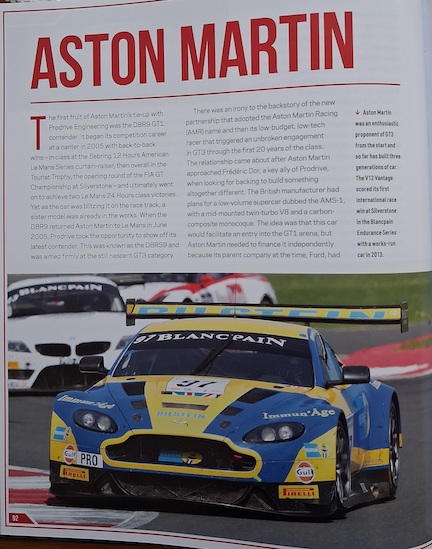
Aston Martin V12 Vantage, Silverstone, 2013.
If you’ve read Gary Watkins in Motor Sport, Autosport, Racer (etc) you’ll know that he applies an almost academic rigor to his subject. Which means that some of his magazine articles almost sink from the sheer weight of information, and they can read more like an essay than a feature. Hence it was a relief that, with 200 pages through which to roam, Watkins writes here much more accessibly than he does in shorter-form pieces. The account in Part 1 of the GT3 story is easily digested, and the (mainly excellent) photographs help, as well as the short interviews with GT3 “pioneers.” These range from team owners such as Toine Hezemans and Mark Lemmer, to drivers including Nick Tandy and Darren Leung and, whilst their contributions add diversity to the text, they sometimes veer a little too close to testimonials of GT3’s quality.
Part 2 is excellent as well, focussing on the extraordinary variety of machinery that has contested GT3. The stereotypical GT3 racer is a pumped-up German GT car, with looks suggesting anger management issues and a steroid habit. You wouldn’t dare kick sand in the face of a GT3 Audi or Mercedes, but some GT3 cars, especially the supercar triumvirate of Ferrari, Lamborghini, and Aston Martin don’t look significantly different from their road car counterparts. But the only way the Bentley Continental or the BMW Z4 was going to be able to duke it out with the class jocks was through anorexia (the stock Bentley weighed over 5000 lb!) and the insertion of an M3 spec V8 which no showroom Z4 ever rocked.
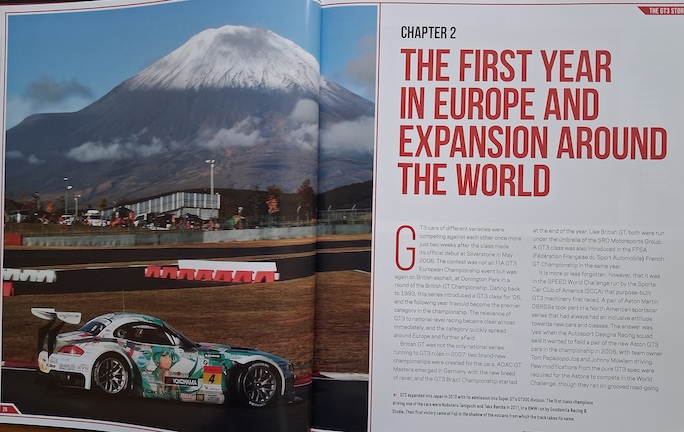
The Tanaguchi/Bamba BMW at Fuji, 2011.
And who even remembers the Lotus Exige racer, the car whose flyweight build and teeny Toyota four epitomized Colin Chapman’s “add lightness” credo? Or the V8-powered Ann Hathaway cottage with the Bauhaus refresh that was the Morgan Aero 8? And don’t even get me started on the Manga chic of the Nissan GT-R and the Honda NSX—the MidNight (sic) Club made flesh?
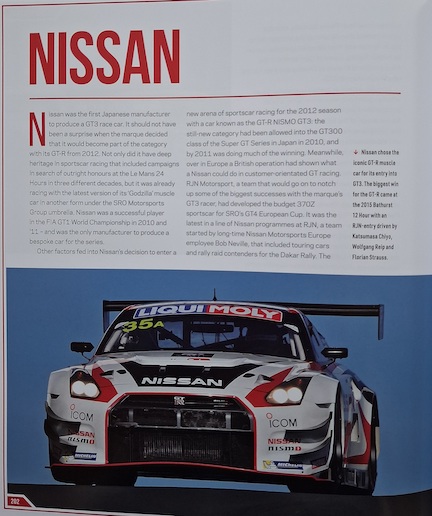
Mean, moody, magnificent GT-R at Bathurst, 2015.
The dead hand of BoP might have guaranteed close performance—no room for hares and tortoises in this Brave New World—but it didn’t fetter the wonderful variety of models and marques that has been chasing GT3 victories for twenty years. And counting …
I last saw a GT 3 car only a week ago, a “historic” Chevrolet Camaro contesting Silverstone’s BRDC Classic. The Chevy’s pit stop was pure theater, thanks to the rolling thunder of its huge 700 bhp V8 and the taut muscled looks that made me catch my breath.
May the church bells ring out—GT3 is here to stay.
Copyright John Aston, 2026 (speedreaders.info)



























 Phone / Mail / Email
 RSS Feed
 Facebook
 Twitter