
P-61 Black Widow, Northrop Night Fighter in WWII
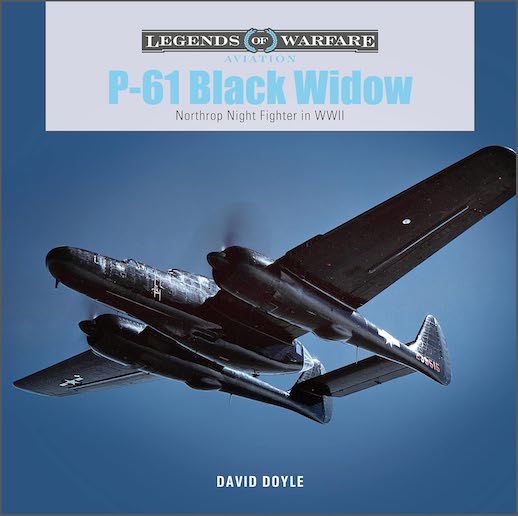 by David Doyle
“The P-61 was a merger of these characteristics—the maneuverability of a fighter but the size of a medium bomber. … The radar equipment installed in these aircraft, as well as crew requirements, necessitated relatively large airframes.”
An article in the Summer 2026 issue of the magazine Smithsonian provided the impetus for this commentary. That article was titled “Masters of the Sky” explaining and describing how “meteorologists and combat pilots teamed up to decipher the science of thunderstorms and changed flying and forecasting, forever.”
In 1945, the chief of the US Weather Bureau established the Thunderstorm Project with the aim to “decipher a thunderstorm’s internal structure.” He recruited former World War II pilots of Northrop P-61s to penetrate storms and “take careful notes of what they experienced.” Realizing I knew precious little about those aircraft referred to as Black Widows, I set out to educate myself.
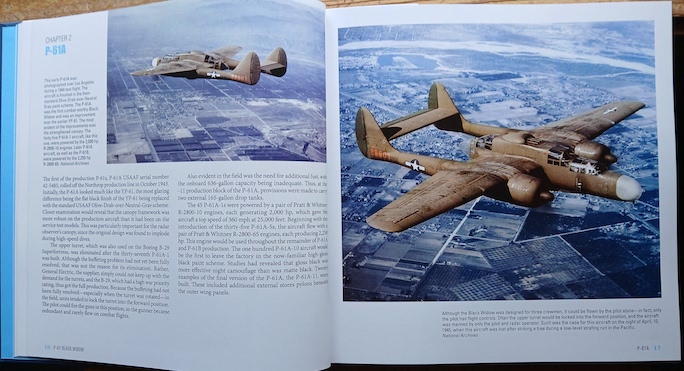
Early P-61A on a test flight over Los Angeles. It’s finished in military standard Olive-Drab-over-Neutral Gray rather than the combat gloss black of production P-61s.
More than just aircraft history was involved in the story. Radar was still nascent when P-61s were conceived and designed in the earliest 1940s. By the end of World War II the radar systems with which Thunderstorm Project planes were equipped were sufficiently developed to enable pilots and radar operators to locate storms and then triangulate the data in conjunction with ground-based instruments. Project aircraft were airborne 1946 and 1947 flying each mission with “five Black Widows in a vertical stack formation at 5,000-foot intervals” if those altitudes and separations could be maintained which wasn’t always the case as those storms turned out to contain severe updrafts and downdrafts.
The Smithsonian magazine article is really fine but I wanted to know more about those Northrop-made P-61 Black Widows. So first I turned to a prolific (200-odd titles!) military-machine chronicler named David Doyle whose works several of us SpeedReaders reviewers have previously reviewed for you.
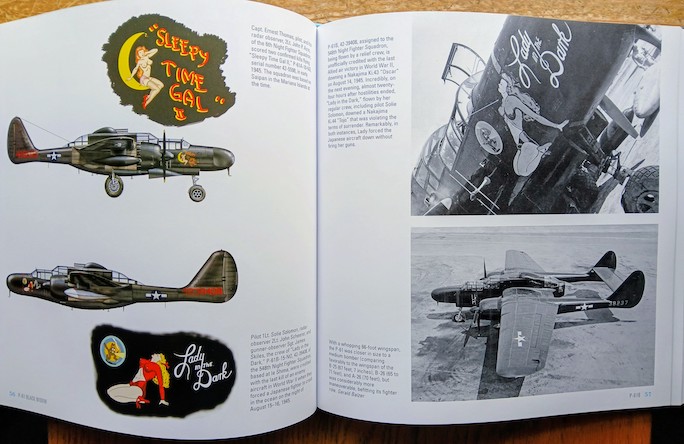
As with other warbirds, crews named their planes and nose art properly decorated them.
P-61’s mostly all wore black or dark blue paint. Those flying night fighters were painted gloss black as it had been “proved more effective night camouflage than was matte” finish. Jack Northrop and his chief engineer Vladimir Pavlecka conceived of their basic layout and power in just 15 days and a year on they were being built and flying. That said, there were running changes along the way hence the reason for P-61s designated XP, YP, then A, B, C, etc and even ones designated as F-15A models modified for photoreconnaissance.
P-61s were big planes, yet fast as the chart shows. They were “America’s only purpose built night fighter during World War II.” As the opening quote indicates they possessed “the maneuverability of a fighter but the size of a medium bomber.” That means each was heavy.
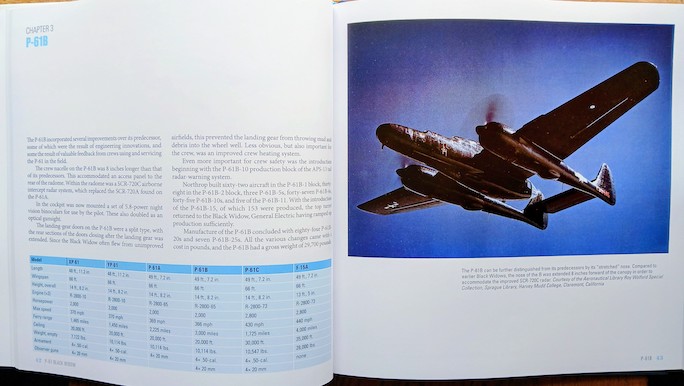
Chart compares vital statistics of various P-61 iterations. The stretched nose of plane in photo (“extended to accommodate the improved SCR-720C radar”) identifies it as a P-61B.
David Doyle relates the story of one plane destroyed by its pilot in a colossal show of bad judgment “when its pilot, mimicking a high-performance takeoff maneuver fancied by P-38 pilots, retracted the landing gear while accelerating down the runway. While the smaller Lightning gained speed rapidly enough to fly away in this manner, the massive P-61 merely settled, propellers thrashing, onto the pavement, becoming a total loss.”
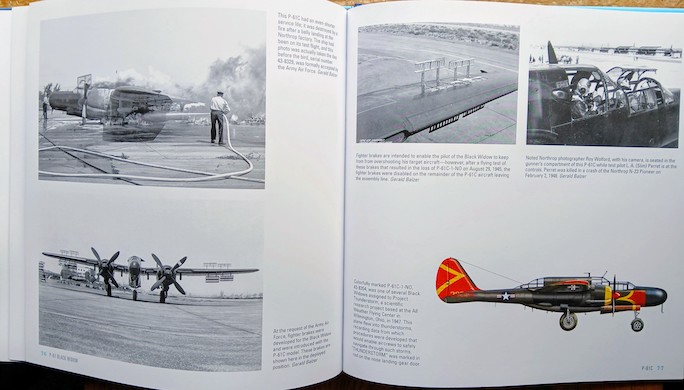
Top left, forced to make a belly landing, then consumed by fire destroyed this P-61C. Other images show air brakes deployed. P-61C in color is a Thunderstorm Project plane as lettering on nose landing gear door indicates.
With the usual thoroughness of his other books in this ”Legends of Warfare” series, Doyle details each model’s changes and features one to another with clear words and a multitude of images. He notes the fate of most of these wonderful Night Fighters such that only four exist to this day. Survivors can be viewed, one each, in the Smithsonian’s Air and Space Udvar Hazy Center, the Mid-Atlantic Air Museum, the National Museum of the United States Air Force, and the Beijing Aeronautics Institute in China.
Copyright 2026 Helen V Hutchings (speedreaders.info)



































 Phone / Mail / Email
 RSS Feed
 Facebook
 Twitter