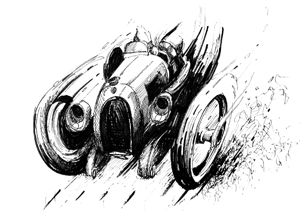

The Chandler Automobile
A History Including the Cleveland and Chandler-Cleveland Marques
 by James H. Lackey
“Chandler was going broke while building the best automobiles it had ever produced.”
A straight-forward and very comprehensive history telling of the Chandler motorcars—all years and body styles noting specifics of production changes—as well as of the people involved, the company they established and ran, its growth and expansion and then the troubles that eventually led to its demise. It’s all presented chronologically, 1912 to 1929, in two parts with the first part focused on Chandler and the second on Cleveland.
For those wanting to restore or maintain Chandlers or Clevelands to factory correct, there are two gems, one at the end of each part. Those gems are text-dense, year by year detailed specifications for each model. They will prove invaluable. To properly cover the Chandler specifications alone occupies 34 pages.
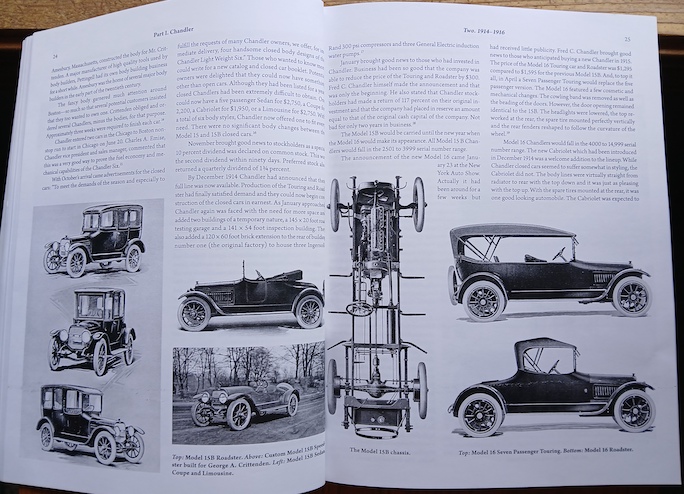
There are many page pairs similar to this throughout showing period images of many models and other details such as this of a chassis.
Because author Lackey has been deeply involved in this era of cars for practically his entire existence (b. 1936), he knew all the right people to contact for additional photos and factory materials beyond that which he’d already collected himself or researched. Thus this book is generously illustrated with nearly 400 images including a 16-page color insert.
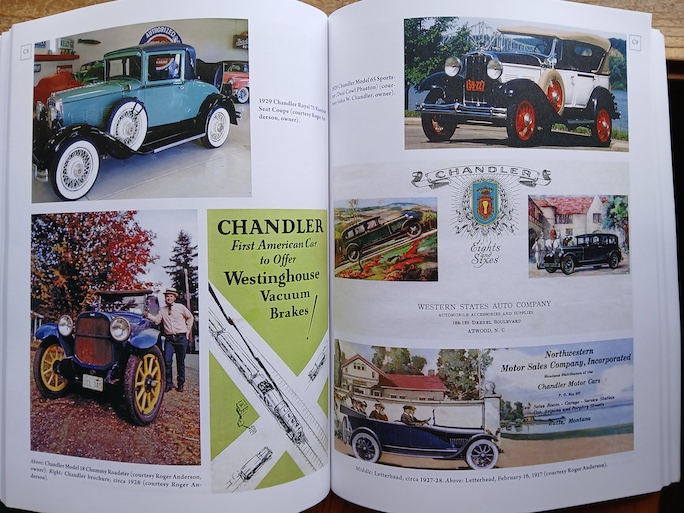
A page pair from the 16-page insert of color images—a real treat given the era. Note particularly the ad touting Westinghouse vacuum brakes. Although the Westinghouse biography by Bill Huber isn’t in this volume’s bibliography for the time this book was published, the other didn’t yet exist.
Chandler’s reputation was beyond reproach both for the high quality of its vehicles and for treating its employees with respect and consideration. There’s a story in an early chapter of a few employees planning a fun outing to Cedar Point, at the time the Atlantic City of the Midwest. A company exec heard about the outing so organized a multi-car caravan which permitted additional employees and spouses to enjoy the holiday, too. Christmastime it was not unusual for Chandler to purchase truckloads of turkeys and deliver one to the family of each of the several hundred employees. Organize an all-employee picnic? Sure, no problem. Plus raises and bonuses were distributed with regularity.
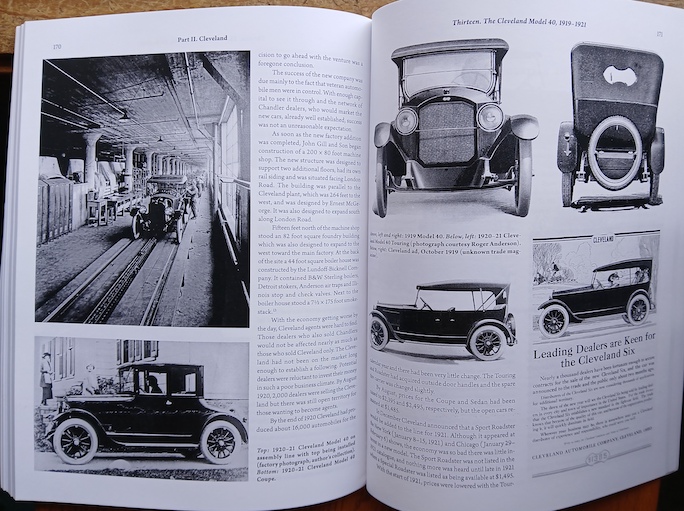
Similar to those first period images shared, these are all of Cleveland automobiles including one of its assembly line.
Chandler was doing well as demonstrated by nine consecutive years of the aforementioned profit sharing with its employees. But then several unforeseen, unpredictable events happened as 1925 ended and ’26 began. Up to then, Fisher Body had been a main supplier of bodies for all Chandler models. But then Fisher’s majority owner, GM, issued a directive that it concentrate its body building on its now corporate sister divisions. It took Chandler nearly half a year to put other body builders—mainly Murray—in place and meantime many of its models were not being produced thus became unavailable to buyers.
The other event in that same timeframe was the culmination of negotiations for Chandler to merge with Cleveland. But with Cleveland bodies also predominately built by GM the timing of that merger meant greatly reduced Cleveland models available for purchase too.
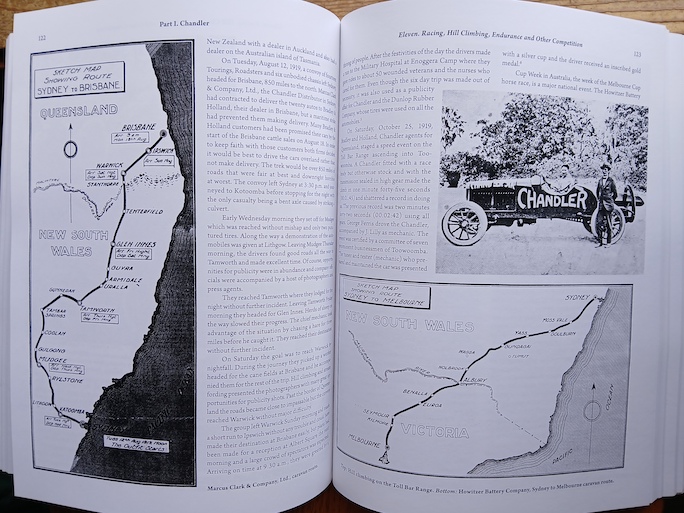
Chandler had dealers in 61 countries. These pages show maps of two routes over which Chandlers were driven virtually trouble free; one is Sydney to Brisbane, the other Sydney to Melbourne. Each required multiple days to traverse.
As profits dropped off noticeably, the Chandler-Cleveland board of directors opted to accept Hupp’s offer to purchase their factory. Hupp had been growing and needed larger manufacturing facilities. So, the last Chandler came off the line on April 15, 1929 and six weeks later the first Hupp rolled out.
Oh, but you did notice the year, didn’t you? Because as we know today something was about to happen starting in October. Thus hindsight proves that “the Chandler-Cleveland board of directors got it right. Hupp, on the other hand, could not predict the future and just eleven months later they paid the price as the economy went down” due to the stock market crash and ensuing Great Depression. Jim Lackey clearly communicates and fully relates all that transpired with Chandler and Cleveland 1912–1919 on the pages of this book, his second.
Copyright 2025 Helen V Hutchings (speedreaders.info)


































 Phone / Mail / Email
 RSS Feed
 Facebook
 Twitter