
Racing with Rich Energy: How a Rogue Sponsor Took Formula One for a Ride
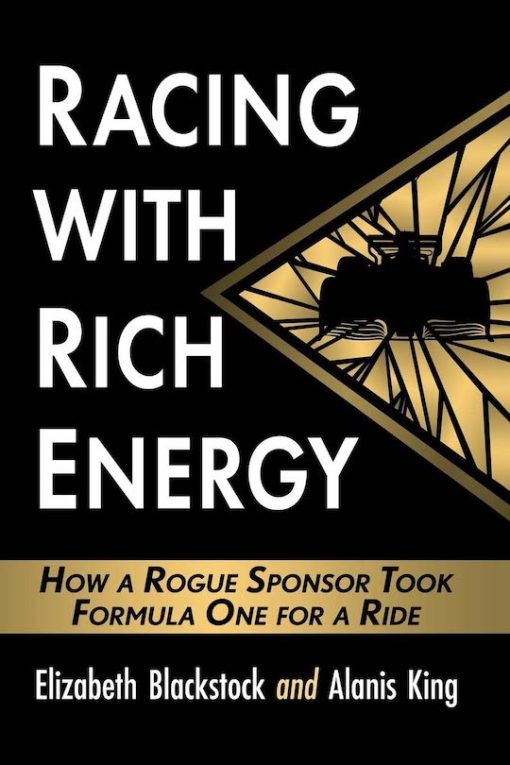 by Elizabeth Blackstock & Alanis King
“For the 2019 Formula One season, the American Haas F1 team took on a sponsor no one had ever heard of: energy-drink startup Rich Energy. What followed was a whirlwind year of bad tweets, lawsuits, and distortions that never quite answered the questions everyone wanted to know. Where did Rich Energy come from? Who was its CEO, William Storey? And what happened after its unceremonious exit from F1?”
Money.
Alcohol- or petroleum-based or some sort of sustainable fuel may be what propels race cars on the track but the real motive power was and is and will always be … Money. Lots of it.
And Money means sponsors.
Sponsors have it. Teams need it. Those hosting events need it. The sanctioning body wants it. In other words, nothing moves without Money.
The FIA (Fédération Internationale l’Automobile) Formula One World Championship came into being thanks to the FIA (actually Jean-Marie Balestre, but why quibble …) wanting to make Money. Given that the existing Championnat du Monde des Conducteurs was not making any Money for the FIA but others—such as the Formula One Constructors’ Association (FOCA) and especially one Bernie Ecclestone—were making at least some Money from that championship, the obvious solution was to kill the Championnat du Monde des Conducteurs and replace it with a championship for which the FIA owned the commercial rights.
What he wanted, Balestre got: an announcement was made in April 1980 at the Rio meeting of the FIA that as of 31 December 1980, the Championnat du Monde des Conducteurs was kaput, done, gone, terminated, consigned to the rubbish heap of history. On 1 January 1981, there would be the new FIA Formula One World Championship, and the FIA would be the sole owner of the commercial rights.
There was the often amusing and often nasty and often pointless FIASCO War (a mash-up of FISA and FOCA) before things settled down and the FIA Formula One World Championship became reality. The rebels that had taken over were finally getting their hands of the Money. Some years later, it was again Money that got Bernard Charles Ecclestone kicked to the curb when Liberty Media bought the right to the FIA Formula One World Championship in 2017.
Allow me to turn the pages back a little bit and provide, for the sake of context, a brief look at Money during the years of the Championnat du Monde des Conducteurs, 1950 to 1980. Money played a part in motorsport from the very beginning. Wealthy sportsmen, entrepreneurs, and manufacturers provided the Money in the early years, on both sides of the Atlantic. Success and Money in motorsport are not necessarily complementary, but they can be.
The rise of professionalism in motorsport meant Money was playing an increasing role, with the United States and Continental Europe embracing the concept, early and often. Beginning in 1910, the Contest Board established the practice of registering racing cars participating in its events as “Specials.” Over the years, the criteria for the naming protocols would change but the commercial aspects of the names of those Specials reflected the role of Money in the sport. In both Europe and the US, the fuel companies, tire manufacturers, and accessory companies supported the sport in the form of retainers and prize monies.
When the Championnat du Monde des Conducteurs held its first season in 1950, the only overt commercial sponsorship for teams that season was the International Sweepstakes event held at the Indianapolis Motor Speedway. The CSI (Commission Sportive Internationale) of the FIA labored under the delusion that motorsport was a sport like, say, the Olympics, meaning the activity is being done for the sake of it being done (pour le sport) and no other motives. Except, teams, clubs, and venues had bills to pay. Revenue was needed. So, fuel, tire, and accessory companies that benefited from the exposure to consumers contributed to the kitty, as did local and even national government in the form of tourist agencies and sporting organizations. Also, specific companies aligned themselves with specific teams— Shell and Ferrari, BP and Cooper, Esso and Lotus and so on—and the practice of appearance (starting) money took hold.
Meanwhile, when the Contest Board of the American Automobile Association (AAA) folded its tent at the end of the 1955 season, the United States Auto Club (USAC) basically picked up the former AAA national championship series, including its commercial structure, Specials, and so forth. Stock car racing in America was professional in that sponsorship and money were part and parcel of the sport. The Sports Car Club of America (SCCA) remained stuck in the “pour le sport” fantasy until the mid-1960s and then it too cottoned on to the fact that money was an important element of the sport. Besides, there was the very real hypocrisy that the SCCA was no longer the “amateur” series it had set out to be.
Things changed beginning with the 1968 season when the CSI decided to allow teams competing in the Championnat du Monde des Conducteurs series (and elsewhere within its purview) to now embrace open commercial sponsorship. Money had spoken. Suddenly, there was a Gold Leaf Team Lotus on the grid in the colors of its sponsor; it took only few years before sponsor colors had done away with what formerly had been internationally recognized “national” team colors.
Money Had Openly Arrived.
Which brings us, finally, to this book. It is a tale with origins in an April 2019 article that appeared on the Jalopnik website where the authors were staff writers. It was entitled “What You Find When You Look Into Rich Energy, The Mystery Sponsor Of America’s F1 Team.” The only American team then was Haas (which also contests NASCAR where it is of course not the only American team). And the mystery sponsor is a British beverage brand founded in 2015 by William John Storey (b. 1978) and an anonymous Austrian scientist.
Dodgy, odd, “suspect” sponsorship deals are nothing new or even unusual in motorsport of any kind, at any level. Essex, Leyton House, Onyx are only a very few (do look them up) of the names that weaseled their way into F1 at various times.
When a team needs money, often rather desperately, a shiny sponsor looks mighty enticing, damn the due diligence. Keep in mind that to compete in today’s FIA Formula One World Championship, even as a relatively hopeless backmarker, requires lots and lots of money—hundreds of millions of dollars/Euros/pounds. Teams are constantly searching for sponsors willing to part with significant sums for the “privilege” of having their name on an F1 car. This is a struggle that often makes whatever happens on track pale by comparison when it comes to nastiness, back-stabbing, and sheer greed.
So, why did authors Blackstock and King get in such a snitch when Rich Energy and William Storey managed to slink into the picture with Haas? The deal caught their attention because it stunk to high heaven. The original Jalopnik article had answers but this book has more. Now, once you start digging, and discover tangles, it is easy to lose one’s way and keep a story on point. When I read this book the first time, in 2022 when it came out, having already read the April 2019 story in Jalopnik, I couldn’t see why a book was even necessary and what it brought to the table. Re-reading it now, I see it as first class investigative journalism.
I am very impressed with what Blackstock and King did here. William Storey and his Rich Energy sponsorship of the Haas team make for a nice case study of an often overlooked aspect of F1 racing, this being the challenge of making ends meet and making things happen on the track. To suggest that Storey is a “rogue” is putting it mildly. Blackstock and King perform some excellent work in their interviews with both him and Haas insiders.
Readers who don’t have much of an attention span may take the book as boring but they may also take comfort in the fact that even seriously studious folk will find the reading slow going at times—but you can hardly fault the authors for wanting to go into all the rabbit holes. So, persevere, the book is worth it. It all comes together in the end and is worth the read!
As an aside, something that is not normally mentioned in polite conversation is that Gene Haas is hardly pure as the driven snow. He had avoided paying something like $30+ million in income taxes and was tried and convicted, spent years in prison, and with penalties, interest, and back taxes ended up paying some $75+ million on top of that. Who says that Americans have no sense of irony?
Blackstock and King have given us a fine piece of historical research that will only improve with age.
Copyright 2025, Don Capps (Speedreaders.info)








 Phone / Mail / Email
 RSS Feed
 Facebook
 Twitter