
The Formula One Record Book
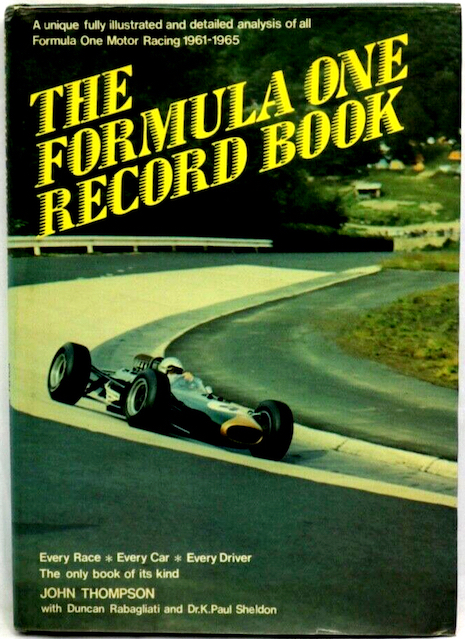
Every Race / Every Car / Every Driver / The only book of its kind. What more do you want?
by John Thompson, with Duncan Rabagliati and Dr. K. Paul Sheldon
Corsametrics.
If Cliometrics is a word, and it is, then Corsametrics should, but it’s not. I made it up.
The former combines the name of the Greek muse of history with “metrics” and the pioneers in that field won a Nobel. The latter combines the Italian word for race with “metrics” and I’ll be content with making a few converts.
Looking through my notebooks I find that the word Corsametrics (initially followed by a question mark) must have come to me one random day in my military career when I was cooling my heels in Area 51 or Bagram or Balad. The notebook is from early 2010 and I was very, very busy about then, bouncing from place to place. Today, I can no longer remember why I never removed that question mark from my own thinking and beat the drum for Corsametrics.
As a historian, looking back is at the core of my work. And looking back, I can tell you that there was a distinct period in time when history, make that History with a capital H, as taught and employed as an academic discipline, changed its MO. Starting in the Sixties and spilling into the Seventies, new subsets of the discipline and a new jargon began to make the rounds. Today we recognize it as a veritable revolution. The concept of History from Below, Gender and Women Studies, Art History, Cultural Studies, Sport History, the History of Science, Automotive History, Military African-American and Ethnic Studies, Public History, Economic History, the History of Technology etc. became new tools in the historian’s “toolbox,” itself a new word in that context, as were “paradigm” and “relational databases” and “content analysis”. Prior to that, the Narrative form of History was the state of the art, whereas History and Metrics had not been natural bedfellows which is why I remember it as a shock to the system to see the motto “If It’s Not A Number, It’s Not Important” emblazoned on a new faculty member’s sampler. The only reason he selected me as Research Assistant is that I was the only grad student in the department who had experience with computers, programming, system analysis, and knew what an “algorithm” was. Lucky me. I think.
So, Corsametrics, which is sort of a variant of Cliometrics. It seems obvious but clearly wasn’t always seen as self-evident: after the racing and winning and losing is done, motorsports is all about metrics. But in the olden days, record-keeping was an afterthought and certainly not done in a consistent let alone standardized, sanctioned manner. Today’s motorsports historian pulls his hair searching for hard data and then reconciling conflicting information. Which brings us to this book. It’s over 50 years old, which means someone not only had the right idea but was willing to shoulder the Sisyphus work. No computers and internet databases then, remember?
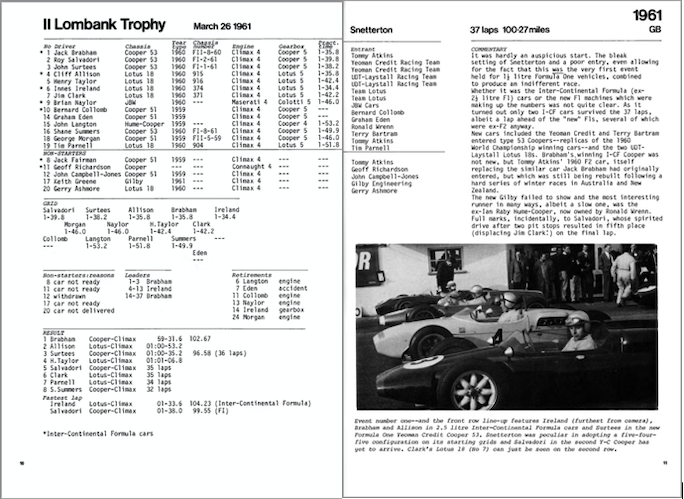
I have long thought that we owe a debt of gratitude to such entities as the Formula One Register (founded in 1966) and others in that vein. And I have long raved in particular about the merits of The Formula One Record Book. Yes, the subsequent A Record of Grand Prix and Voiturette Racing (below) took that to the next, higher level but as Werner Herzog suggests, Even Dwarfs Started Small. (We don’t like to repeat ourselves here so go read that review to get a fuller picture of the book and the people behind it.)
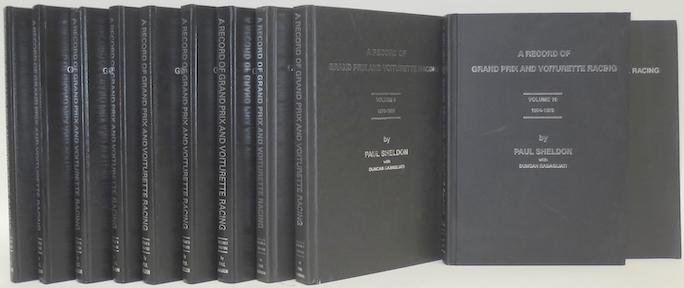
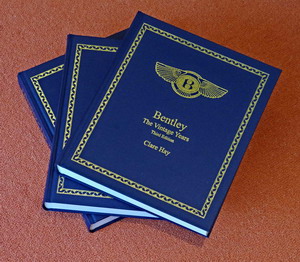
This set covering 1900–1978 sold for £750 at Bonhams in 2015. Today the Formula One Register is working on updating the “black books” and has added a Year Book series.
Those early Corsametricians of the 1960s did what I did already as a schoolboy: scour magazines such as, say, Autocourse, Motor Sport, Autosport and to a lesser degree Autocar, Motor, Road & Track, Autoweek, Competition Press (to mention just some of the English-language sources) and the like. I assembled voluminous loose-leaf binders of clippings of race results, with copies of magazines and books piling up in every corner of my room. Fundamentally, this is something of a solitary endeavor so for authors Thompson, Rabagliati, and Sheldon to have found each other is very much the exception, not the rule.
A key virtue of the early compendia is that they track a multitude of events/series, unlike, for instance, the more recent books covering the Championnat du Monde des Conducteurs between the years of 1961–1965 that overlook those events that were held outside the championship using the Formule Internationale No. 1. Also, the early sources tended to list chassis numbers, but, truth be told, the accuracy of that sort of data is hardly iron-clad. With today’s research tools, that can be weeded out.
Surprisingly, The Formula One Record Book is still available, often at quite reasonable rates. Not only that, but it holds its own in many ways. Although an heirloom publication, printed on paper, certainly a product of its zeitgeist, and perhaps lacking some of the bells and whistles, I have a great fondness for it. When I started my correspondence with Paul Sheldon (and Betty, to an extent) in late 1991, with my first purchases of A Record of Grand Prix and Voiturette Racing directly from St Leonards Press, we partook of lengthy debates about data and metrics and The Formula One Record Book—but regret not bringing up Corsametrics with Paul; I am sure he would have been chuffed!
Copyright 2025, H. Donald Capps (speedreaders.info).





 Phone / Mail / Email
 RSS Feed
 Facebook
 Twitter