
Porsche 911: Icons of Excellence
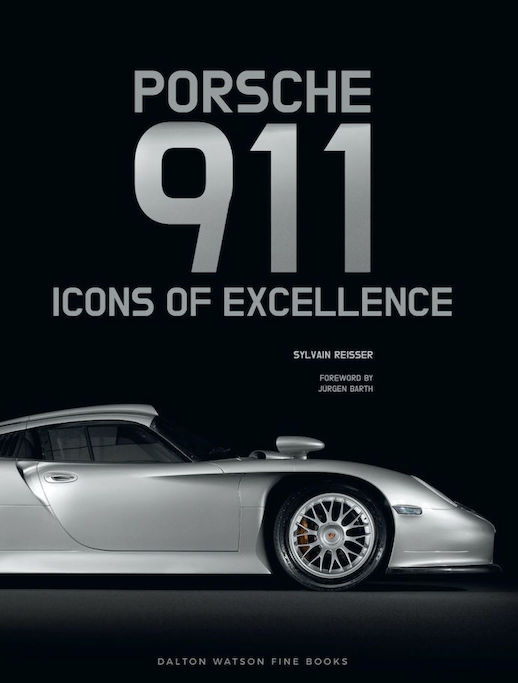 by Sylvain Reisser
“Today, no one could imagine it not being part of the landscape. The 911 has become one of the most desirable cars ever made, and its prestige has only continued to increase despite fierce competition. Without competition, the 911 would certainly not have had the same destiny. This is what the book aims to show.
There are several versions of 911s. The aim here is to highlight those that have an extra feature.”
This excerpt from the Preface is admirably clear—and one can only feel sorry for the person who, uninspired or rather unenlightened by the title and subtitle, passed it by as just another generic 911 book. Consider this: Jürgen Barth, who started at Porsche back in 1963 when the 911 story is just beginning, and wrote the Foreword to the book calls it “captivating”—twice. Can’t argue with someone who ran Porsche’s race and rally efforts as well as the homologation programs!
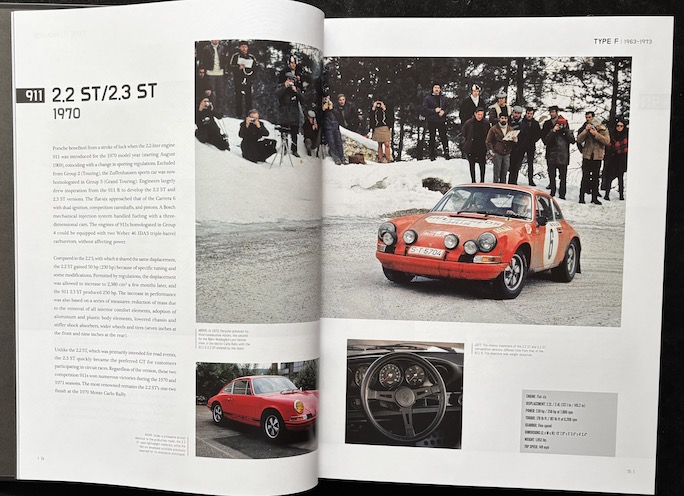
This is a car book so go ahead, look at the cars. But take in the whole scene: at the top, it’s winter, duh. Everyone is bundled up. Except . . . one woman is only wearing a skirt, and not even a long one.
By the way, the photo captions are tiny. And not 100% black. Grumble.
That excerpt above just begs to be juxtaposed with the first sentence in the book proper: “This car has no future.” It was a Porsche man who said that, prototype testing manager Helmut Bott! A few paragraphs later, the waters have calmed a bit, at least internally at Porsche, but at the car’s public launch “the 911 was met with a cool reception. Complaints were numerous.” Hah. In 2017 the one millionth 911 rolled off the line:
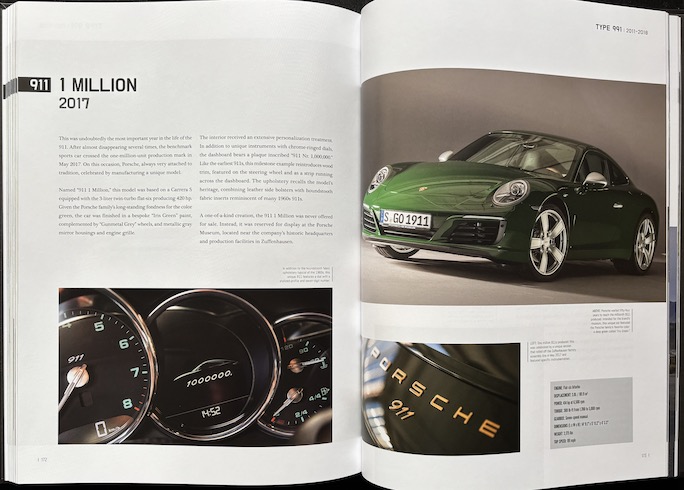
You’ll not see this one-off in the wild: Porsche kept the millionth car for itself.
The 911 model was originally called the Type 901. If you knew that, and maybe even the story behind that, this book is for you. Actually, it may be even more for those who didn’t know that because it presumes no prior 911 knowledge except a recognition that any model name that has remained unchanged for 60+ years must have spawned a profusion of variants, each within distinct type designations. In fact, that very aspect makes 911 taxonomy/recognition challenging even for marque enthusiasts: there is probably no other family tree with as many branches as the 911 one.
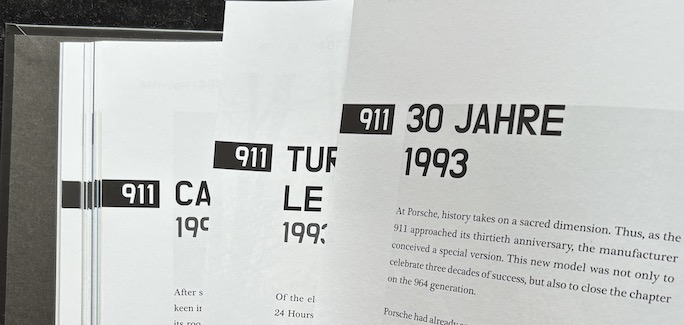
Fanned out those tabs at the beginning of each variant show they’re more than just decoration.
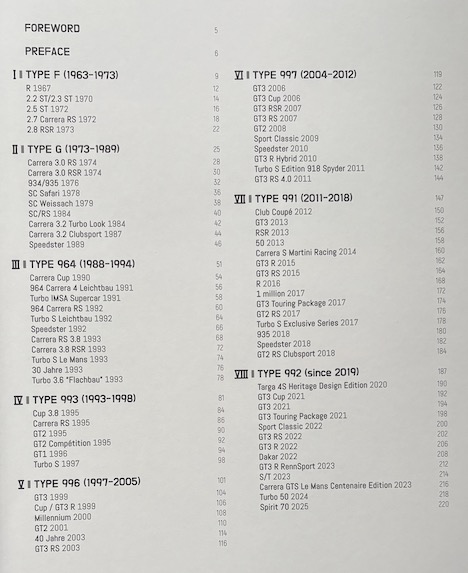 What the 75 examples across eight different Types presented here have in common is that they fall outside the series production cars, meaning they are limited editions (in some cases one-offs), special commissions, or dedicated motorsports machinery. The 911 expert may not find anything specifically new here but the convenience of having the special cars corralled between two covers makes this is a very handy reference book.
The book has no Index but the Table of Contents does just fine, at least in regards to the cars, although it bears pointing out that the text makes mention of any number of things—other 911s, people, events etc etc—that advance the story.
Written by a veteran French author (originally published by Glénat as Porsche 911 d’exception, ISBN 9782344066508) the book goes from the first R model in 1967 to the 2025 Spirit 70 model that pays homage to it as the third of four planned Heritage Design releases.
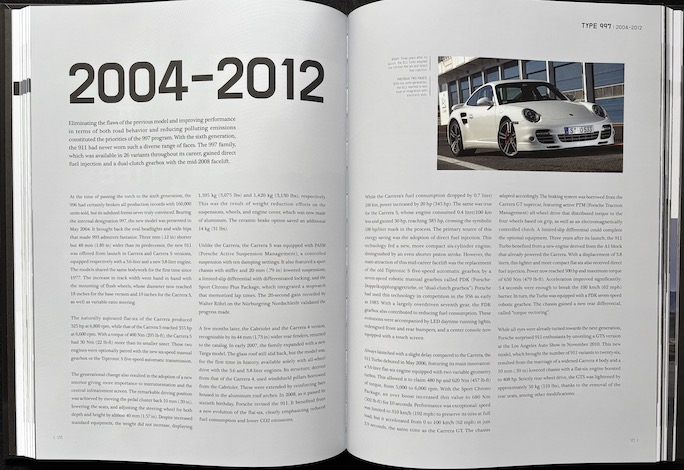 Each of the eight Types is introduced on two pages. Something that really cannot be well explained is what sort of critical mass the development of a new model has to reach before it gets a new type designation and launches a new generation. Each variant is then discussed on another 2–4 pages, accompanied by a table of basic specs and suitable photos.
For under $60 this is a lot of book. Did someone say captivating?
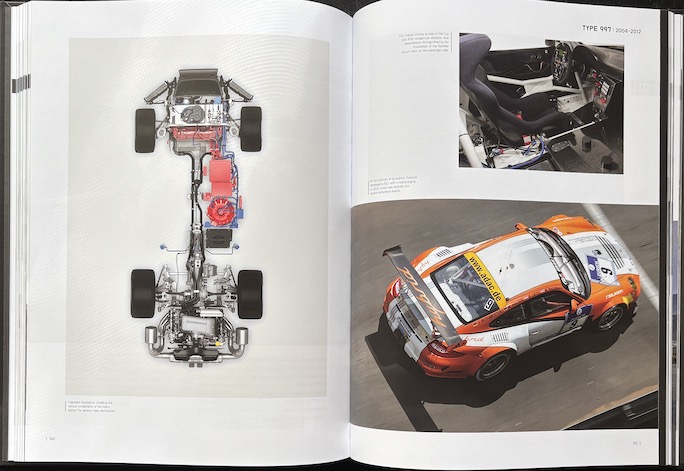
Look at the chassis view. Doesn’t look like your regular 911, does it?
Copyright 2026, Sabu Advani (speedreaders.info).















 Phone / Mail / Email
 RSS Feed
 Facebook
 Twitter