
Packard: 1940–A Pivotal Year
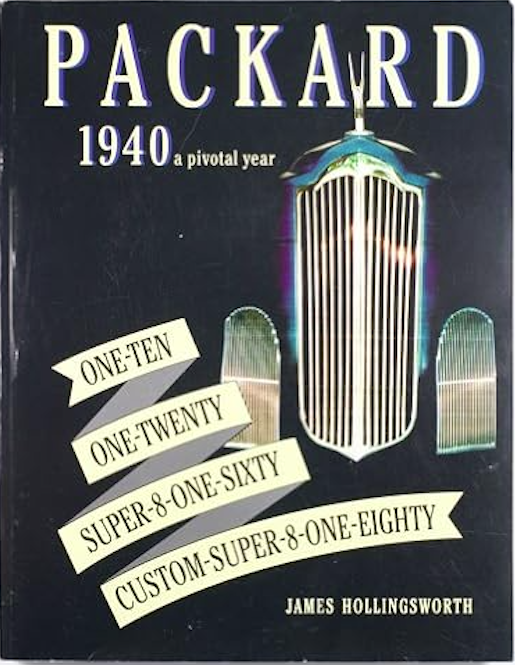 by James A. Hollingsworth
Many automotive historians agree that the American automobile reached maturity with the introduction of the 1940 models. Typically cited as evidence for this thesis are the introduction of what are considered to be true technological milestones that have come to be recognized as hallmarks of the modern American automobile, those being the introduction of standardized lighting systems with the nearly simultaneous industry wide adoption of the sealed beam headlight system, the introduction of the first practical completely automatic transmission with GM’s Hydramatic, and Packard’s introduction of air conditioning, which it marketed as an option and called “Weather Conditioner.”
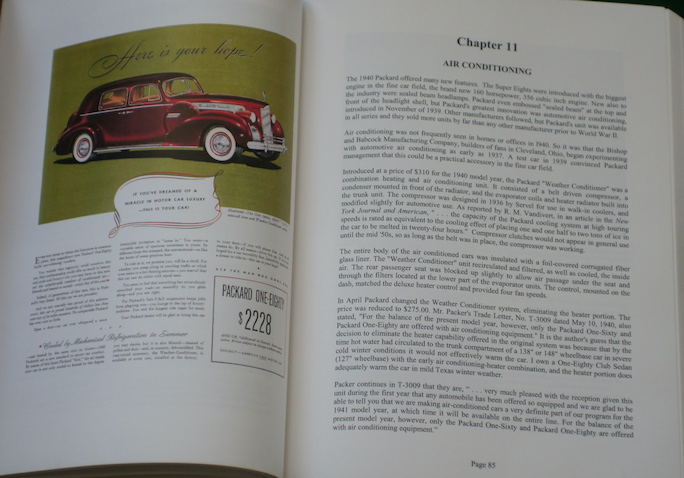
The first two had immediate and lasting impacts, while the appearance and availability of air conditioning’s impact would be postponed until the mid-Fifities, initially due to the interruption of all automobile production for private sales due to World War II and then the effects of the prolonged pent-up demand for new cars, any new cars, once production resumed when peace was restored in late 1945. A/C didn’t become common until the mid-Sixties, is nearly ubiquitous today, and is certainly a hallmark of the modern automobile. But it first appeared in 1940, thanks to Packard.
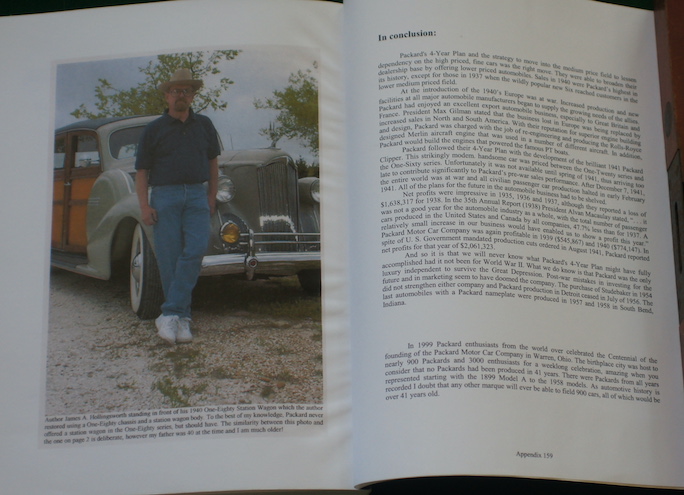
 The author, unfortunately now deceased (2012), quite literally grew up in a Packard family. His father was a cattle rancher in Texas and counted on Packard’s reputation for engineering excellence and reliability to support his demanding day to day operations year round. The frontispiece is a full-page color photo (likely printed from a transparency) of his father standing at the right front corner of his 1940 model 120 sidemount-equipped station wagon. We learn that Mother objected to the woody’s incessant squeaks and rattles and that it was soon replaced with something more to her liking—a 1940 Packard sedan.
In the Forward and Acknowledgements, Hollingsworth tells us that this book is the result of many years of research, materials accumulated from sources too numerous to specifically identify and credit but thanked nonetheless, and assistance and encouragement from friends and family, again too numerous to single out for recognition, and above all a strong dose of perseverance.
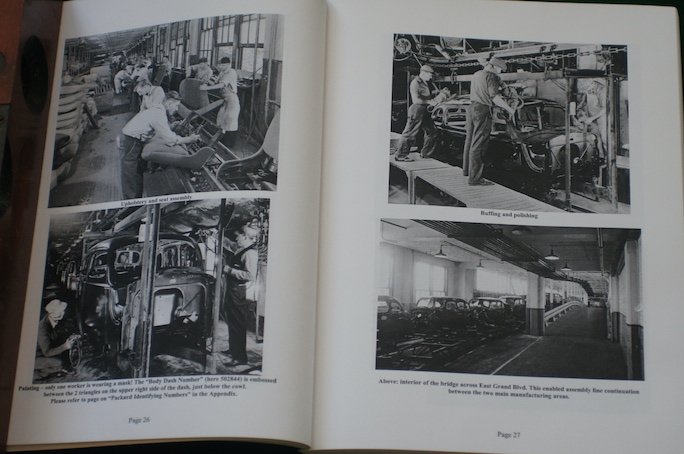
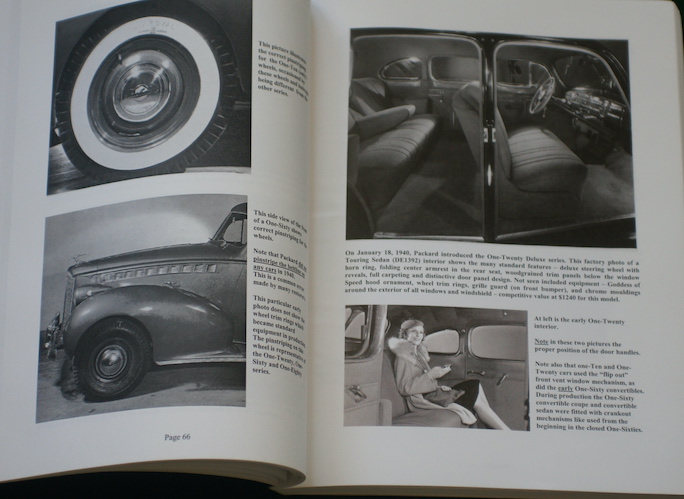
A historian’s quest for specific information on Packard’s four separate lines of cars offered for the 1940 model year is greatly complicated by the baffling lack of a published comprehensive official service manual for the cars. This is especially confounding when one considers that the two most costly models, the 160 and 180, were completely new that year with brand-new engines that shared almost nothing with previous models other than they were side valve straight eights. Compounding the confusion factor are the numerous references in the combined 1940 Owner’s Manual for the 160 and 180 (which contains a surprising amount of technical and service information), as well as to the 1938/1939 Service Manual which covers models that were discontinued at the end of the 1939 model year (that year’s Super 8 and the Twelve) and therefor contain superfluous information for the owner of a 1940 160 or 180 (which are mechanically identical). At least the sections in that Service Manual pertaining to those models are clearly identified so as to eliminate confusion.
Hollingsworth tells us that it is due to this dearth of organized comprehensive service reference material for the 1940 models that he set out to correct that glaring deficiency. Does his book do that? Well, yes and no.
When used in conjunction with the 1938/1939 Service Manual and the 1940 160/180 Owner’s Manual, it fills in most of the many blanks, but one must still go from one to another to find all the information one may be seeking. (But that’s supposed to be part of the “fun” of the hobby, right?) Owning a 1940 Packard today pretty much means it’s no longer a daily commuter so how inconvenient can it be to have to hit the books every once in a while? At least now there is a reference source, which is more than could be said prior to this book’s availability.
One thing the book is NOT is a strict substitute for a service manual. Hollingsworth’s research reached out far and wide and in so doing discovered numerous interesting, nay, fascinating “sidebar” anecdotes that flesh out the 1940 Packard story in ways that simultaneously entertain, educate, and record for posterity. 1940 was Packard’s second most successful business year, with exactly 98,000 cars produced, so there’s lots to tell. (Only 1937 was better, when production totaled 109,518.)
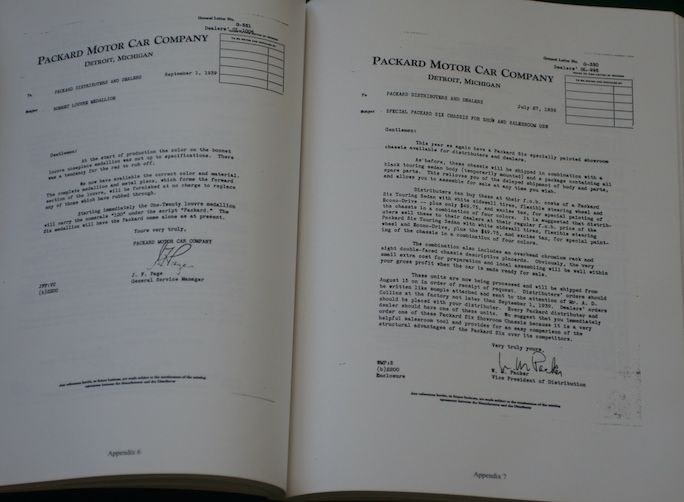
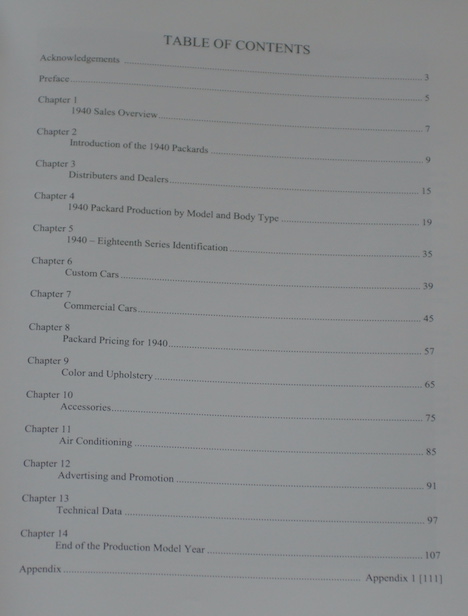
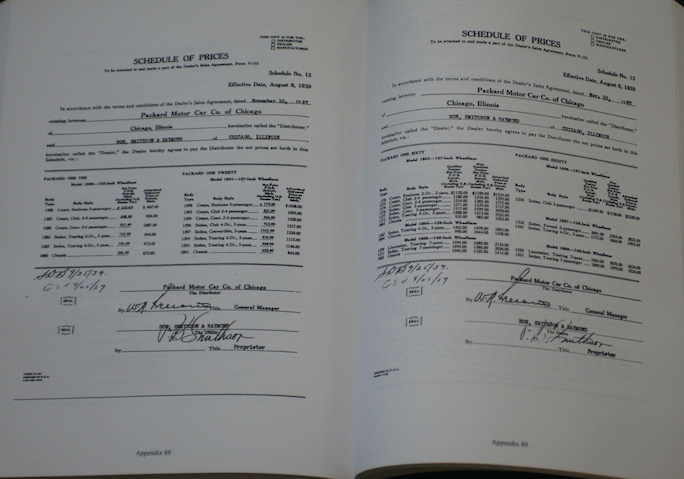
The book is essentially divided into two sections. The first section of 110 pages, or 40%, is original text and historical illustrations and photographs. The second section is the appendixes, which are entirely reproductions of official PMCC documents pertaining to the 1940 models or events occurring during the time the 1940 models were current. These are often fascinating reading, as their language, tone, and sense of urgency offer us a glimpse “behind the scenes” of what was really going on at Packard headquarters in Detroit in those days. Packard was doing more than just reasonably well, so the public thought, but contrary to that popular perception, all was not peaches and cream, not by a long shot.
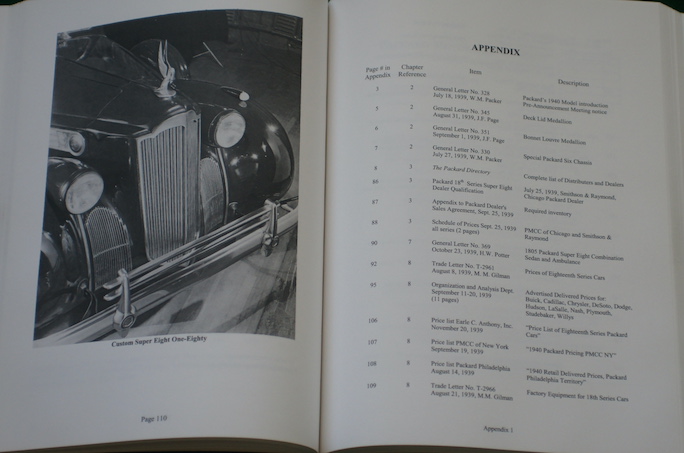
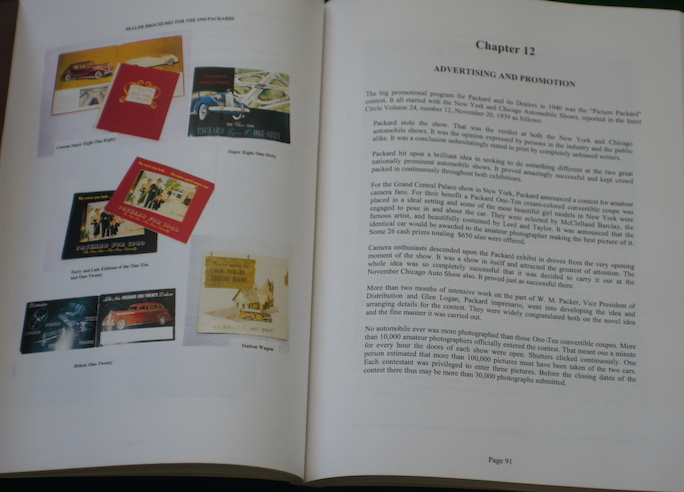
The book’s paper quality is sturdy, non-glare off-white which makes for easy reading. The print quality is clear and sharp, photo reproduction is overall quite good, though many tend to be on the dark end of the scale, but not so dark as to obscure important details, though they often aren’t as sharp as one would desire. Color is effectively used to reproduce some of the more striking print ads from the year and to illustrate small details of accessories. For a privately produced and published work of this magnitude, especially for a first effort, it is remarkably well done. The printer is not identified, which is unfortunate, as they certainly deserve their share of credit for the excellence of the final product.
I was aware of this book when it was first published in 2002, and as a nearly life-long Packard enthusiast (my first car was a 1937 Packard 120 Touring Sedan), it drew my immediate attention. Classic Era Packards were and always have been a primary focus of interest, and I’d come to subscribe to the theory that the American automobile had achieved maturity with the appearance of the 1940 models. But the book was available only in softcover, and rather pricey at that, I thought. I no longer recall the price now, but I was then already enough of a “book snob” that I would only consider a hardbound volume for inclusion in MY library, thank you very much! And I’m oh so much more worse about that today, with bookshelf space at a premium (and that only three years after having treated myself to a dedicated library with permanent floor-to-ceiling shelving on every square inch of wall space possible). But, softcover or not, I now needed to have this book—because I just acquired a beautiful 1940 Custom Super Eight 180 Club Sedan. Suddenly I had to learn about that car as quickly as possible.
As the book is out of print, the Packard Club has expressed an interest in acquiring the copyright from the author’s estate in order to reprint it. Where that stands at this time is unknown so for the present, the book is relatively hard to find used, with prices all over the map, reaching into the three figures for mint copies. Only 300 had been produced originally.
If you have a 1940 Packard of any of the four series, you will benefit from having this book. The information it contains is invaluable and not readily available in a single volume elsewhere.
Copyright 2026, Mark Dwyer (speedreaders.info)







 Phone / Mail / Email
 RSS Feed
 Facebook
 Twitter