
How F1 Works: The Sport Explained
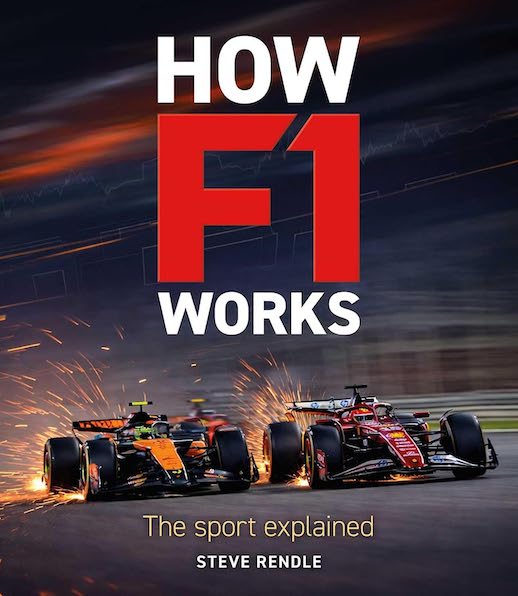 by Steve Rendle
“In total, these various (FIA) Regulations stretch to over 500 pages, with the Technical Regulations alone forming 264 pages.”
“… Drivers are not permitted to take a drink until after they have been weighed.”
I hear that Liberty Media are a litigious bunch so I won’t repeat what my wife said when she saw this book’s title. Her enthusiasm is firmly in check for the “sport” which has been pimping itself around ever since Bernie Ecclestone realized what Gulf state potentates would pay to hold a Grand Prix. I still watch every race, but it’s the sturm und drang of Formula One I love, the lip-bitingly late brake, the optimistic dive to the inside, and the knife-edge drama of a Monaco pole. Battery deployment, super clipping, tire strategy, and Abu Dhabi’s Yas Marina circuit? Maybe not so much.
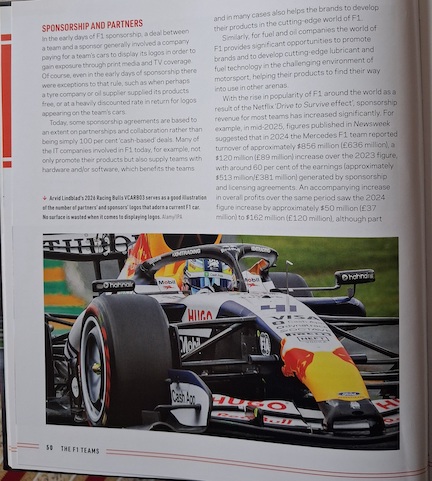
How many sponsors can you spot? I counted 22
When Evro sent me this book I feared I’d struggle to say very much about it as F1 was my sanctuary, my safe space even, from tedious guff like logistics and infrastructure, the very subjects that Steve Rendle was going to explore. Jeez, I sighed, another damn book about—cue gorge rising—the F1 Brand, the F1 Franchise for Drive to Survive parvenus. Of course, the book’s likely readership isn’t ageing F1 alumni like your reviewer, who these days even bores himself with misty- eyed reminiscences of Peterson at Woodcote in ‘73 and Lauda at Zandvoort in ‘85. Hopes weren’t so much high as subterranean.
Happily, I was wrong. Because this 384-page, well-illustrated, and up-to-the-minute book mightn’t appear to be what F1 students, both young and old, want but, arguably, it is what they need. Steve Rendle has written an extraordinarily detailed book on every facet of how Grands Prix work. It has four main sections covering the F1 Team, The Circuit, The (yes!) F1 Franchise, and The Race Weekend, each illustrated with shots of the familiar—cars ‘n tracks ‘n drivers—and the less so—such as CNC tools and the FIA Scrutineering Garage.
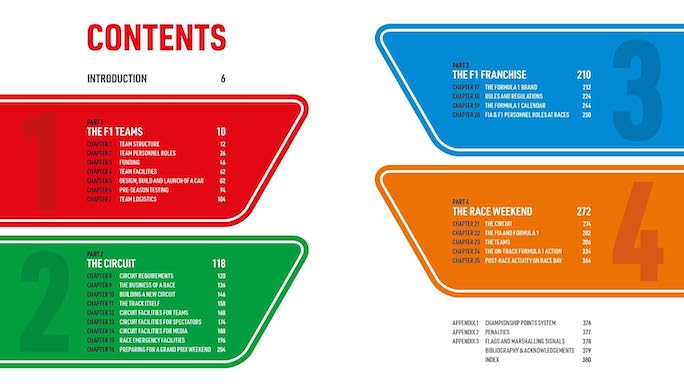
The book is in Evro’s trademark style, with clear font, a design snappy enough to hold the attention, and with a pleasing heft that befits its price.
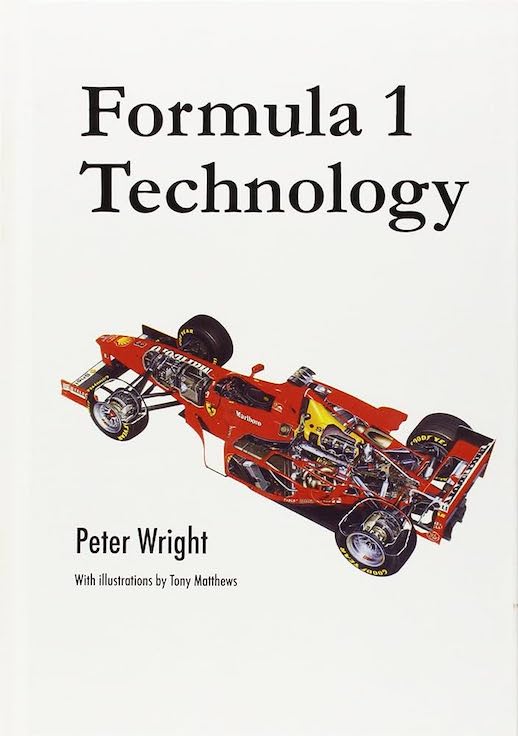
The author has already written about F1 (Formula 1 Technology: The Engineering Explained) as well as Haynes Manuals on three F1 cars, and he clearly Knows His Onions. Look elsewhere—Pete Lyons, Maurice Hamilton, or Nigel Roebuck—if you want to be immersed in the romance of the sport, or to learn about its heroes and villains. Jean-Pierre Van Rossem, anyone? Or perhaps sir might prefer Prince Malik Ado Ibrahim?
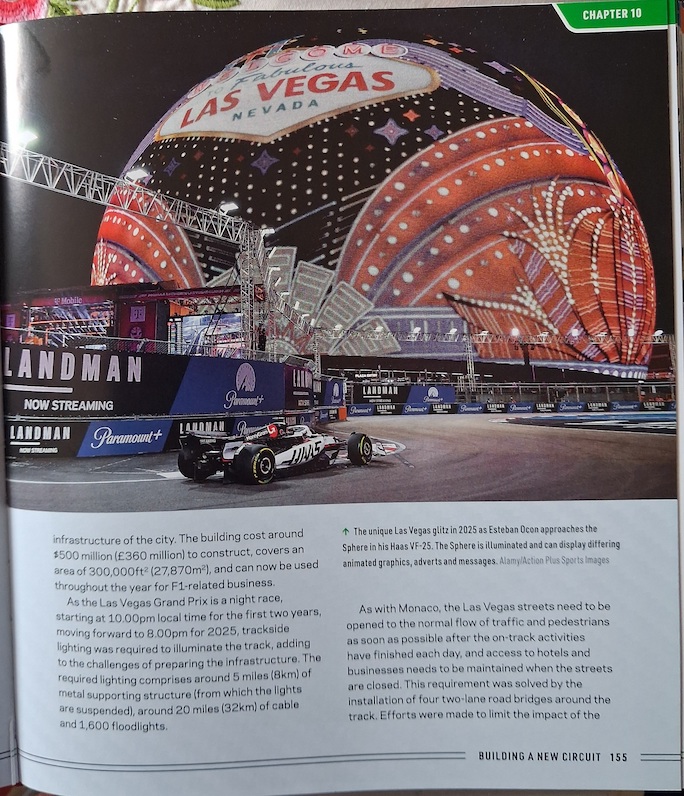
Las Vegas, never confused with Spa.
Steve Rendle writes in a crisp, authoritative style and avoids expressing his own views on F1’s many facets. It’d have been fascinating to read his opinions, given his deep immersion in the sport, but had he expressed them, it would have risked taking an already big book towards critical mass. Rendle is neither an apologist nor an advocate for F1’s quirks and excesses, but his diligence in briefing the reader on the more arcane aspects of the sport is exemplary! Given the near obsession that both Liberty Media and the FIA* have about confidentiality, I suspect the author had to cultivate more than a few of his own Deep Throats in the F1 community. He treats the reader to a blizzard of facts, many of which will trigger reactions from the reader—from intrigue to disdain and, in my case, more than a little sniggering. Try these for size: the Mercedes F1 team is now worth an estimated $6.3 billion, the same team needed 21 trucks to move its motor home between European races, Silverstone pays $40m to host a Grand Prix ($17m less than Azerbaijan), and, as mentioned in the opening quote, a dehydrated driver isn’t even allowed a drink before being weighed. What does the FIA think these guys drink, Red Bull spiked with lead shot?
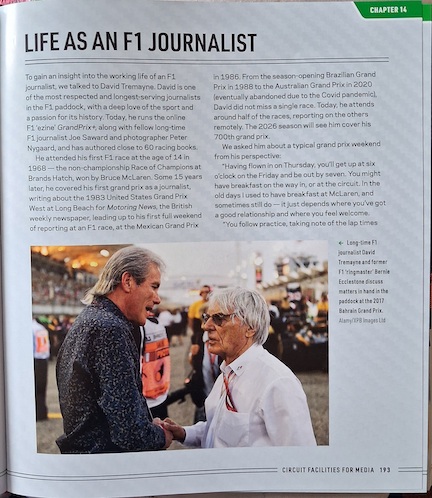 Although I don’t lose sleep obsessing over the minutiae of F1, such as the provenance of circuit safety barriers, I did find that reading about how the haybales of the Fifties evolved into today’s Tecpro oddly fascinating. I also suppressed a shudder at the memory of the Seventies’ love affair with catch fencing; who would have thought that tethering wire between wooden posts next to a racetrack might be risky? Nobody would deny that modern F1’s exemplary safety measures are a Good Thing, especially Romain Grosjean (remember his fiery Bahrain crash in 2020?). The beguiling anarchy of a Sixties’ paddock couldn’t be sustained in a made-for-TV sport, and modern technology means that sloppy timekeeping and exploding lap charts rightly remain unmissed. Remember Canada 1973, the race whose victor still remains the subject of debate? As the sport grew, and its value leveraged, old guys in blazers were never going to keep up with its demands. Brooklands’ mantra was, notoriously, “the right crowd and no crowding” whilst modern F1’s approach is to pack ‘em in (all welcome) and charge the bejesus out of them. Every major sport has espoused capitalism with a glee that is often crass, and F1 has long since learned how to chase the money.
And I can sort of live with that, but this extraordinarily informative book also reveals the staggering degree of regulation that applies to every facet of F1. Given how much F1 likes to commemorate its seventy-something-year history, isn’t it ironic that what made the sport so appealing in its first few decades was its laissez faire philosophy, from soft touch (and commendably brief) regulations to its use of such a glorious diversity of circuits. Did you know that F1 tracks now can’t have a straight more than 1.2 miles long, nor a total length of more than 4.3 miles? That the start line can’t be closer than 820 ft from the first corner? Will the sky fall in if it’s an edgy 814 ft, I wonder? Let F1 commemorate the 16-mile Circuito di Pescara and the 14-mile Nordschleife while also looking forward to the challenge of the … uh … Madring, the apparently unironically named 5 km track built around an Exhibition Center which will make its debut with the 2026 Spanish Grand Prix.
My jaw dropped ever southwards as I raced through the pages, and I had thought that I’d be struggling to crawl. But get this: “During the podium ceremony, the drivers are required to wear their race suits, buttoned up to the neck?” and, almost unbelievably, even the color of the podium carpet is stipulated—green or blue. But the apogee of absurdity is reached when we consider the winner’s trophy, which has not escaped the dead hand of regulation. Because, yeah, seriously, “the winner’s and constructor’s trophies must be no less than 50 cm and no more than 45 cm high.” Who writes this shit and why?
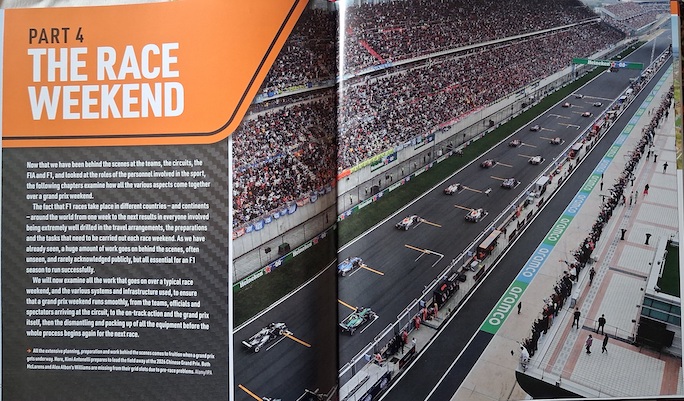
This race weekend was the Chinese Grand Prix 2026.
The sport loves to use nostalgia to wallpaper its brand, and we are often treated to sepia reminiscence of the roaring boy swagger of a Hawthorn or Moss, the Seventies’ sleaze of James Hunt (Marlboro in one hand and a hot blonde on the other) or the beatified Senna soulfully looking into the future he didn’t have. In contrast, and thanks to the fact that gratuitous regulation applies to on-track as well as off, the modern driver is often a petulant brat who spends half the race bleating about how the bad man in front tried to push him off. Drivers have evolved from true grit tough guys—men such as Jack Brabham, Clay Regazzoni, and Keke Rosberg—to a class of swots and snitches.
How F1 Works is a comprehensive dive into its subject matter, and the author deserves great credit for the depths he’s reached. But the book’s unintended consequence is that it lures the reader into their own reflections of how the sport has evolved. And only they can decide whether that evolution has been a blessing or a curse …
- Autosport reports that the FIA has decided to abolish its presidential term “in a move understood to have been brought forward by president Mohammed Ben Sulayem.” Quel surprise.
Copyright John Aston, 2026 (speedreaders.info)















 Phone / Mail / Email
 RSS Feed
 Facebook
 Twitter