
HOTOL: Britain’s Spaceplane
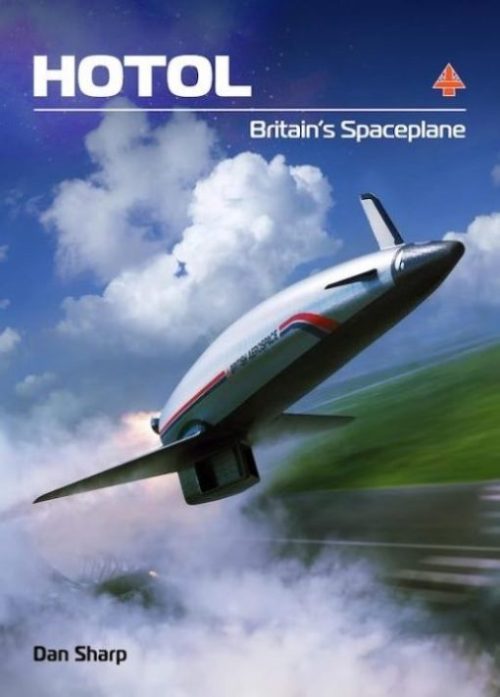 by Dan Sharp
“Clearly, the Hotol project ended without the vehicle being built and an effort has been made, in the writing of this book, to avoid passing judgement on the decisions made by those involved in the Hotol story. It seems, where Hotol is concerned, that everyone familiar with the project has their own views on it one way or another.
Would the Hotol project have resulted in a viable vehicle if fully funded and given the development time asked for by the aerospace companies? It cannot be said for certain that it would.”
Wait—if more money and more time had been on the table, the project might still not have succeeded?? What other factors are there??
Mind you, Dan Sharp contrasts the British project with the American Space Shuttle that had launched just a year earlier “with vastly higher levels of funding” and rules it “not viable” either. It all depends on the criteria you apply. For the Brits those included winged / uncrewed / reusable, with quick turnaround / capable of operating in the airless environment of outer space but still be single-stage. If you remember your science lessons you know those last two items are not compatible: to be able to deal with the “unfortunate fact that the Earth’s gravitational field is about 10% too high to make a Single-Stage-to-Orbit rocket practical” a hybrid propulsion system was thought to be the only solution. (Which is why the NASA Shuttle launches with external tanks and lugs a lot of extra weight around.)
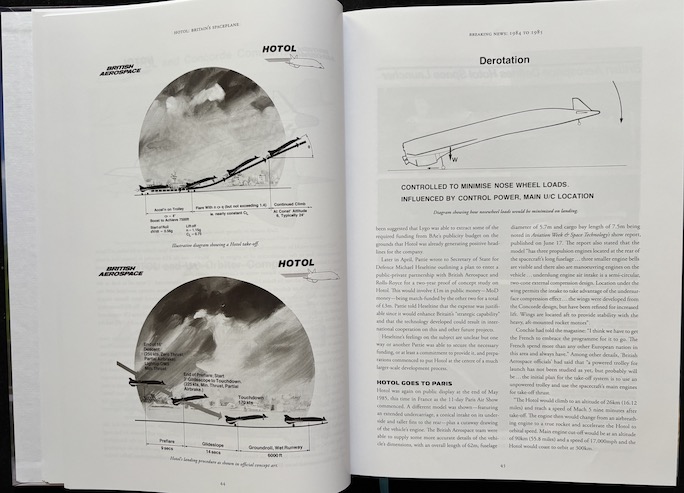
HOTOL stands for: HO = Horizontal / TO = Take-Off [and] / L = Landing
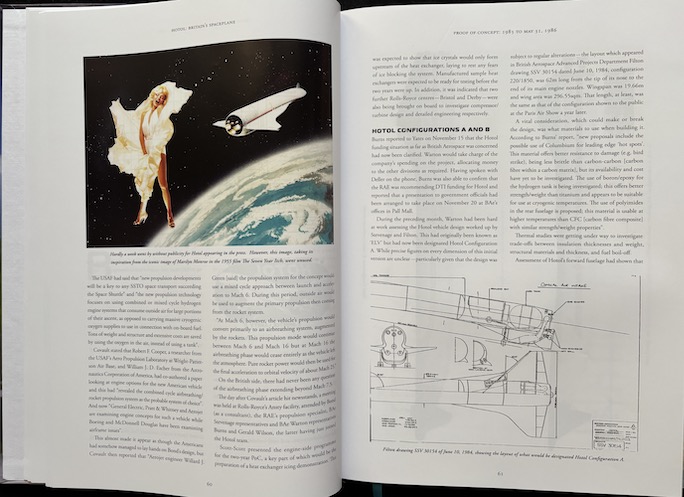
Certainly eye-catching although this advert “went unused.” Ms. Monroe is not in the Index, hence our remark that it is “selective.”
An entire chapter is devoted to that unauthorized leak and it is the one chapter, of 12, that makes for relatively light reading. For everything else, copious amounts of grey matter are required. You probably won’t need your slide rule.
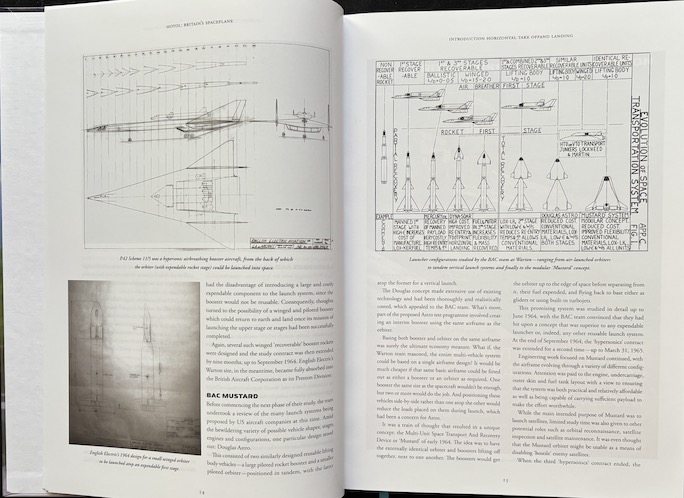
One of the brains behind the HOTOL project considered that acronym a “disgraceful, horrible name” concocted by “some PR idiot.” The intended name had been Orbital Swallow or in a pinch, Swallow. But HOTOL had the same ring as an earlier BAe project, VTOL, which was well established in the public’s conscience.
The book proceeds chronologically. To lay the groundwork, Sharp starts with fundamentals such as how an airbreathing engine achieves combustion, how a liquid hydrogen/liquid oxygen combo burns, and basic rocket architecture and fuselage configurations.
HOTOL was of course not the only idea the world’s rocket scientists investigated and so the book discusses (several) alternate approaches and of course most (all?) of the numerous HOTOL configurations/variants (none of which went past the paper/theoretical stage). If you are on familiar ground with this, know that cf. HOPE-X, Hyperplane, Star-H, DC-X are not included but, say, Hermes, NASP, Sänger, Skylon, LART are. This is, incidentally, the only book about Hotol. Work on it started in 2018, as a follow-up to Sharp’s 2016 book in Crécy’s “British Secret Projects” series (vol. 5) which dealt with the “British Space Shuttle” aka MUSTARD (Multi-Unit Space Transport and Recovery Device).
Research on that book brought Sharp into contact with Alan Bond, one of the founders of Reaction Engines Limited that created the HOTOL project, as well as deputy technical manager Gerald Wilson. Both of them made much material available that is new to the published record, hence the book is dedicated to them. Other HOTOL and Reaction Engines Ltd. people have contributed/commented as well, ergo this book can be considered properly vetted by principals, down to minutia as peripheral as BAe’s wind tunnel model naming convention. There are many bits from interviews, internal communications, and press notices. Thank goodness the book has an Index (albeit selective)!
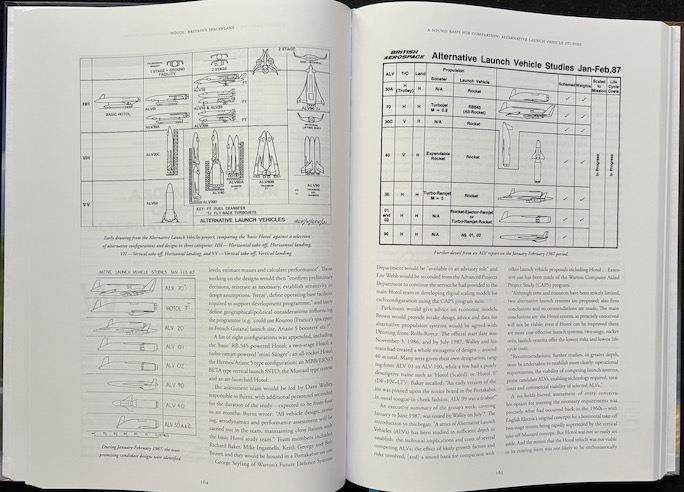
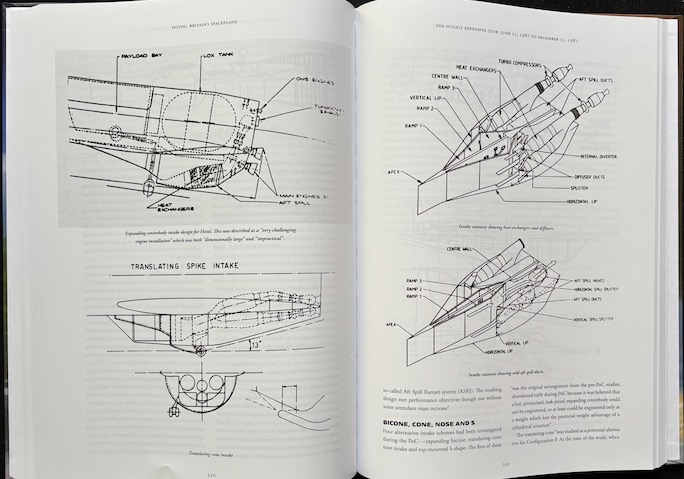
The following excerpt is not directly related to the photos above; it is used here merely to illustrate how demanding the text gets at times (although Sharp is here only summarizing a BAe summary so his prose is circumscribed by that): “Its engine was a PS350 standard RB.545, which used US Standard Atmosphere, 1976, data as the basis for the air it would be utilising. Its spill ramjet was designated Standard A and it used liquid oxygen for de-icing below 7.5km to be subsonic. Rocket specific impulse was 458 seconds with a nozzle area of 100:1.” As we say, you have to stay sharp.
Through much of 2024 prospective readers of this much-delayed book could see it taking final shape as the author posted frequent progress reports on the interweb, with the manuscript getting larger—and then smaller again. As ever, a really hard part of book-writing is to make peace with all that has to be left out in order to keep a book to a size a general-interest readership will find manageable.
After reading this book you will appreciate how vital, and technically complicated, heat exchanger technology is to cooling the 1000-degree air at hypersonic speeds before it melts the engine. That topic was in the news as recent as 2024, when Reaction Engines Ltd. in the UK/Reaction Engines Inc. in the US finally had to declare bankruptcy. Which sorta brings us back to the opening quote. What are the odds that after years in the making, this book came out just in time to sing a swan song?
Lest we forget: excellent, coated paper; very good image reproduction; easy-on-the-eyes layout; and, hey, a sky-blue book ribbon! And all these riches for such a small price!
Copyright 2025, Sabu Advani (speedreaders.info)
 RSS Feed - Comments










































 Phone / Mail / Email
 RSS Feed
 Facebook
 Twitter