
Mercedes and Auto Racing in the Belle Epoque, 1895–1915
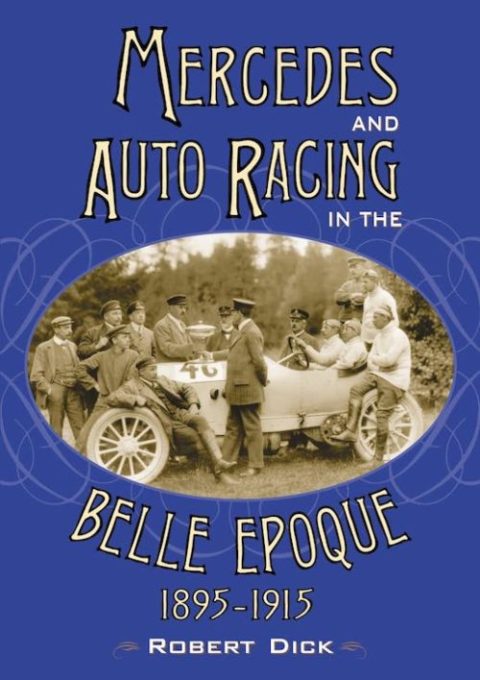 by Robert Dick
“Many particular questions and legends have been in need of clarification and reevaluation; the marketing of the original Daimler engines in France; the position and influence of ‘Monsieur Mércèdes’ Emil Jellinek and his favorite engineer Wilhelm Maybach; the French boycott and the great crisis of 1909; the origins of the voiturette movement; the Mercedes and the Benz successes in America; the role of Ernest Henry in the development of the revolutionary Peugeot. So the history of Mercedes and the other racers of the Belle Epoque is worth telling in some detail.”
“Worth telling in some detail”. . . Well, check. Nothing in this 2005 book, reprinted in 2014, hints at the fact that the author will publish two more (reviewed here as well) on various aspects of early racing. Each moves the needle in a solid way in terms of advancing the body of knowledge—but apparently not in terms of sales because Robert Dick (b. 1953) would keep on writing IF he found a publisher. (Here’s a sobering thought: the manuscript for this first book sat around for 20 years before a publisher “snapped” it up!)
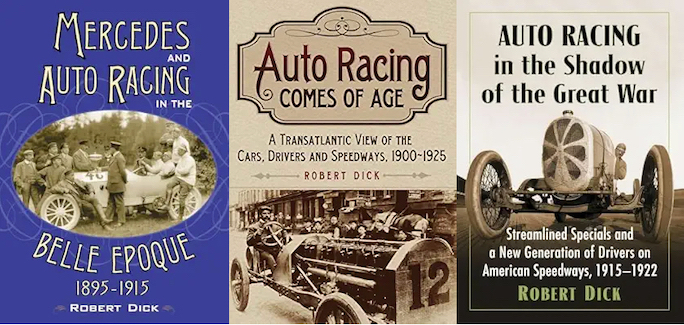
The meticulously researched book set a high bar and it simply boggles the mind that it and the other two are not nearly as widely known and respected as they deserve! True, they are, well, demanding reads (because of their complexity, not the writing style) but that is to their credit. The Mercedes book especially is embedded into big picture context, the first chapter being titled “Scenery,” not in the sense of landscape but mise-en-scène, setting the scene, the establishing shot that sets the tone for all that is to happen.
The curtain rises on 1867, Paris, the year and place that self-propelled carriage meets gas-burning engine which Dick describes as “no rendez-vous, merely coincidence, and no question of wedding.” The book may be about racing but thanks to such fully rounded and rich prose the exposition is slow, slower still because you’ll want—need—to reread some sentences and paragraphs to absorb all the detail. The first several dozen pages are as much social as motoring history. If you are in the habit of spot-checking an Index while you read you’ll discover soon enough that its five pages do not contain every item that occurs in the text nor every single mention of any one thing (for example, Itala has one page reference in the Index but occurs in multiple places in the book).
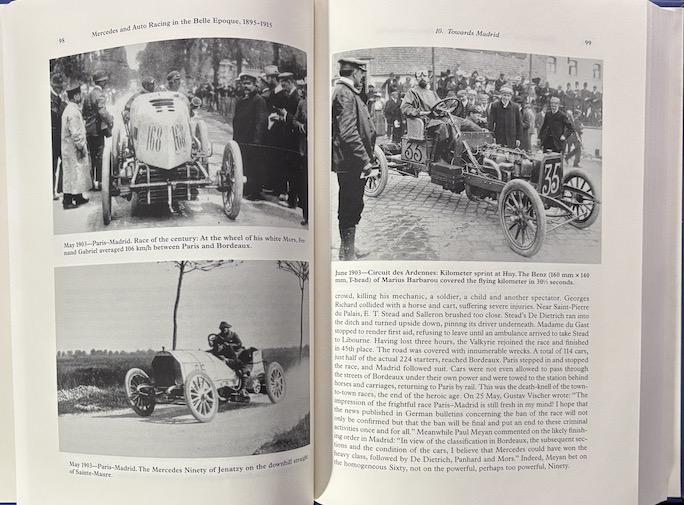
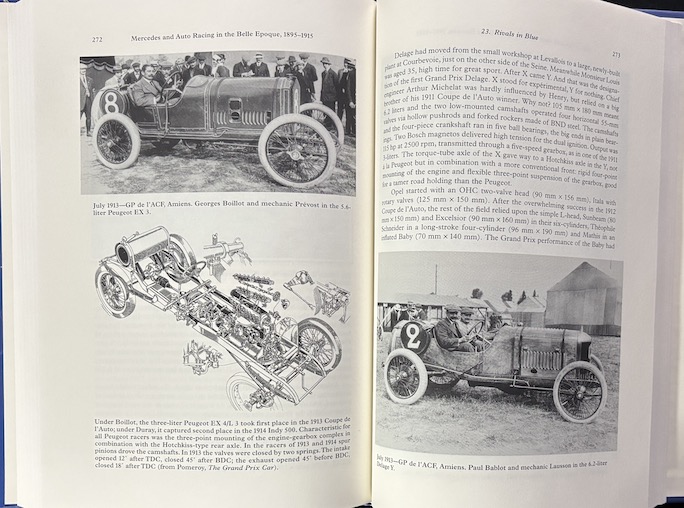
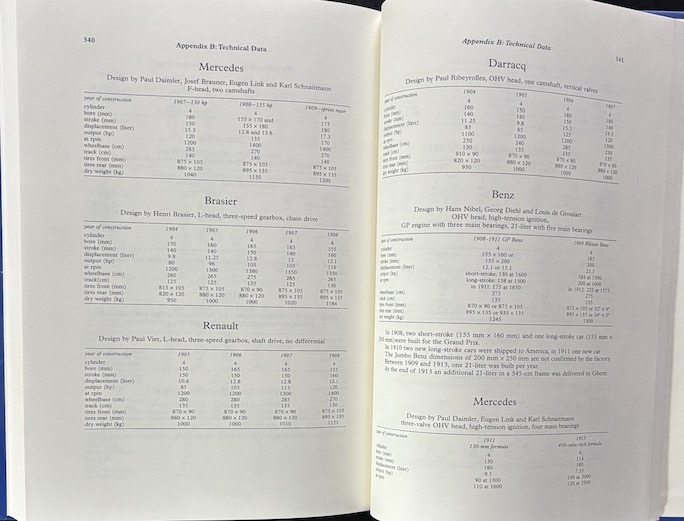
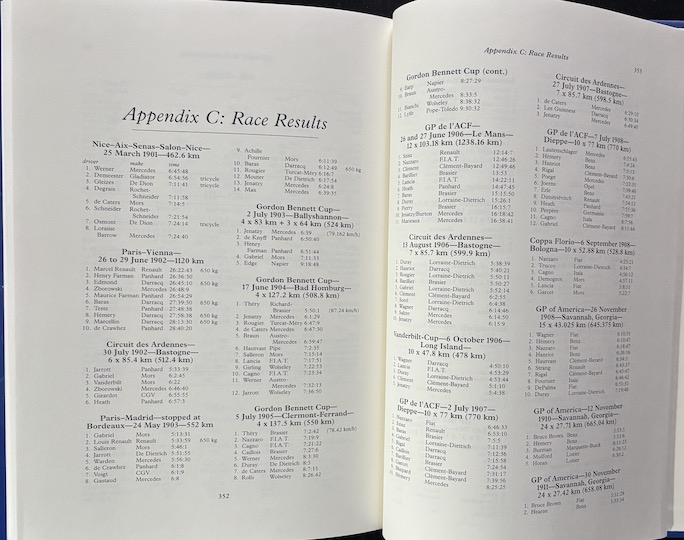
That the author who is a mechanical engineering and automotive historian lives in Germany is particularly relevant to this book because of access to primary sources. In fact right in the Preface he makes a remark that will make scholarly types perk up: “Secondary sources have been avoided as far as possible.” Instead, Dick draws on primary sources in the form of contemporary factory records at the archives of Daimler, Opel, Renault and Fiat, as well as period journals and the like. Lower-tier events such as the countless hillclimbs and sprints are referenced only in passing if at all. Three Appendices offer capsule commentary on specific cars (also names of mechanics by event [and if you ask WHY mechanics matter, you must read this book!], and an entertaining 1914 poem), technical data, and race results (both below).
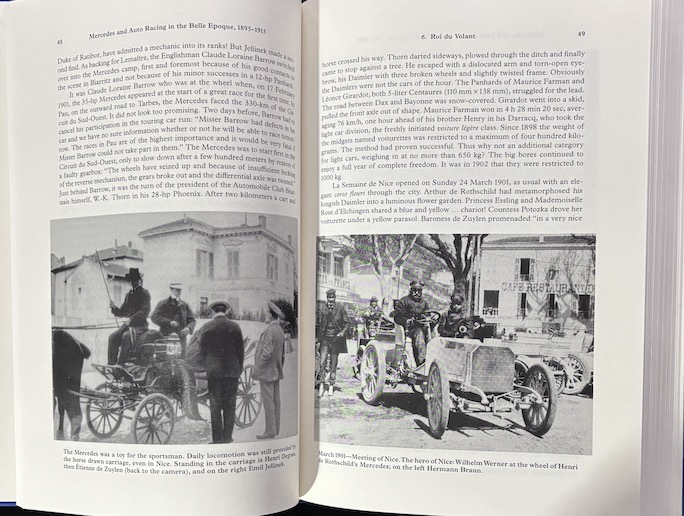
More than 300 images accompany the text and they are well placed and reproduced surprisingly well considering the physical parameters of books by this publisher.
Returning to the introductory quote, the book does indeed shed light on all those issues and more. In terms of writing craft and research acumen the book is quite exceptional, and the aforementioned lament that it appears to be, for lack of a better word, overlooked merely illustrates that good books without publicity are doomed to stay in the shadows.
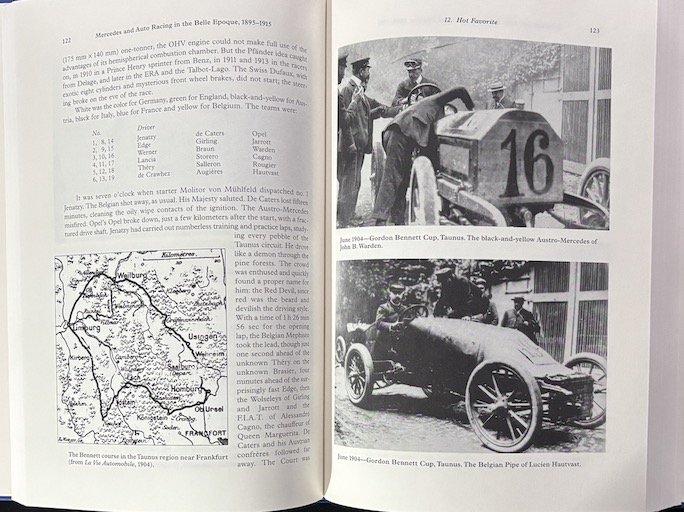
If you like books, do make an effort to find the original 2005 hardcover (ISBN 0 7864 1889 3), not only because it is nicer to handle but because the softcover will become dog-eared in no time.
The softcover, printed on-demand, is on sale right NOW at the publisher.
Copyright 2025, Sabu Advani (speedreaders.info).
 RSS Feed - Comments












 Phone / Mail / Email
 RSS Feed
 Facebook
 Twitter