
Old Farm Tractors
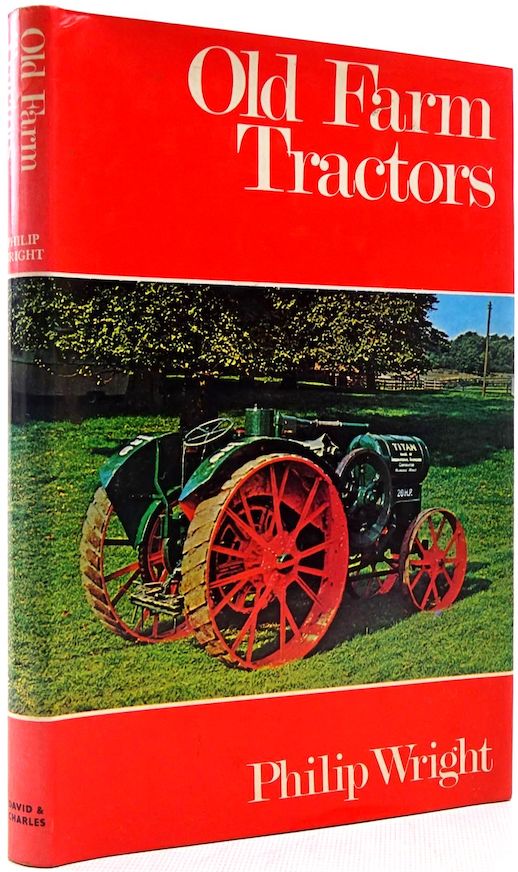 by Philip A. Wright
“The art of ploughing has not altered a great deal since the prehistoric era . . . Since the turn of the century, however, the internal combustion engine has become the chief motive-power . . . [With this book] I am satisfying a wish to place on record a note on the evolution and progress of the farm tractor.”
There were some motorized vehicles that preceded road-going automobiles in terms of being productive and useful to civilization. Today many of these machines are seen and celebrated in museums or at farm shows. But some writers, in concert with their publishers, have been telling of these machines for far longer. This now out-of-print—but still findable book and affordable, too—is an example.
Reading its title in 2026, “old” has a different frame of reference from when Old Farm Tractors first published more than sixty years ago in 1962 or even when its second edition released a decade later.
The very first chapter titled “The Pioneers” notes that “early oil engines . . . bedded down in barns to drive farm machinery.” They included “Richard Hornsby & Sons of Grantham . . . their Hornsby-Akroyd patent oil engine was on sale before Dr. Diesel had produced anything.”
Then Dan Albone “in 1897 began experimenting, and by 1902 the first Ivel tractor was being tried out. There were some distinguished supporters, including S.F. [Selwyn Francis] Edge . . . who became a director of Ivel Agricultural Motors Ltd, formed in 1909 with a London office.” By this reference the alert reader will, in case he/she hasn’t already realized, this farm tractor history is told from the British perspective.
It is not just written by the then-recognized British transportation historian and author Philip Wright but its publisher’s identity struck that chord of recognition. That was David & Charles who not all that long ago acquired Veloce Publishing adding it to the imprints of its publishing group.
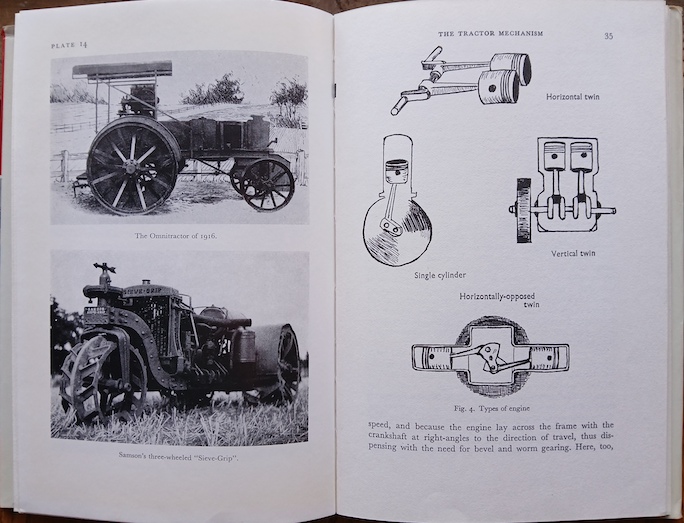
Tractors top left a 1916 Omnitractor, bottom American-made Samson Sieve Grip with wheels designed to minimize soil compacting. Facing page shows engine configurations.
The second chapter begins by noting that the outbreak of the first world war “suddenly thrust farmers into the forefront” due to “increased demand for home-grown food. . . . May 1917 an Ivel tractor was demonstrated on a farm owned by the celebrated engineer, Mr. S.F. Edge in Sussex.” It goes on relating that Hornsby developed its chain-track anticipating orders that never materialized so in 1908 they were forced to sell “the patent rights to the Holt Caterpillar Tractor Company . . . who persisted with its development.” Then when Winston Churchill suggested developing and building “small armoured shelters holding men and machine guns to be mounted upon Caterpillar tracks . . . the rejected Hornsby idea was imported from Holt” to build those first tanks for war.
In the odd or unusual approaches companies had experimented with rotary tillage as far back as 1893. But it wasn’t until 1927 that a company named Fowler had real success. Their Gyro-tiller “took 10 feet of land at a time . . . pulverised up to a depth of 22 inches.” The machine weighed over twenty-three tons with its six-cylinder engine producing 225 hp.
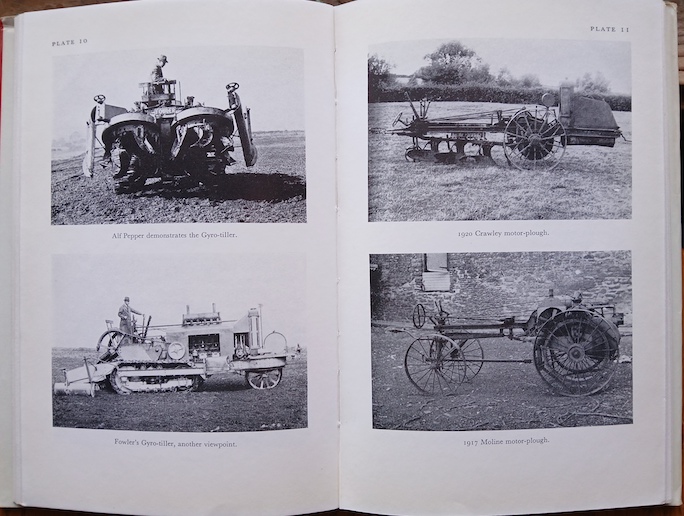
The unusual machine on left is Fowler’s Gyro-tiller. Facing page at top is a 1920 Crawley motor-plough, bottom a 1917 Moline motor-plough
Wright’s review of tractors in the UK concludes with telling of Irish-born Harry Ferguson’s 1920 designing of “his first three-point linkage for attaching implements to the tractor, which meant the driver no longer had to leave his tractor to adjust the implement” and its profound effect on both farming and the tractor industry. Then “with the approach of second world war, and after Ferguson’s famous handshake agreement with Henry Ford” Ford-Fergusons were made in America. These two men’s handshake ”agreement of trust and confidence” was subsequently violated by Henry Ford II when he took over control of his grandfather’s company. It required court action to ensure that handshake agreement was honored with past royalties awarded Ferguson.
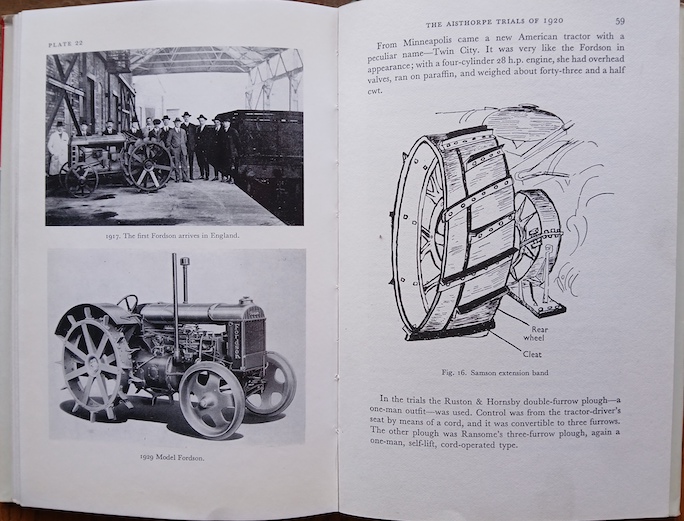
Top left shows the 1917 first-ever arrival of Fordson tractor in England, bottom is a 1929 Fordson. Facing page illustrates Samson’s wheel with extension band.
Wright notes in closing that the evolution of crawler and wheeled tractors would continue as each type is, as they have always been, valued and that, “today the countryside is loud with the hum of machines all contributing to the feeding of the population.”
Copyright 2026 Helen V Hutchings (speedreaders.info)
 RSS Feed - Comments







































 Phone / Mail / Email
 RSS Feed
 Facebook
 Twitter