
Carrera RS 964
 by Christoph Mäder
“The Porsche Carrera RS stands as a milestone in the company’s history. It emerged during a period of dramatic upheaval. By the late 1980s, Porsche was financially strained and on the verge of its most significant restructuring to date. The prestigious Formula 1 and Group C racing programs had been cut. What followed was a radical shift in direction: the motorsport department returned to the brand’s roots.”
There are some buzzy words in that excerpt—milestone, upheaval, strained . . . if you think that’s the author stacking the deck to get your attention, realize that they are not his but by someone who knew Porsche’s racing division from the inside, and at just that era: Jost Capito whose industry bona fides not only deserve their own book but give him a wide frame of reference so when he says in his very excellent Foreword that Mäder “is among those who truly understand the RS in all its depth” you can take that to the bank. And you may have to make a trip to the bank because this limited edition book ain’t cheap, and why should it be, given its specs.
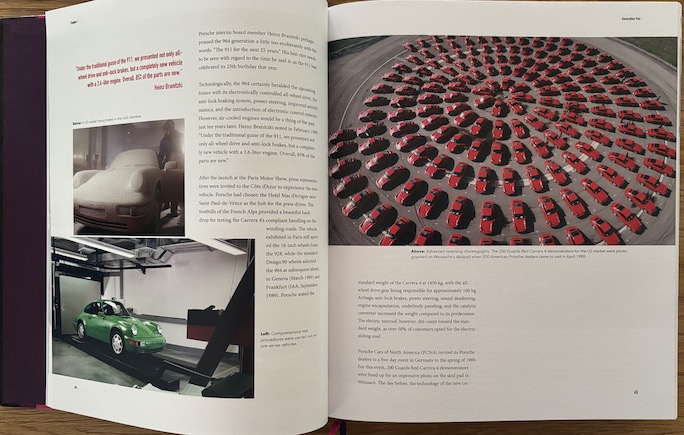
The photo on the right represents this book perfectly: in each case lesser souls could have settled for a more simplistic approach. Why should Porsche spend untold hours to arrange 200 red cars in a spiral when they could have just lined them up on a parking lot grid? Why should Mäder spend untold hours to make his book the best it can be? Maximum impact.
If you say the title needs the word “Porsche” to make sense, this book is probably not for you because it is way too specialized.
Any Porsche 911 is a performance car but only high-performance versions get the RS badge. Porsche is stingy with them. To gain one, a bunch of stuff has to be lost . . . namely creature comforts. It is said that today more examples of the RS from the iteration prior to this one exist than were actually built so you can deduce that an RS must be so covetable a machine that there is a market for fakes. The micro detail in a book like this is one way to guard against that.
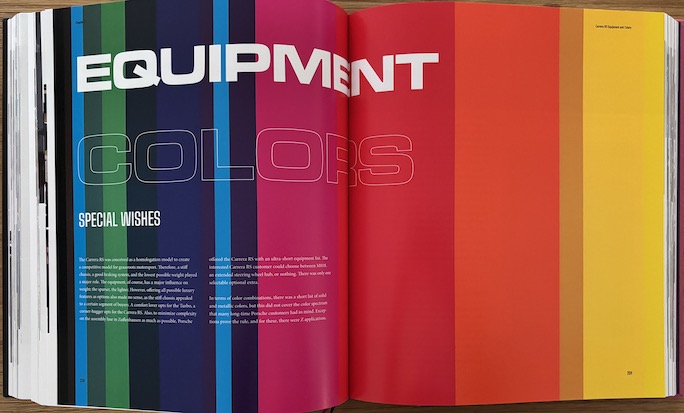
Remind you of the 1990s? That’s the plan.
Just to orient yourself, “964” was Porsche’s internal project number not for a whole model but for an AWD system for the fourth-gen 911 in 1981. Why that year? Think: Audi Quattro; and that is where the book begins, a few years before that actually, which brings us to the question of the existing and voluminous Porsche literature.
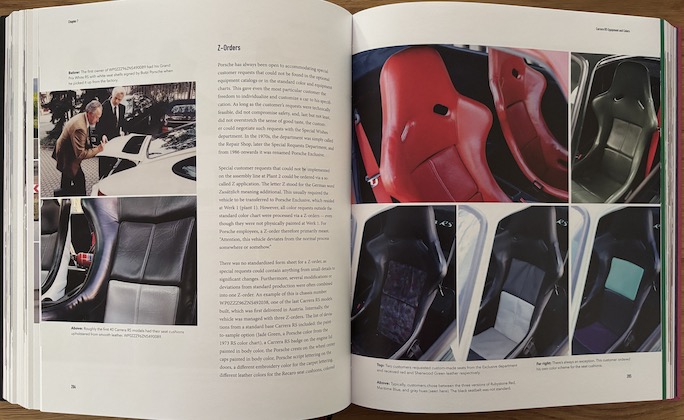
Top left: cool idea to get your special car signed by a special person (Butzi Porsche) on the engine cover. But on the outside??
If you are a book collector, specifically of Porsche 911 books, that particular section in your bookcase is probably sagging more than any other. Not only are there rather a lot of books deserving of shelf space but some of the heaviest ones are by this very author and his colleagues/collaborators. Each is a reference-level benchmark and has been reviewed here:
- Carrera 2.7 (Snodgrass, 2015)
- Carrera RS (Gruber and Konradsheim, 2015)
- 911R (Mäder/Konradsheim/Gruber, 2017)
- Turbo 3.0 (Snodgrass, 2018)
- 911 GT2 (Mäder and Koum, 2021)
There should have been another one by now, 964 Turbo S Lightweight by Mäder and Koum, but it is still not fully baked so Mäder meanwhile put his energies into writing the present book, about the wider 964 family (Carrera 2 and Carrera 4 models between 1989 and 1994 of which an RS version was available 1991–94).
In terms of appearance and scope and top-notch production values, the above books are pretty much cut from the same cloth even though they were produced under three separate imprints but this newest one is, well, more. That’s because this is Mäder’s one-man show; from writing to layout to marketing (and, gulp, financing) this time he is not answerable to anyone and can pull out all the stops. In fact, he set up a whole separate company for that purpose.
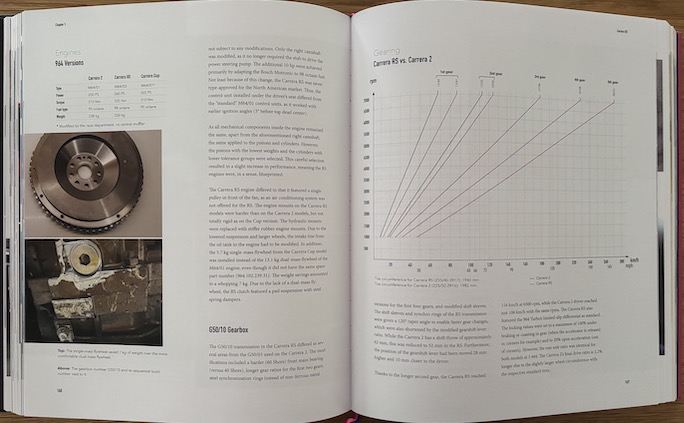
Sometimes a graph with coordinates is just the ticket . . .
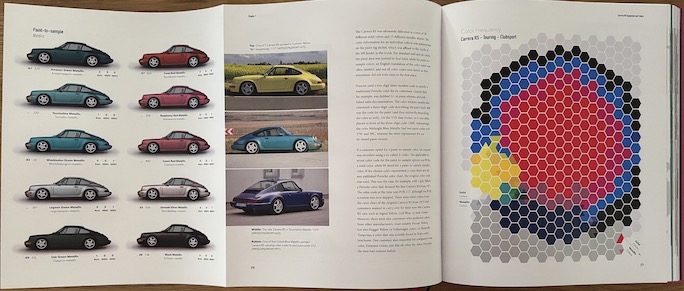
And sometimes that type of graph just won’t do. The cluster on the right shows at what frequency specific colors were chosen by customers. Also note the foldout (left); on the preceding three pages another 30 color choices are shown.
Since Mäder has circled the Porsche subject before and will again, research is pretty much an ongoing activity so the fact that this book took (only) three years to pull together is neither here nor there. It may well take you three years to digest every word and number in it, certainly you will be returning to it again and again. To appreciate how serious Mäder takes research study the Acknowledgements page of this book—those are not names you could afford to disappoint if you want their input the next time around.
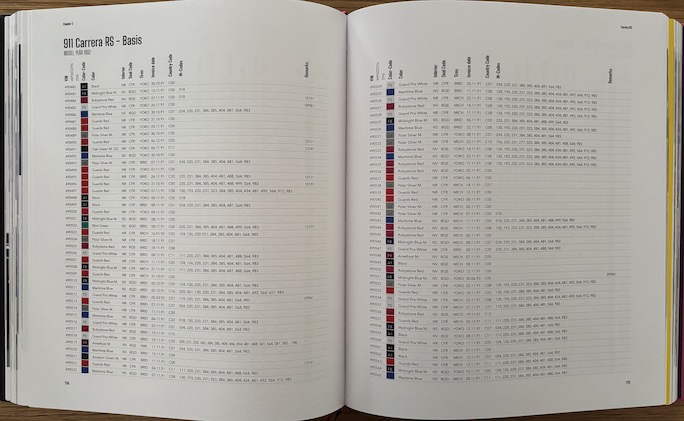
Do ordinary mortals need 17 pages of tables for just one variant? Who wants to be ordinary?
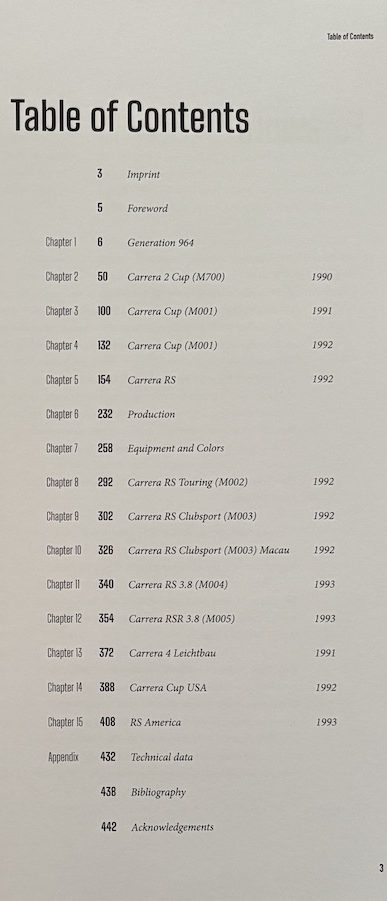 The Table of Contents shows that all branches of the family tree will be explored, and in an organic manner. What it doesn’t and probably can’t show is that really everything, from development and assembly to business case and the competition to tire pressures and race results, is considered. There is no Index, which would surely have become unmanageable and thus ineffective.
Mäder communicated with many people who worked on or with the RS, meaning factory staff to drivers and owners. Having himself been Team Manager of a Porsche Supercup racing team gives him a particularly keen understanding of the meta story.
This review could drone on and on, the message wouldn’t change: if you want to know all there is to know about the RS, this is the book. If you can do with less detail, there are others but you will be consumed by book envy.
The book and slipcase we show above is the English standard version (in Rubystone Red + black) of which there are 1600 numbered copies; plus 964 in German and 260 in French. Additionally the English and German versions come in a Special Edition in linen (€459.81) of 300 in Rubystone Red, 300 in Maritime Blue, 200 in Pearl Grey, and 164 in Amazon Green.
Retail prices vary by country, shipping, taxes, customs etc. so contact the publisher first!
An Errata page (exceedingly short so far!) has been started on the publisher’s website. This will at some point be compiled into a printed supplement that will be added to all future books.
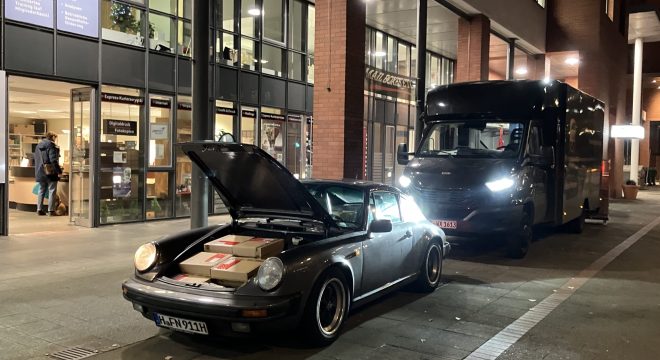
Express delivery: How many books fit into a 911? Mäder stuffed 12 under the front lid and 44 in the cabin. Don’t you wish one of them had your name on it?
Copyright 2026, Sabu Advani (speedreaders.info).
 RSS Feed - Comments



















 Phone / Mail / Email
 RSS Feed
 Facebook
 Twitter