
Mercedes and Benz Racing 1900–1955: An Appreciation
by Roy P. Smith
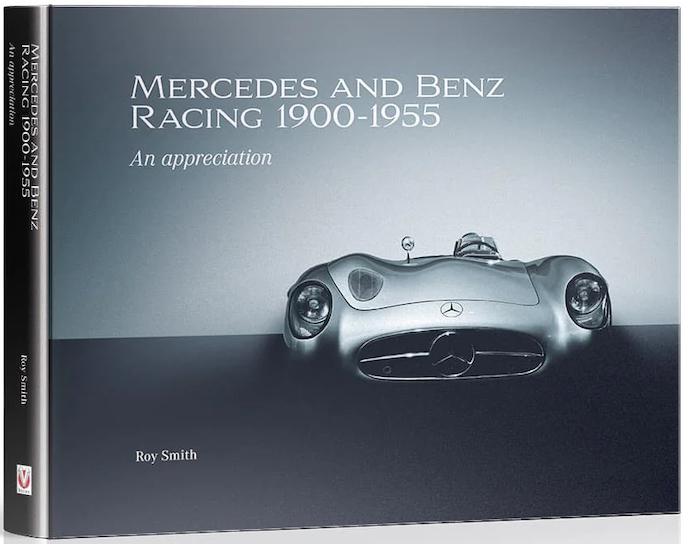
“Much has been written about the history of Mercedes and Benz, though generally the early racing days have been treated lightly, with just a cursory reference to a few of the more prominent performances. Previous histories were published many years ago, before the age of the computer and digital imaging.
… The intention is to make it easy for the reader to pick up the story whenever and wherever in the history they like, and immediately understand it without the encumbrance of excessive technical detail.”
Isn’t it grand when an author comes right out and declares what he will do, and how he will go about it? Almost 600 landscape pages (12 x 10″) and more than 1200 images with a smudge-defying satin finish beg to be picked up again and again. Although, at over 7 pounds the picking-up will become a bit of a struggle!
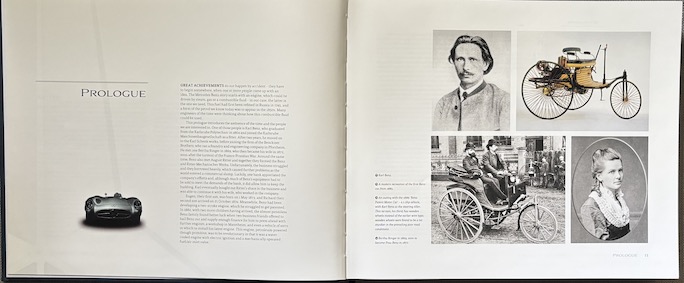
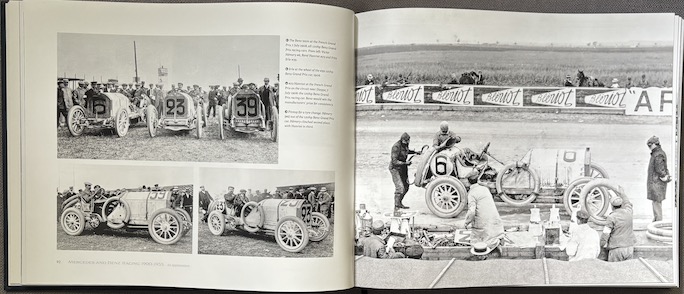
The page on the right shows the oldest photos in this book, from 1869, the portraits of Benz (which is undated) and his future bride.
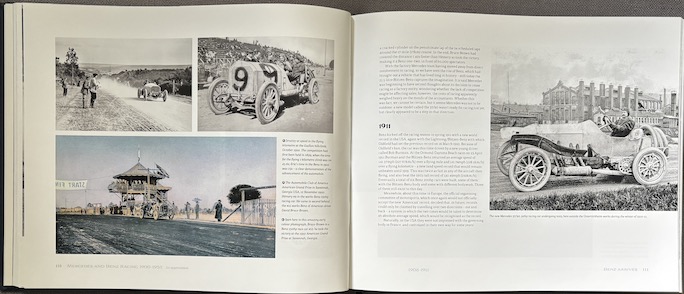
Another novel photo, a color shot dating to 1910.
Color us surprised, first of all. By the book, certainly, but even more so by the fact that almost a year after being released, copies are still available from the publisher. An eminently approachable subject, a respected author, a publisher with marketing savvy and a global footprint—all the right ingredients are here for an instant sell-out. The $200 MSRP may raise eyebrows but nowadays is entirely in line with other substantial books, and, besides, pales in comparison to the work that went into it.
The subtitle, An Appreciation, lends itself to an easy compliment: you, the reader, will appreciate that the book exists, Smith himself praising the publisher for “the courage and fortitude” to take on such a mammoth project. We have reviewed most of this author’s previous books here and no matter the topic (Alpine/Renault, Porsche, Gordini) there is a common denominator: exacting research, thoughtful photo selection, and use of primary sources. We once quoted Smith as saying, “I never really wanted to be a detective!”—but he kinda is.
 A book that aims to be relevant to both “newcomers and hardened enthusiasts alike” is the most compromise-fraught to write. The former will stand to benefit most from what did get included and the latter won’t struggle too hard to look elsewhere for what is—intentionally, for reasons of space and intelligibility—excluded. Chassis numbers, just to get that out the way, are only mentioned when they are deemed to be “reasonably accurate.”
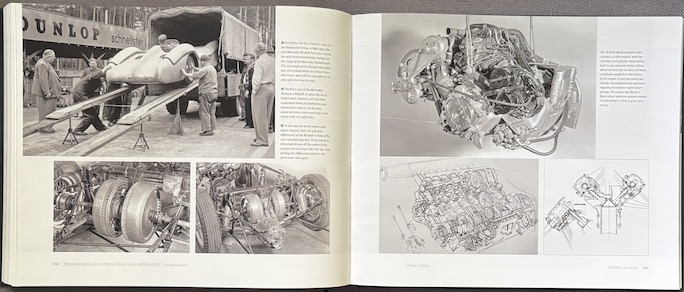
Smith specifically recommends Karl Ludvigsen’s writings to the reader as a source for technical matters but you can see that there is no shortage, in words or image, of relevant tech detail.
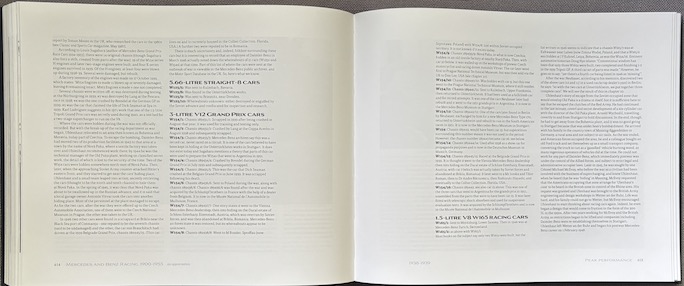
Am example of Smith presenting everything that is specifically relevant to the story he wants to tell. This handy list is introduced with the words, “There is much uncertainty and, indeed, folklore surrounding these cars but it is interesting to record that an employee of Daimler-Benz in March 1946 actually noted down the whereabouts of 21 cars (W125s and W154s) at that time.” This data is sanctioned by M-B so forget anything else you may have seen.
A Prologue introduces the cast of principal characters. In fact, it takes us back to 1745 to the first recorded use of the combustible fluid which would evolve by the 1850s into the stuff we know today as “petrol,” just about the time one Karl Benz is born (1844). One the one hand it is peripheral to the core topic of the book but a reader will surely have to do some independent reading to more fully apprehend why it was Benz, and his competitor Daimler, who became dominant in a nascent industry that was beset by countless business and technical failures.
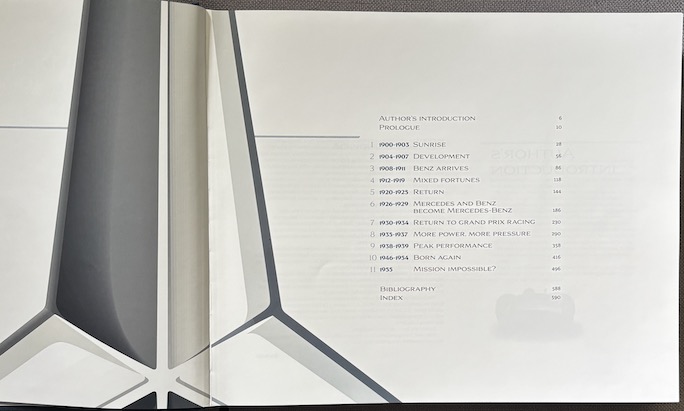
It may take a moment to recognize that the graphic is a segment of the three-pointed Mercedes star.
The bulk of the book then progresses chronologically, divided into “chunks” of years, in other words nothing as straightforward—or restrictive— as decades. If you already know enough about motorsports to recognize the year 1955, when this book ends, as the one in which the most horrific racing accident ever happened, directly involving Mercedes-Benz, realize that M-B did not stop racing because of that! The decision to withdraw factory teams from GP and sports car racing at the end of that season had already been made, and Smith paints a clear picture of how expensive racing was and how much M-B wanted/needed to allocate their resources to solidifying the place of their successful and capable road cars on the global scene. That the hiatus that was meant to last only “for several years” (the firm did continue to support non-factory rally teams though) continued to 2010 before GP racing was resumed is a whole ‘nother story. And maybe book?
Two things to be aware of: there is a high-level Index of only cars (all the_), and key people and events; and the photos are not credited nor is there a list of credits at the end. The reason the latter matters is that so many of the photos have not been published before. This specifically applies to the John Fitch archive which also yielded transcripts of interviews and files that had once upon a time been intended to become a biography (possibly written by journalist Michael Keyser who has custody of that material). Its presence here materially advances the scope of this book. So do the photos, regardless of what their sources are. The publisher made the comment that they have taken “a light-handed approach to [image] restoration” so as to preserve patina; as there are several very important and therefore well-known images included here it’s interesting to compare Veloce’s choice. (And see it validated.)
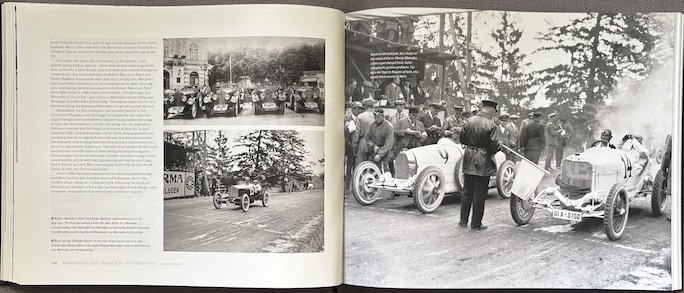
An example of the varying quality of original sources. All these photos are from 1925. The ones on the left look just as you would expect vintage photos to look but the one on the right, even at the much larger size, is uncannily sharp.
The font size is distinctly on the small side, but that’s the inevitable consequence of trying to keep to a prescribed page range.
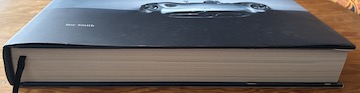 In physical terms the book may look and feel intimidating but the writing style is dynamic and the organization easy to follow. Many primary sources (interviews, excerpts from published material etc.) are used, allowing event coverage to benefit from the conventional type of race report (bird’s-eye view that seeks to account for all the moving parts) to what the military would call action reports that represent the single POV.
Book prices on the secondary market fluctuate … you’ll want to press the trigger while you can. Also, publishers and authors do need to recoup their costs lest they too suspend their efforts, see above.
Copyright 2026, Sabu Advani (speedreaders.info).







 Phone / Mail / Email
 RSS Feed
 Facebook
 Twitter