
The Maserati Book
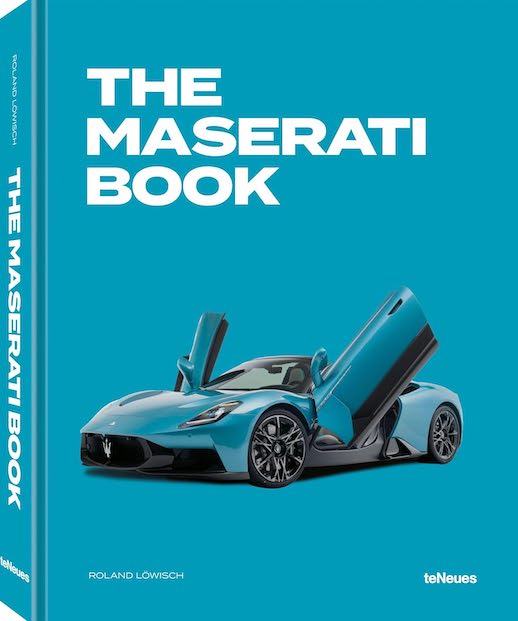 by Roland Löwisch
“It may actually suit Maserati that its parent company Stellantis has backed off its original plan to turn the brand into a fully electric sports car maker. A fully electric MC20, the MC20 Folgore, has been cancelled, and other EV projects have been put on ice for now.”
(English / German) There is a reason for starting with that excerpt: that plan had been announced in 2022, to be in effect by 2025. Obviously the sky did not fall in 2025. It’s not clear, though, if the author is talking about only phase one, the addition of an electric counterpart for each model in the line-up, or phase two which was scheduled for 2030 when all of Maserati’s internal combustion engine vehicles are to be replaced with EVs. But that is probably not why this book came out in 2026.
Instead, you have to already know a little about Maserati history to guess why that year matters: it’s the centenary of the first Maserati-branded car appearing at a race, the 1926 Targa Florio where it won its class. It’s also the year one of the Maserati brothers designed the marque’s famous Trident logo.
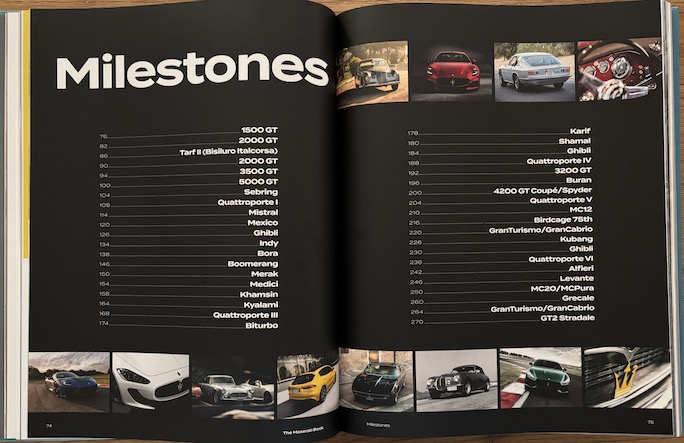
Depending on how you feel about this type of book you may not give this list the time of day. But, come on … Medici? Buran? Kubang? You may have seen those names in some dogeared magazine but not in a proper book.
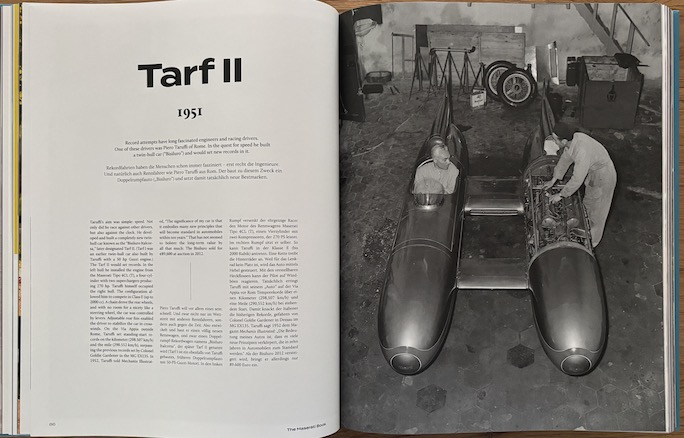
Rather peripheral to the overall story of this book but too good not to show here.
As that excerpt above makes clear, author Roland Löwisch put thought into this book, the kind of thought that goes beyond the sort of platitudes that this sort of photo-heavy, text-light supercar book is usually saddled with. Further, there are four multi-page interviews with long-time Maserati styling chief Klaus Busse, Classiche head Cristiano Bolzoni, Vincent Biard of Maserati Corse, and—no stranger to our readers—serial Maserati author Walter Bäumer. Insightful, all.
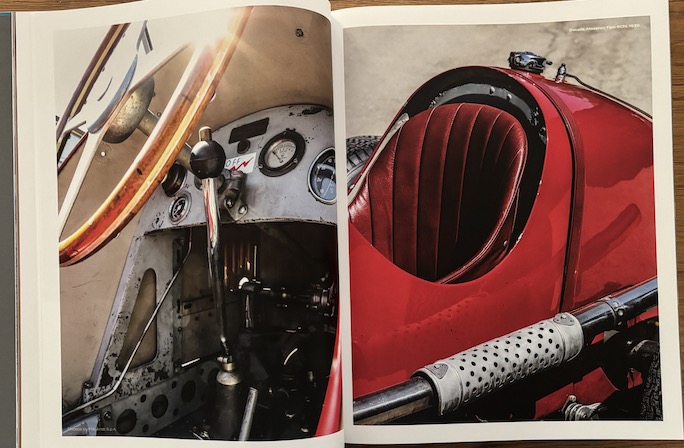
Some of the photos are so big that you almost want to take step back lest your eyeballs go crosswise.
The sheer size of the book (290 mm x 370 mm) makes handling it an event—and storing it a challenge. The only remedy for the latter is to keep collecting such books, which, in this case is real easy because there are already three others in this “Car Book Series” and quite a tall stack of others like them, especially by this publisher and also a few others.
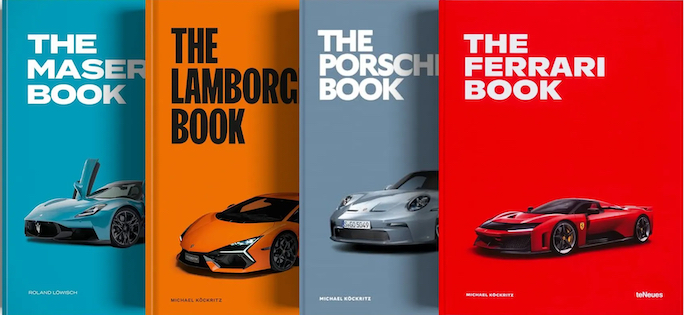
Not all Maserati cars and not all aspects of Maserati history are covered (and none pertaining to ownership experience or brand positioning let alone the effect of either on the marketplace), which is not this book’s intent. It is instead a curated look at Milestone road cars between 1946 (1500GT) and 2024 (GT2 Stradale), each of which covered on a few pages of mostly photos, sparsely captioned. As the firm was founded already in 1914, and was especially successful in prewar motorsports, there are many storylines you’ll want to run down on your own—no mention, for instance, of Maserati being the first Italian back-to-back Indy winner.
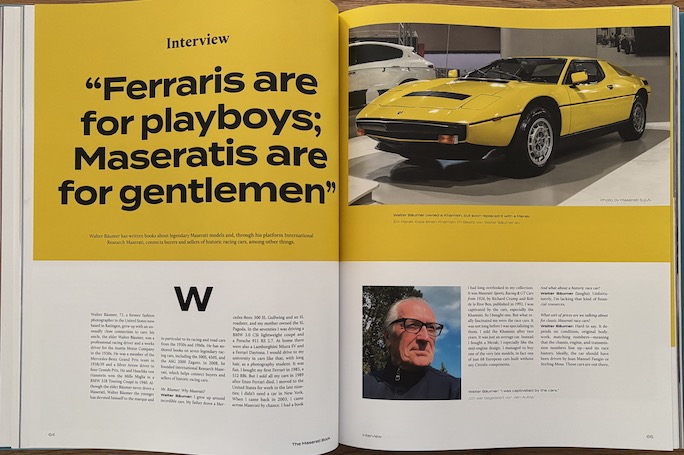
This is one of the four interview sections; the reason we show this one is because it is with the fellow on the right, Walter Bäumer who has written several voluminous Maserati books—in which he never says much about himself or what makes him tick.
And that header might as well be the subtitle for the book because that is kind of this book’s message.
A recurring theme, especially in the Q&A with chief designer Klaus Busse, is that Maserati has a distinct design esthetic and vocabulary. There are some really solid ideas here and you may well end up becoming aware of things you hadn’t known to look for before.
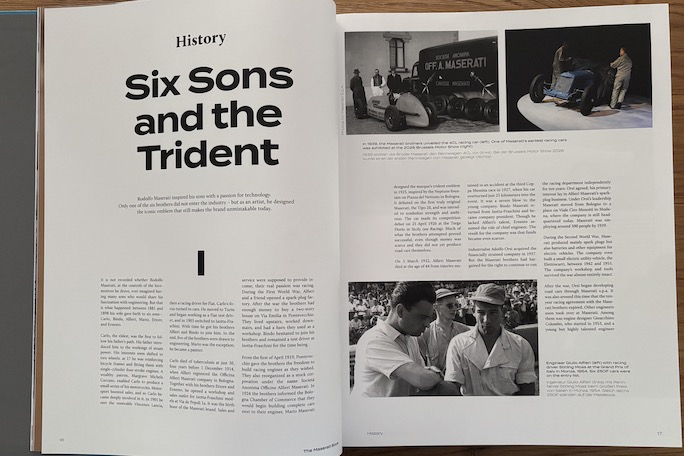
The English text is followed by the German version; the text is more or less the same but the photos are different and their captions are in only the respective languages. Meaning, audience participation is required if you really must know what you’re being shown.
The publisher of this book is synonymous with premium production quality, and well photographed and well selected imagery. There is no Index and while there is a Table of Contents the specific cars covered are not apparent until you hit the “Milestone” list we showed at the beginning, some 75 pages into the book which does show page numbers but not production years. (Much like the cars themselves, the publisher too has a distinct design esthetic and you just have to embrace it.)
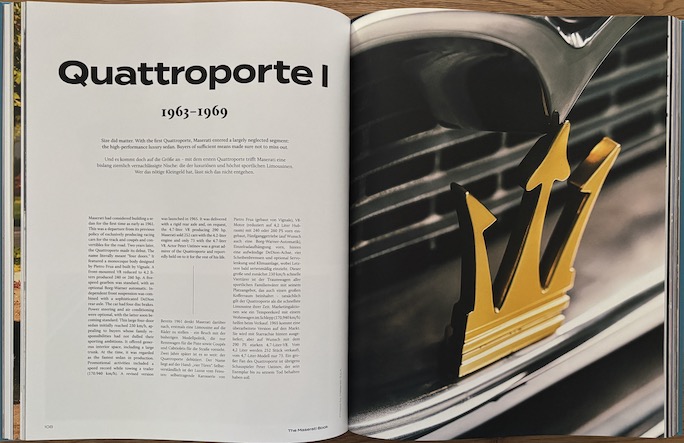
The trident, you say. Big deal. Nothing to see here. Except, there is. First of all, consider that the image shown is about three times the size of the real thing, which isn’t just a matter of “zooming in.” Then consider light, shade, depth of field. Now go TAKE a photo like that, and see what happens. Hah.
Copyright 2026, Sabu Advani (speedreaders.info)








































 Phone / Mail / Email
 RSS Feed
 Facebook
 Twitter