
Grand Prix Ford: Ford, Cosworth and the DFV
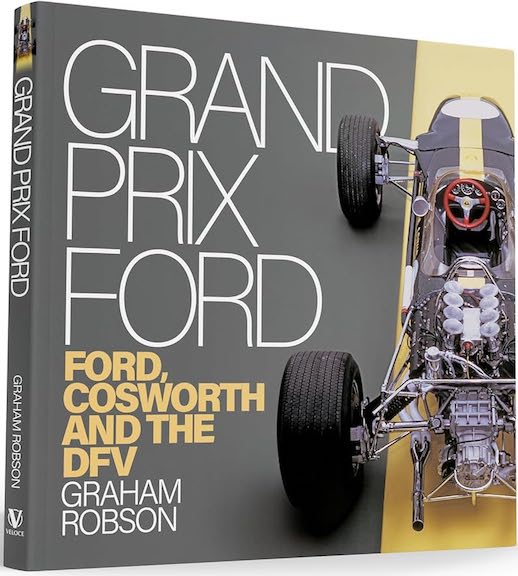 by Graham Robson
“In June 1967, the Ford DFV engine not only won its very first F1 race but would carry on winning F1 races and Championships for the next 16 years. When the DFV was launched, Keith Duckworth, who had conceived, designed and detailed almost all of it, was a mere 34 years old. An unlikely story? Perhaps – but all true.”
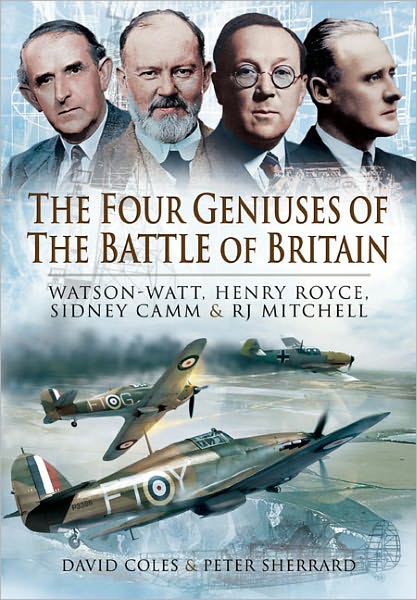
In 1940, during the Battle of Britain, Luftwaffe chief Hermann Göring demanded to know what his fighter pilots needed to defeat the Royal Air Force. Ace pilot Adolf Galland boldly replied, “Give me a squadron of Spitfires.” Roll forward 35 years. The BRM F1 team, World Championship, and multiple Grand Prix winners—the last being as recent as 1972—are in terminal decline under the ownership of the bombastic Louis Stanley. Latest hire Mike Wilds is asked what is needed to make the car more competitive: fitting a DFV.
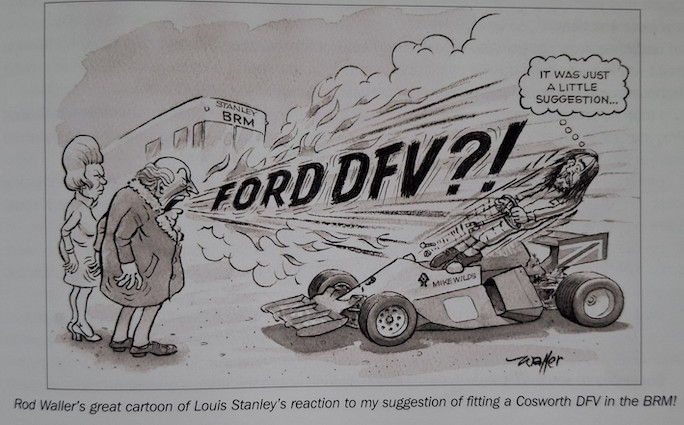
This cartoon is not from this book but from one you’ll want to read anyway; and it fits here perfectly.
Needless to say Wilds was fired immediately. BRM staggered on until 1977 when a proud history ended in ignominy.
Many other F1 engine constructors followed BRM into oblivion in the 1960s and 1970s, including Matra, Repco, and Weslake. Only Ferrari remained and won World Championships and Grands Prix during this era. The cause of this shakeout is the subject of this book.
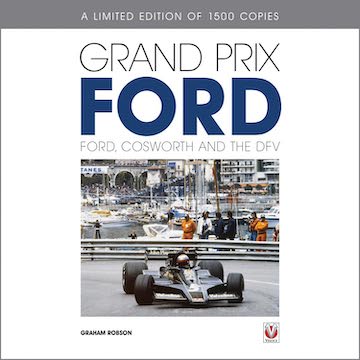 If this piques your interest but you have a well-stocked library, check that you don’t have this book already—different cover image, different ISBN (978-184584624), different binding, the same in all other regards. That was the first edition in 2015, limited to 1500 copies, which had been created from “a concept placed with Veloce Publishing by Anthony Pritchard, shortly before his death in 2013.” (FWIW, author Graham Robson is himself deceased, since 2021; it is not known what prompted this posthumous 2026 re-issue except that publisher Veloce has a tradition of reviving their back catalog.)
The Ford Cosworth DFV (Double Four Valve) engine made its debut in the 1967 Dutch Grand Prix in a Lotus 49 driven by Jim Clark. Its final win was in 1983 at the Detroit GP in a Tyrrell 011 driven by Michele Alboreto. These races were bookends to an astonishing total of 155 Grand Prix wins over 16 years. The last podium finish was the following year at Monaco when Stephan Bellof finished 2nd—in a race he might have won. These final races were undertaken using a Cosworth DFY engine, a tweaked version of the DFV.
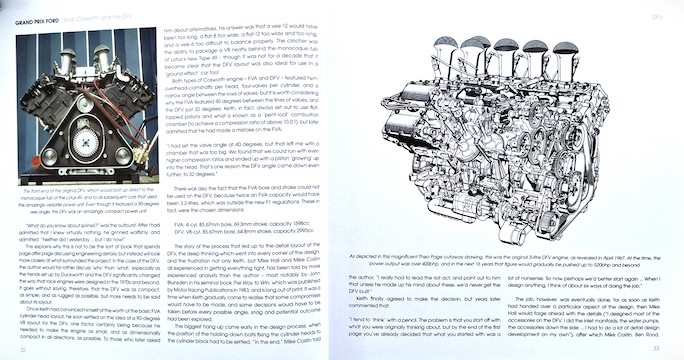
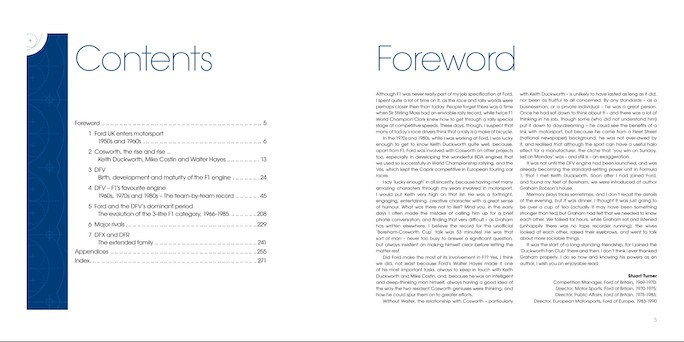
So, there is a great deal to cover in 272 pages, particularly as there is also a fair amount of material outside of a pure DFV boundary. The beginning of the book covers familiar ground. As part of the US Ford “Total Performance Initiative” (which resulted in the quadruple Le Mans-winning Ford GT40), Ford in the UK contracted the Cosworth company (named after cofounders Mike Costin and Keith Duckworth) in 1965 to build a Ford-branded engine for the forthcoming 3L F1 regulations. £100k and two years later the DFV engine emerged.
The Double Four Valve name arose as a result of work Duckworth was already carrying out for the new F2 engine formula that was to begin in 1967. He had determined that the best design would be for four valves per cylinder on a Ford 1600 cc block—this was eminently successful. It was named FVA, Four Valve (Series) A. Although the configuration was different in many ways, the DFV name followed.
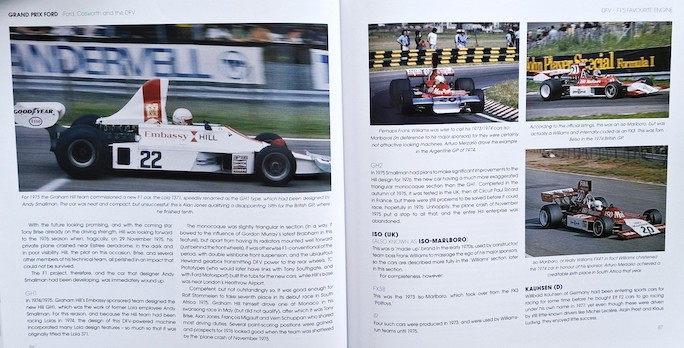
The main section of the book is a team-by-team account of all the F1 cars with one or other of the DFV-family of engines that started a World Championship event between 1967 and 1991. The author has counted a total of 53 brands. McLaren and Williams gained their first F1 GP victories using DFVs but the value of the book is introducing those who are new to F1 history to defunct entities such as Apollon, Bellasi, Connew, and Fomet.
Such a proliferation of teams arose because the DFV was competitive against the opposition from the outset, and it was (relatively) inexpensive. In 1977 a DFV would have set you back £14,610, about £117k/$158k today. And there were increasing numbers of second-hand DFVs available. With a Hewland gearbox, a young F1 designer anxious to make his mark and an aspiring driver bringing in some sponsorship, you could go F1 racing. But as many teams discovered, this was often not enough to get past the first practice session. By the time the DFV had reached the end of the road, the dreamers had mostly disappeared. As had many of the sponsorships. The Onyx team was sponsored by Jean-Pierre Van Rossem (“Marxist / anarchist / multi-millionaire / convicted fraudster / heroin addict”) who founded a Belgium political party expressly to avoid another jail sentence. Read more about him and many other shady characters in Crispian Besley’s excellent Driven to Crime (Evro).
The team-by-team account includes those models that used the DFV. Not all models have a photo linked to them and several minor teams not at all. For a (nearly) complete photographic record you will need to get the Peter Higham Formula 1 Car by Car series also published by Evro. And even he failed to include a picture of the Apollon albeit this was a slightly modified version of the Williams FW03 / Iso-Marlboro.
The book is not just about the F1 DFV. There is also a chapter on the period rival engine manufacturers such as BMW, Repco, BRM, Ferrari, Maserati, Matra, and Weslake. There is another on the DFX and DFR developments—“The Extended Family.”
And finally, the DFV performed in many other theaters outside of World Championship F1, not least in winning the Le Mans 24 Hours twice.
Even if you are knowledgeable about the cars and engines of this era, this is an inexpensive, informative, and entertaining read. The author doesn’t mince words when describing some of the all too many delusional efforts. Segued into the narrative of great drivers, cars and races, there are also gems such as the race from Cape Town (South Africa) to Southampton (England) between an ocean liner and a Ford Corsair 2000E, the latter a UK saloon / estate car from the mid-1960s. Alas we are not informed who won.
Robson authored a copious number of books on motoring and motorsport, including a companion volume to this one titled Cosworth: The Search for Power (2017, same publisher).
Copyright 2026, Paul Lea (speedreaders.info)







 Phone / Mail / Email
 RSS Feed
 Facebook
 Twitter