
Formula 1 in Camera 1970–79 Vol. One
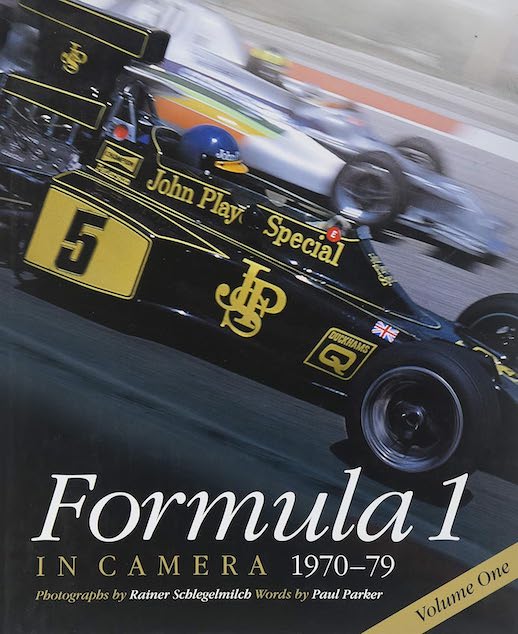 by Paul Parker
“The years that separate the Lotus 72 from the Williams FW07, the fastest cars of 1970 and 1979 respectively, illustrate how much speed was found from chassis design and tyres and how little from engines.”
Chassis design . . . that means visual tell-tales, means ideal fodder for a photo book, means an unassailable reason to discuss this particular decade out of a series of several . . . even if a photo book is not an ideal candidate for a wordy book review, mainly because it itself is—usually—light on words. Not this one, though, nor any of the others in this short series, and that brings us to a rather pressing reason to present this more than 20-years-old book now: continued availability in the US market of this UK title is no longer a sure thing, in fact the US distributor hasn’t seen new supply for three years. So, folks, you are on notice: vote with your wallets to send the publisher a message, both to expand the series and to not abandon the US market!
For the technically minded, this decade is rife with innovations.
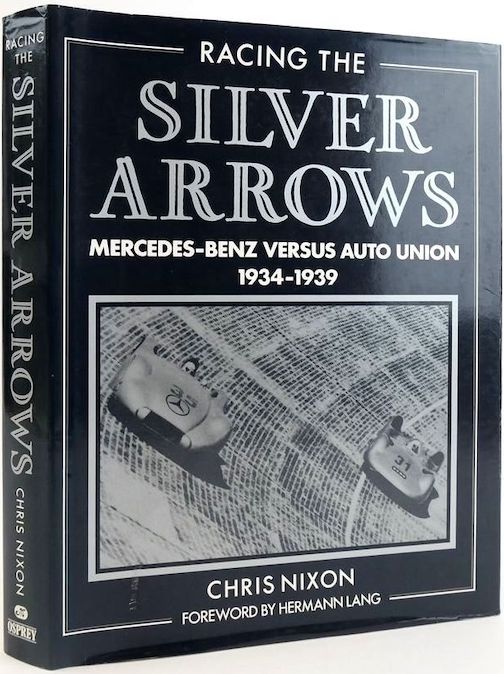
This here is in the revised 2018 edition that had first been published in 2003 and reprinted several times. The F1 series has a parallel one, Sports Car Racing in Camera, and we did already review one volume from it back when the original publisher, Haynes, was still in business. Behemoth Publishing took over some Haynes titles, and they still have various volumes of each series in their catalog; you can still easily assemble a full set from secondary market finds.
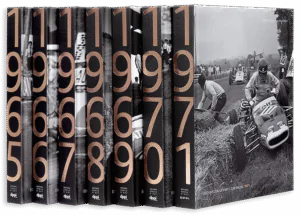 All but one are written by Paul Parker; the 1980–89 volume in the F1 series was penned by Quentin Spurring (2005). Of Parker’s writing we once said that it was “the proverbial ‘cut above’” and this remains as true as ever and it is what sets these books apart from similar work by others (publisher Cercle d’Art comes to mind right away but their series, right, has a different flavor and is also rather more expensive).
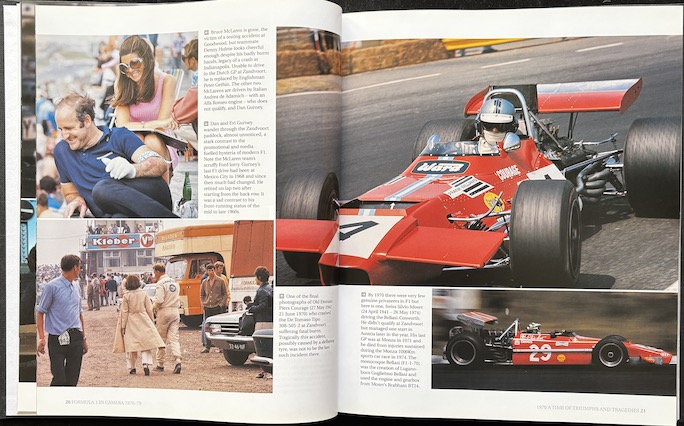
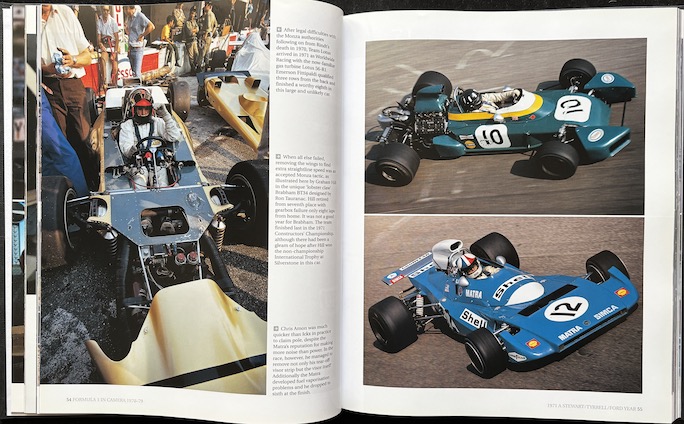
Any photo on any page will want to make you hit the books for the detail behind the detail: what’s with Denny Hulme’s gloved hand (top left)? Bottom right: Silvio Moser (who??), a privateer driving a (what??) Bellasi. And the caption top right: “One of the final photographs of Old Etonian Piers Courage.” Heartbreak.
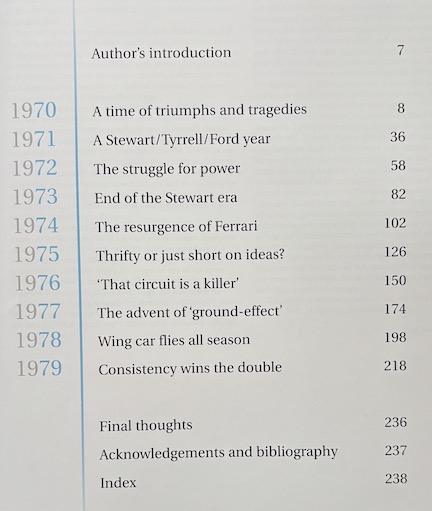 Parker’s expansive photo captions convey not only a staggering amount of micro detail of the historic/interpretative kind but “paint a picture” thanks to atmospheric, people-focused, clever prose. That said, and actually this is a neat sample of Parker’s way with words, he cautions “those of a pedantic nature who rejoice in statistics and similar” not to expect a “blow by blow account of the minutia of F1”—1, because recorded facts and figures are not always consistent but also, 2, the photographer whose work propels these books, Rainer Schlegelmilch of Germany, didn’t attend every race because of his day job as a commercial photographer. Considering Schlegelmilch’s outsize impact on the field of motorsports photography it is amusing to think that he treated it as a hobby, having only fallen into it rather by accident in order to accommodate an acquaintance. At any rate, in terms of reportage there really is nothing relevant missing from Parker’s coverage except that it does not cover every race. So, pull your copy of Formula 1: All The Races – The First 1000 from the shelf (that one because its rich data and analysis are exceptionally well organized; also it receives updates) and orient yourself within the Big Picture.
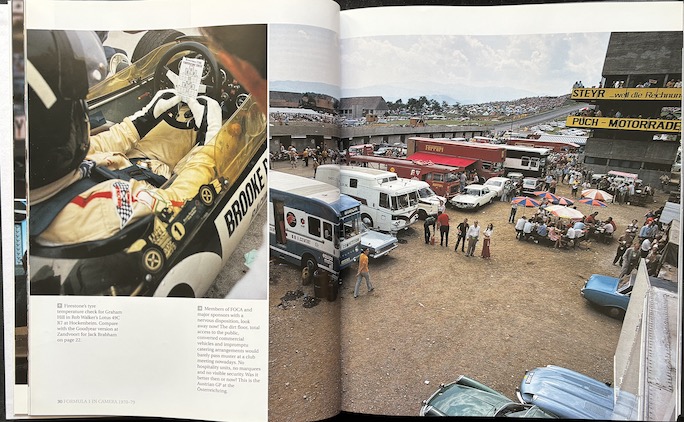
Clever caption (right): “Members of FOCA and major sponsors with a nervous disposition, look away now!” Why? Get your own book!
Some people, some teams, quite a few of the venues from this 1970–79 decade are still around but to anyone new to F1 not a whole lot in this book will look familiar, especially not the sheer variety of machinery. Also, there were still a few privateer efforts but that ended in that decade. There will be plenty of readers who attended F1 races in period and they will be oddly affected by reliving memories, not merely in a rosy-tinted nostalgia-imbued sense but by being reminded, especially by the photos, of epic tragedies, such as Piers Courage being killed on track in 1970, followed a few races later by Jochen Rindt, the only F1 World Champion to be crowned posthumously. And who can remain composed upon seeing vivacious Barbro Peterson, knowing that not so many years later she would commit suicide, inconsolable over her husband Ronnie’s death in 1978. Photos have that power.
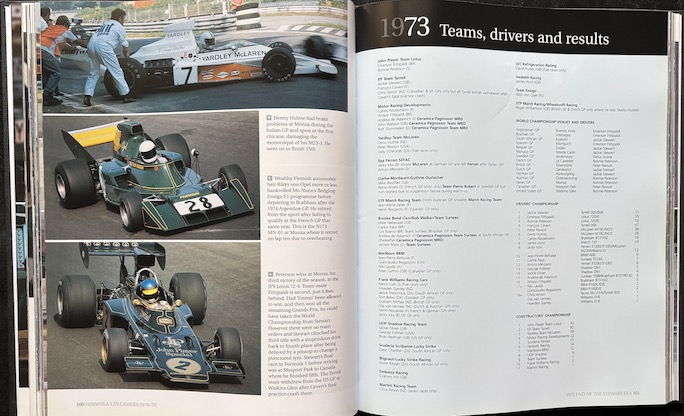
Right page: You may not have heard of Olympus Cameras Wolf Racing, but you surely know their drivers James Hunt and Keke Rosberg. And who the heck is Team Rebaque? Team Ensign? Team Merzario?
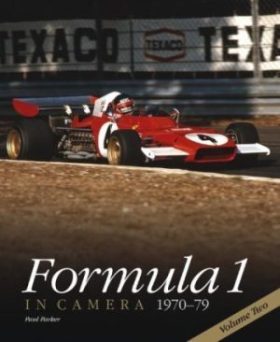
Each year begins with a brief summary essay and ends with a concise table of results (teams, drivers, championship standings, and each season’s race venues; above). There is an Index, and very fine it is too. Photo reproduction is excellent and thanks to a rounded spine the pages open fully flat so no detail is swallowed by the gutter. An almost trite point begs to be spelled out anyway: knowing how to select the “right” few hundred photos out of thousands is un uncommon skill; Parker has it. But even he must have thought the subject deserved a second stab so he and Haynes published a Volume Two (ISBN 978-085733074) in 2012 with another 250 images.
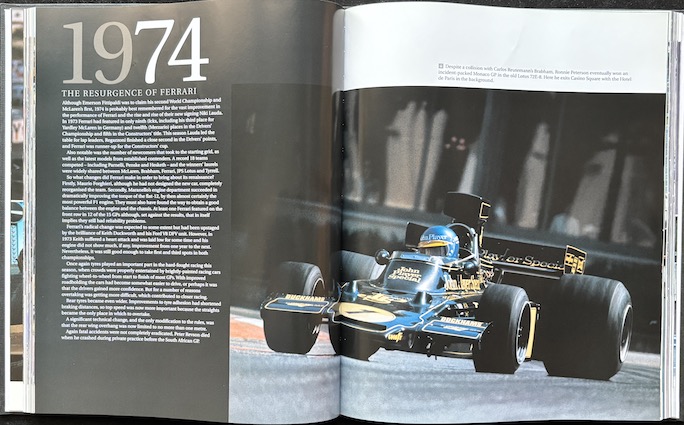
That headline . . . “The Resurgence of Ferrari” . . . just what the doctor ordered for the upcoming 2026 season.
Copyright 2026, Sabu Advani (speedreaders.info).





 Phone / Mail / Email
 RSS Feed
 Facebook
 Twitter