
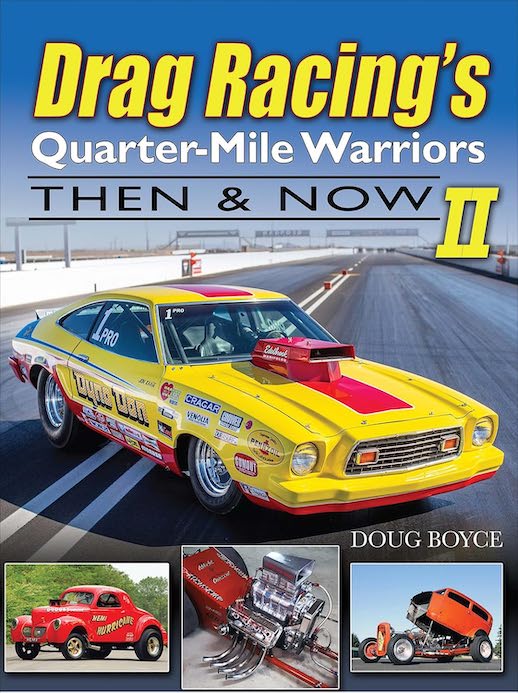
Drag Racing’s Quarter-Mile Warriors II
 by Doug Boyce
“To many fans, the sport of drag racing today has lost much of its flavor. The Fuelers no longer race to the 1,320 mark, it’s difficult to differentiate one Funny Car from another, and Pro Stock lost me when rules stated that an engine from any manufacturer was ok to use in any car.”
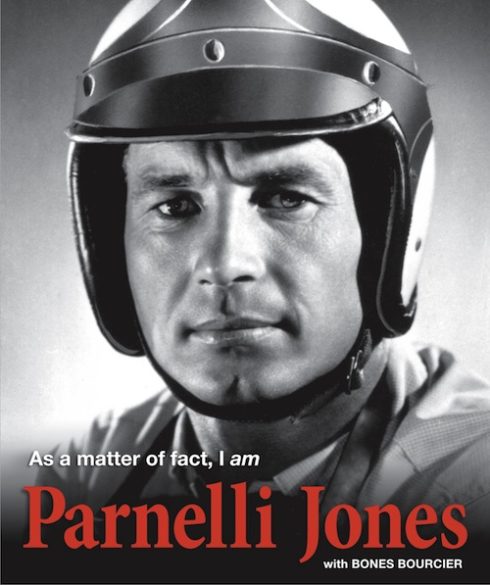
All those names in that excerpt may mean nothing to you but one look at the book cover tells even the layperson that we must be time-traveling because indeed not one car looks like another. But do you know what category each falls into?
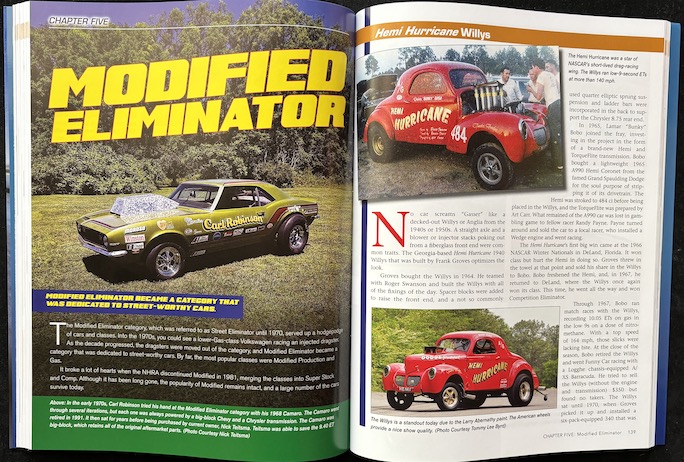
It’s not much of a stretch to guess what went into the name Chevoom—but how about Chevamoco? There are bigger questions . . . what differentiates the classes Middle Eliminator from Little Eliminator from Street which all fall (along with others) into the Competition Eliminator category which is different from Modified Eliminator which is different from Super Stock Eliminator. The head it is a-spinning. Whole books would be needed to work it all out, and Boyce has written quite a stack of them. As one does when one has a lifelong addiction to drag racing.
 The book covers the late 1950s to the 1970s, showcasing examples from all categories and all manufacturers. The presence of the numeral “II” in the title is your clue that there must have been a prior book. That came out in 2014 (ISBN 978-1613251331), was well received, and is these days only available as an on-demand printing from the publisher but still easily found on the secondary market. It presented 75 cars, the new one adds another 70, and there is talk of a third one because “interest in the sport’s past has never been stronger.” Who knew.
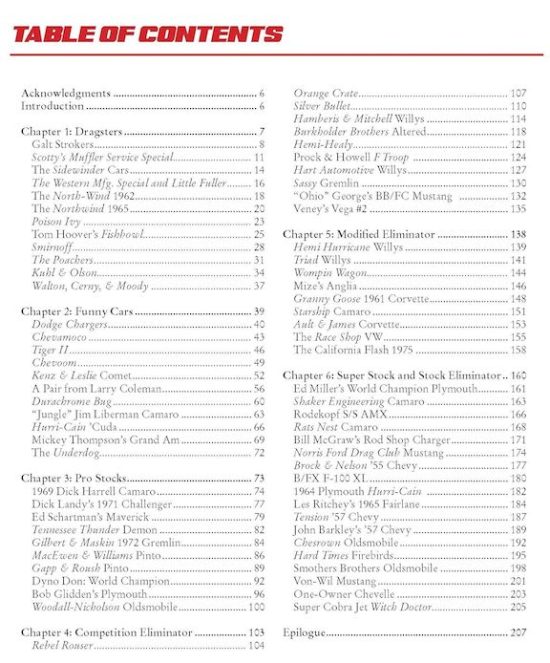
Divided into 6 chapters representing different categories each individual car is presented separately (on 2–3 pages each), making it very easy to find via the Table of Contents (there is no Index).
 As Boyce writes, today’s cars look more like fighter jets than street cars. While fundamentally true, the first couple dozen pages in this book also don’t look much like street cars, but that’s not really what the book is concerned with anyway. The point here is to account for the whereabouts of once well-known and -recognized cars, review their claims to fame, be it in period or nowadays, and trace their builds or, if applicable, rebuilds, the latter to be seen as distinct from “recreations” which are not covered.
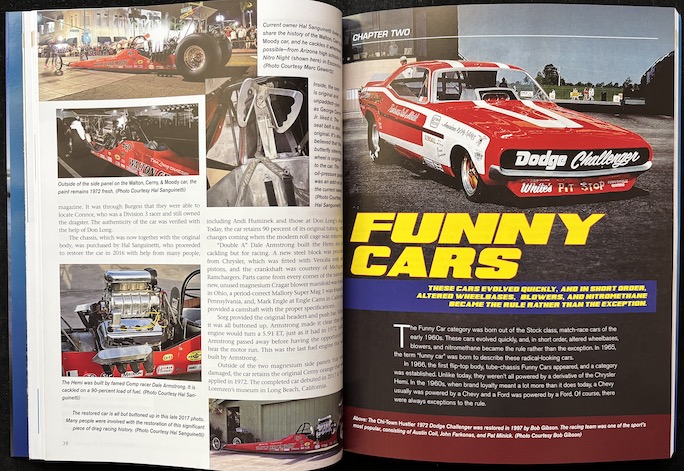
If you see any of these on the street you’re on the wrong street.
Plenty to show and tell, then. In fact, on the “show” side, Boyce has gathered over 500 photos to illustrate the Then & Now of which the title speaks. The amount of detail about people, cars, and places is vast but presented in an engaging style—this book isn’t so much about nostalgia but appreciating the roots of car culture in America.
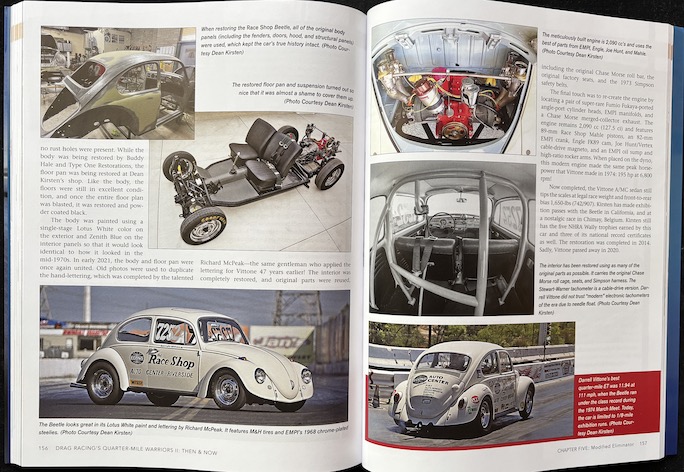
This Beetle looks so unassuming and relatable that the nickname White Lightning seems wishful thinking. But consider this: 195 hp at 6800 rpm. If you think of cars only in terms of the daily commute, how’s this metric: 111 mph for the quarter mile. This 1967 car had been retired in 1985, remained disappeared for 35 years, and is now fully restored to its 1970s spec when it, alongside another Beetle, was the one to beat.
Copyright 2026, Sabu Advani (speedreaders.info)














 Phone / Mail / Email
 RSS Feed
 Facebook
 Twitter