
Eleanor in the Village
Eleanor Roosevelt’s Search for Freedom and Identity in New York’s Greenwich Village
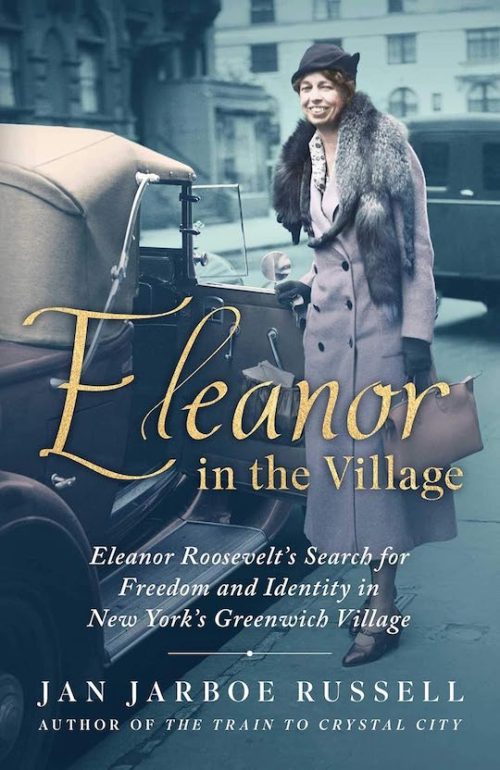 by Jan Jarboe Russel
“Asked what her favorite word was that kept her going, Eleanor said, ‘The word is hope. It’s the most neglected word in our language. Yet without hope, there can be no solution to mankind’s trouble.’”
Awareness of this title came to your commentator by way of an email that turned out to be unintentionally misleading. The way it was worded and the photos that accompanied it gave the impression the book included information and photographs of Roosevelt family-owned and -driven vehicles as part of the story it told. Such proved to not be the case although what author Jan Jarboe Russell chose to write did produce an interesting read from a slightly different perspective as she sought to describe, per the subtitle, Eleanor Roosevelt’s Search for Freedom and Identity in New York’s Greenwich Village.
Russell freely shares that she conducted very little independent research in existing papers or archives although she did interview two individuals: David Roosevelt, grandson of Eleanor and Franklin, and Ellie Zartman, the niece of Eleanor’s friend and secretary Malvina Thompson. For the most part, however, Russell relied on other written and published biographies. As examples, “For the chapter on Eleanor’s birth and childhood, I depended on . . .” and “For details on FDR’s childhood, I relied on. . .” or “Eleanor continued to be politically influential throughout the 1950s and until her death . . . as documented by . . .”

The book’s 21 images are all in a single section, mainly fairly small and of others who figure in the narrative. Top left in the car are NY governor Roosevelt, Missy LeHand, and Eleanor. Opposite is Franklin in a favorite place, on the water. Bottom l is Lorena “Hick” Hickok. Opposite: Eleanor and her driver/bodyguard Earl Miller.
That richness of published works, not counting this one, tallies at least 15 different titles. For those who may be interested that list is appended below in alphabetical order by the surname of author.
This book provides a biographical overview of Eleanor from her less than happy or nurturing childhood, education and early adulthood experiences that included falling in love with her distant cousin Franklin, and he with her, and all that ensued. Because it is more about her, while Franklin’s life and experiences are mentioned, the real focus is on Eleanor and not superficially but her own internal thoughts and challenges. Because both became deeply involved in public life and service, and with the times being what they were, suffice to say that neither led an inconsequential existence.
Each of the relatively short 21 chapters opens quoting something attributed to Eleanor. Two that resonated were: “I think at a child’s birth, if a mother could ask a fairy godmother to endow it with the most useful gift, that gift would be curiosity.” The other is “Great minds discuss ideas. Average minds discuss events. Small minds discuss people.” Happily for them—and us—Franklin and Eleanor each were endowed with curiosity and were the right people in the right places to cope with and ultimately surmount the challenges with which they—and the entire world—were faced.
When Franklin suffered a cerebral hemorrhage and, in Eleanor’s words, “slipped away from us” she was the one who contacted newly-anointed vice president Harry Truman and informed him in person with “Harry, the President is dead. Is there anything I can do for you?”
Upon being informed “Winston Churchill addressed the House of Commons in a choked up voice. ‘In Franklin Roosevelt there died the greatest friend we have ever known, and the greatest champion of freedom who has ever brought help and comfort from the New World to the Old.’” Eleanor then went about ensuring that Franklin’s ceremonial farewell would be to his liking.
When her own time came 17 years later in 1962, although she’d requested hers be “a simple service,” as another observed that would not be possible for she’d become the most admired woman in the world. She had earned the like, the respect, and the admiration of people everywhere and was, for many, a standard bearer, an inspiration.
Copyright 2025 Helen V Hutchings (speedreaders.info)
Eleanor in the Village:
Eleanor Roosevelt’s Search for Freedom and Identity in New York’s Greenwich Village
by Jan Jarboe Russell
Scribner / Simon & Schuster, 2021
237 pages, 21 b/w images, cover
chapter end notes, index
List Price: $28
ISBN 13: 978 1 5011 9815 1
**
Black, Allida M 1996 Casting her own Shadow, Eleanor Roosevelt and the Shaping of Postwar Liberalism
Cook, Blanche Wiesen 1992 Eleanor Roosevelt, Vol I The early Years 1884-1933
Gardener, Deborah S 2009 Roosevelt House at Hunter College, the story of Franklin & Eleanor’s New York City Home
Gentry, Curt 2001 J Edgar Hoover, The Man and the Secrets
Goodwin, Doris Kearns 1995 No Ordinary Time; Franklin & Eleanor Roosevelt, The Home Front in WWI
Gurewitsch, Edna P 2002 Kindred Souls, The Friendship of Eleanor Roosevelt and David Gurewitsch
Lash, Joseph P 1971 Eleanor and Franklin, The story of their relationship Based on Eleanor Roosevelt’s Private Papers
Quinn, Susan 2017 Eleanor and Hick, The Love Affair that Shaped a First Lady
Roosevelt, Eleanor 1950 This is My Story
Roosevelt, Sara Delano 1933 My Boy Franklin, as told by Mrs James Roosevelt to Isabel Leighton and Gabrielle Forbush
Rowley, Hazel 2011 Franklin and Eleanor, An Extraordinary Marriage
Strausbaugh, John 2014 The Village; 400 Years of Beats and Bohemians, Radicals and Rogues, A history of Greenwhich Village
Teague, Michael 1981 Mrs. L: Conversations with Alice Roosevelt Longworth
Ward, Geoffrey C 2014 A first-class Temperament: The Emergence of Franklin Roosevelt 1905-1928
Wetzsteon, Ros 2003 Republic of Dreams, Greenwich Village, The American Bohemia
 RSS Feed - Comments













 Phone / Mail / Email
 RSS Feed
 Facebook
 Twitter