
Superveloce: How Italian Cars Conquered the World
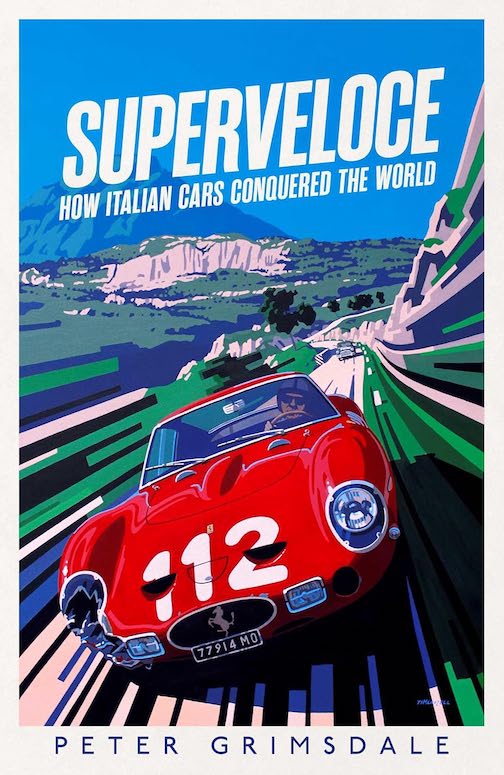 by Peter Grimsdale
“Nowhere more than in Italy did the motor car become an agent of social and economic change . . . the automobile was the force behind Italy’s (industrial revolution), embedded in the nation’s culture as an instrument of liberation.”
It helped that I attended a performance of Verdi’s Requiem while reading this book, as it is the musical equivalent of the Italian automobile. Both speak the same language—there’s beauty, style, hyperbole, theater, and a sense of sheer joy which no mere Volkswagen or Ford can ever hope to endow. I might be a classical music agnostic, but the Requiem left me uncomfortably close to tears, just as the howling red Ferrari 206S I’d seen a few months earlier at Goodwood had done. All Italian cars, from humble Seicento to haughty Gran Turismo Berlinetta, share a DNA that somehow enables them to transcend their mere function. I should know, I’ve owned five of them and, although hardly exotica, every Alfa Romeo and Fiat can transform the humblest English byway into the Raticosa Pass, mid Mille Miglia, and persuade the driver to exercise his/her inner Tazio Nuvolari.
Peter Grimsdale’s day job used to be TV producer and commissioning editor, but he has also written fiction and two excellent books on motorsport, High Performance: When Britain Ruled the Roads and Racing in the Dark: When the Bentley Boys Conquered Le Mans. Although I had expected a similar page-turner style in Superveloce, the book was very different in style and content, almost thesis-like in its subject matter. There’s a lot of information to digest in the book’s 65 chapters and 356 pages, meaning that I found that reading only a chapter or two at a time best suited my metabolism.
What distinguishes Superveloce is the author’s willingness to depart from the purely automotive by describing the societal and political environment his subjects inhabited. The automotive industry does not operate in a vacuum, and not only is it influenced by the prevailing culture but it also itself can influence that culture. Post-war Italian films inevitably feature Dante Giacosa’s Fiat Cinquecento, and the Alfa Romeo Duetto. driven by Dustin Hoffmann in The Graduate epitomized a whole era, as did the incomparably lovely Lamborghini Miura that starred in the opening scene of The Italian Job. And then there’s Roman Holiday, in which Audrey Hepburn co-stars with a Vespa scooter; as Grimsdale puts it, “style could be democratised,” and “those who thought of Italians as ice cream sellers had been swept aside by a new generation who regarded all things Italian with respect.”
 In common with Stephen Bayley (Cars – Freedom Style Sex Power Motion Colour Everything) and Kassia St Clair (The Race to the Future), the author is diligent in describing not only the machine but the zeitgeist in which it was conceived. Post-war Italy was as much about Fellini and Rossellini as Agnelli and Ferrari, and one can only admire the author’s chutzpah in beginning his book with a discussion of a painting by Lorenzo Delleani commissioned by (take a breath) Count Emanuele Cacherano di Bricherasio. It depicted the nine men who, in 1899, “gripped by a sort of automotive euphoria” created Fabrica Italiana Automobili Torino, now better known by its acronym.
Entrepreneurs worldwide were creating their own automobile manufacturers, but, as the author reminds us, Fiat’s genesis was all the more remarkable for taking place in a country “which had changed little since medieval times” and had not enjoyed an Industrial Revolution, unlike its northern neighbors. But Italy’s long tradition of artisan metal workers equipped it perfectly to create the shapes designed by the Pininfarinas, Gandinis and Giugiaros, who each displayed the uniquely Italian virtue of Sprezzatura – “the art of making something difficult look easy, with style and grace.”
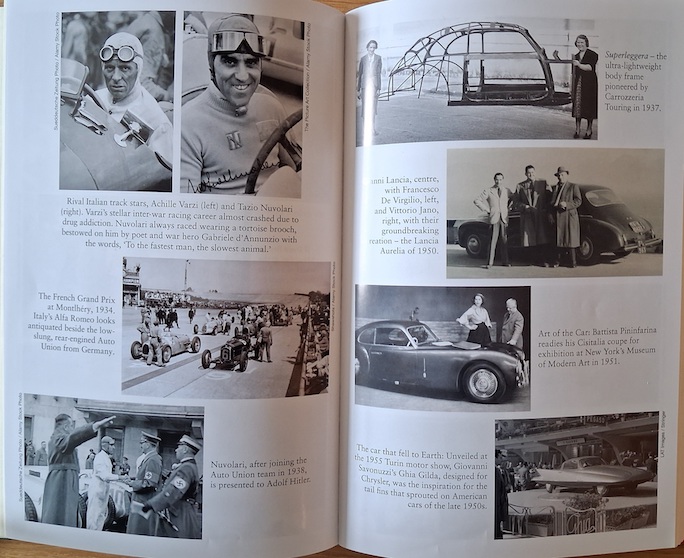
Almost every Italian marque has been annealed in motorsport, and the book covers the themes you’d expect. Alfa Romeo’s pre-war glory sits alongside the day when Enzo Ferrari (“as tightly closed as a walnut”) first beat the Alfas (at Silverstone in 1951). That was the famous occasion when the man who was no stranger to hyperbole declared “I have killed my mother.” Later, Ferrari’s Machiavellian flirtation with Ford in the 1960s is also described—just who was playing with whom, I wonder? But I was surprised that there was only fleeting reference to the 250GTO, the car that is illustrated on the dust jacket and which deservedly has icon status. And while the book doesn’t end at a specific date, the narrative peters out after 1969. Which means that there is nothing about the sublime Alfasud, which rewrote the rule book for small, front wheel drive cars. And I was surprised that there was no mention of Mauro Forghieri, the architect of so much Maranello glory. And, while I am nit picking, the illustrations add little as they are small and unremarkable. But, given the span and detail of the book, to illustrate it properly would have resulted in a much bigger and more expensive work. As long as one’s smartphone is at hand it’s easy enough to remind oneself of the sinuous curves of the Lancia Aurelia or the Isotta Fraschini Flying Star. Few cars ever said “Great Gatsby” like that one did.
Reviewers normally make a note of quotations from the book to use in the review but I found myself with an embarrassment of verbal riches from Superveloce. I cannot resist quoting Pininfarina (yup, him again) on the suitability of the Fiat 500 for Italian driving, describing it as “the light cavalry which is needed to launch the attack on our cities, most of which have medieval layouts.” Words that resonated with me, as I recalled the angst of navigating even the most modestly proportioned Fiat through the tiny alleys and squares of Siena and Pisa. And finally, consider these words about Alfa Romeo, the most mellifluous sounding marque of all, as well as the one with the best badge (starring a red cross and a green serpent): “Alfa Romeo stands apart. . . . Its elements are like those of the human spirit which cannot be explained in logical terms.”
All I can say now is Forza Italia! Read and enjoy.
Copyright 2025, John Aston (speedreaders.info)
 RSS Feed - Comments


 Phone / Mail / Email
 RSS Feed
 Facebook
 Twitter