
Birth of a Giant, The Men and Incidents that Gave America the Motorcar
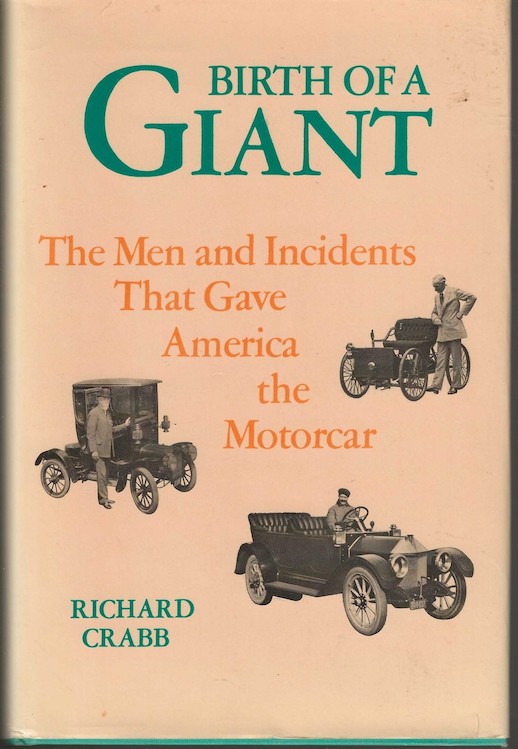 by Richard Crabb
“Herbert R. Lewis; who worked with both Buffalo Bill Cody and Alfred Sloan—from horses to horsepower” to whom this book is dedicated.
Spurred by his lifelong interest in history, Alexander Richard Crabb (1911–1999) wrote three books that were published: The Hybrid Corn-Makers, a first-hand account of the development of hybrid corn; Empire on the Platte, the story of the Olive family of cattle barons in Nebraska’s Platte River Valley (chosen for a special edition during the Nebraska State Centennial); and this Birth of a Giant, the history of the development of the automobile up to World War II.
It’s a logical place to conclude his history for post WW II the auto industry would expand exponentially. That said, Crabb could logically have concluded his narrative post WW I for the second world war would be “industrial” in nature with hand-to-hand combat diminishing, replaced by the machine guns, tanks, and airplanes produced by the automobile and truck manufacturers under orders of their governments.
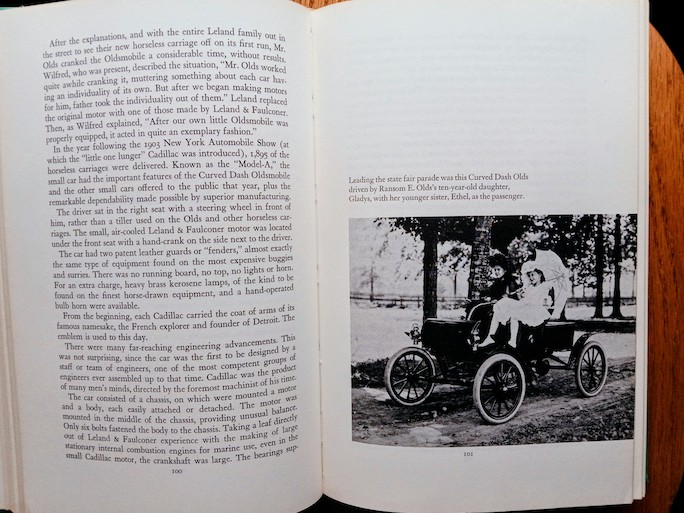
This image was provided by Gladys Olds Anderson, Ransom E. Olds’ eldest daughter of herself and her sister, Ethel, from the family album whom the author interviewed.
Much has been written in books and magazines since 1969 when this book was published. Yet with the passing of time information, facts, and nuances of those early years are filtered and diluted with each recounting. What makes this book so worth your while to seek out to read for yourself are the sources, namely the people who were still alive. Richard Crabb located and sought each out in order to interview them. Then, as he wrote his book’s narrative, to ensure that his writing was accurate, he provided pages to authorities to proof, correct, or embellish on well prior to submitting his manuscript for publication. So outstanding is his book, it earned the Thomas McKean Memorial Cup Award from the Antique Automobile Club of America (AACA).
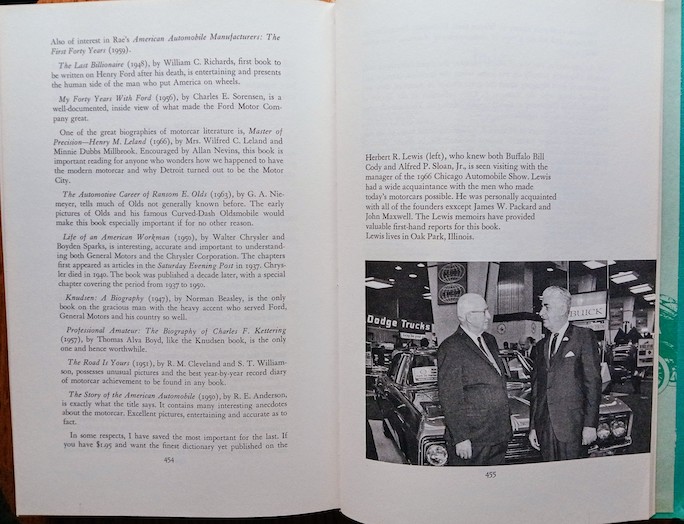
The gentleman on the left in this 1966 photo is Herbert R. Lewis who was one of Crabb’s primary sources for Lewis. He had worked with Alfred Sloan “both before and after Sloan joined General Motors.” The man on right is then-manager of the Chicago Auto Show.
One of the primary sources for Crabb resulted from a chance meeting with Herbert R. Lewis and to whom Crabb dedicates his book. Lewis had known and worked with Alfred Sloan both before and after Sloan had joined GM and had been personally acquainted with most all of the carmaker’s founders. Lewis and Crabb met “almost every week for several hours over a period of more than two years. … In the course of these interviews, Lewis made several thousand feet of tape recordings of his motorcar experiences [and] placed in my hands enough letters, pictures and mementos to fill four standard filing cabinets.” Some of those photographs illustrate this commentary.
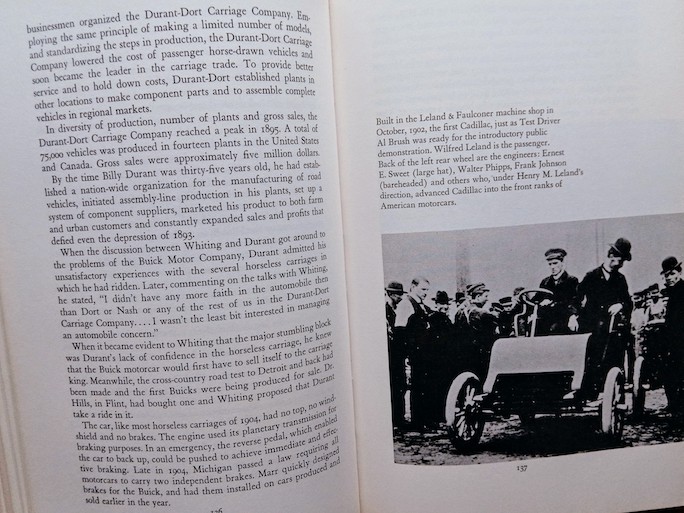
The widow of Henry Leland’s son Wilfred provided this photo from the family album. In driver’s seat is Al Brush with Wilfred his passenger. Behind left rear wheel are engineers Ernest Sweet in large hat, Walter Phipps, and a bareheaded Frank Johnson.
In one place, Crabb writes “It has been estimated that three hundred Americans were at work before the turn of the century on some type of self-propelled road vehicle.” Some pages further on he notes “new motorcars had been coming into the market at the bewildering rate of 40 to 60 a year since 1900. Many of the manufacturers went out of business the same year they announced their new models. This … made it difficult if not impossible to finance even a superior motorcar.” The reality was these fledgling enterprises simply devoured financial resources.
There are multiple chapters and pages sharing anecdotes about those who became the automotive industry leaders. Yet by the time the world was embroiled in the Great War, as the first world war came to be called, America would clearly lead the world in motorcar production with General Motors, Ford and others producing cars and trucks sold via distributorships the globe around. Yet, as would be true after that second war, the “economic aftermath swept over the motorcar industry of the United States like a violent storm. Before it was over the weaker carmakers had been swept away and even the strongest had been tested.”
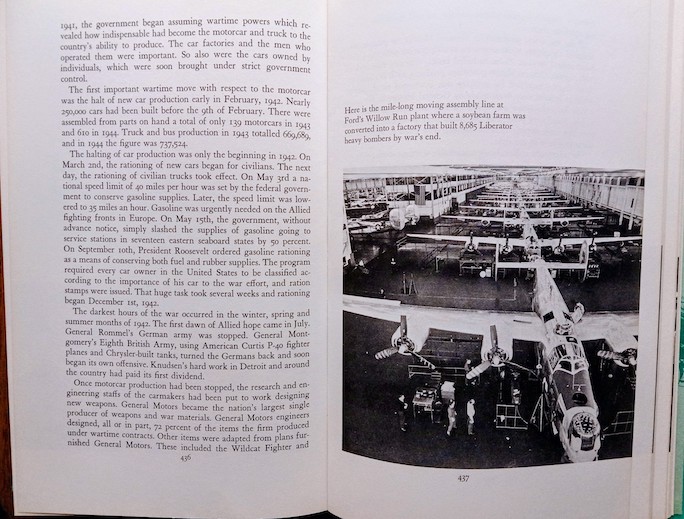
The mile-long moving assembly line at Willow Run built 1,685 Liberator bombers by the end of WW II.
Even as Ford, the man and his company, is generously covered and praised for his achievements—especially the Model T and successfully, virtually single-handedly, breaking the Selden patent stranglehold over the entire industry—Crabb doesn’t overlook some of Henry Ford’s foibles. He notes “Edsel Ford … was the outstanding industrial management figure. … A modest man, he was destined to labor in the shadow of his illustrious father. … Edsel marshaled the company’s great power for the war effort in World War II. … The last Flying Fortress produced at the Willow Run plant was mounted on the grounds as a memorial to Edsel Ford.”
It becomes clear why Crabb had extended his coverage to the second world war for one of his primary original sources mentioned earlier, Herbert Lewis, gave him first person experiences. “Lewis had worked with Sloan as chief sales officer at Harrison Radiator.” When Walter Chrysler had struck out on his own, Lewis felt as Crabbe wrote “From Alfred Sloan with whom he had worked at General Motors, Chrysler had learned the magic of helping every man on his team do his best work.”
The final chapter describes how industry stepped up to producing armaments, aircraft and more in support of the needs of the Allies during World War II. But we also know from the pages of Edward Young’s 2024-published book Building Engines for War it wasn’t as simple or uncomplicated—though just as much an achievement—as Crabbe’s final chapter reads. It is followed by an appendix listing “References for Further Reading.” Those references are both instructive and bear close examination; perhaps even follow-up to acquire titles with which you are unfamiliar or that are missing from the shelves of your own library.
Copyright 2026 Helen V Hutchings (speedreaders.info)
















 Phone / Mail / Email
 RSS Feed
 Facebook
 Twitter