
The Kalamazoo Automobilist: 1891–1991
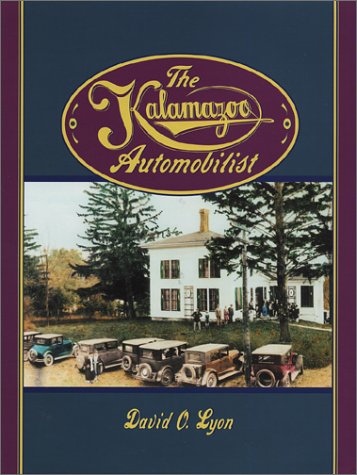 by David O. Lyon
“One cannot separate the manufacture of the automobile from its influence on the lives of citizens and it is here we find a brief review of its presence on the streets of Kalamazoo.”
This is a big book at over 500 pages. But then it tells a big story; that of the transportation-oriented history of one place during its first century commencing with its 1891 origins. While one may not think of Kalamazoo, Michigan as an automotive mecca consider the following automotive makes and makers (listed in alphabetic order) that called it home: Barley, Blood, Cannon, Checker, Cornelian, Dort, Greyhound, Handley, Handley-Knight, Kalamazoo, Lane, Michigan, Pennant, Reed, Roamer, States, and Wolverine. In addition to those seventeen, others made trucks, train cars, and tractors. Each had its impact(s) and effects on the culture and lives of Kalamazoo’s residents.
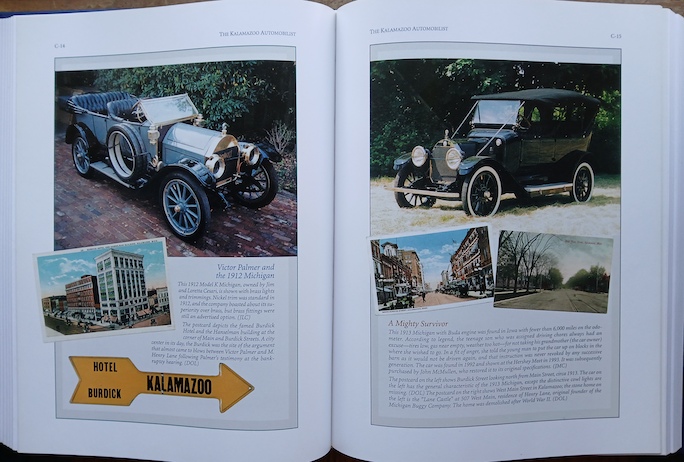
An effective approach and use of the 32-page color insert pairs the photo of a made in Kalamazoo vehicle, in this case Michigan Motor Car-made Michigans, that are part of the Gilmore Car Museum collection with area period postcard images.
Today those who are car-centric think of Kalamazoo, with a population around 75,000, for the nearby sprawling campus of the Gilmore Car Museum and of which the author of this book has written. Others may think of Western Michigan University, one of Michigan’s top public research universities, with its nearly 55,000 undergraduate enrollees engaged in learning on its nearly 1300-acre campus and from which this book’s author is retired after 35 years as faculty member and department chair.
Amongst that alphabet soup of car makers, the Michigan Automobile Company Limited was started by the sons of the “king of washboards” Charles D. and Frank D. Fuller. But soon they grew disenchanted with car-making because in those earliest days no one was supplying parts and/or components and having to make everything from scratch meant higher labor costs which rapidly ate up any potential profits.
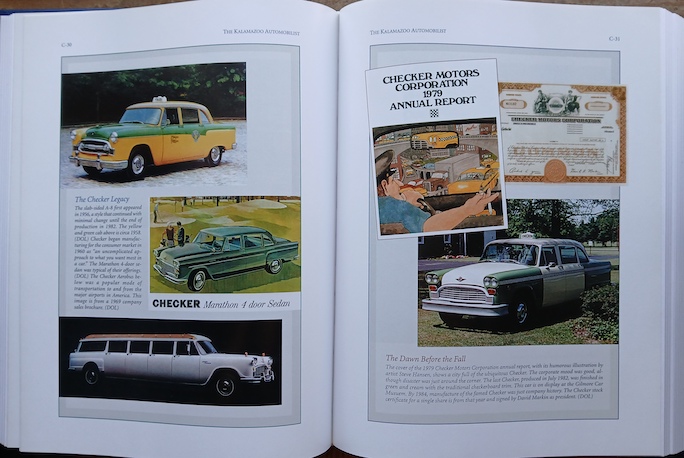
Likely the Kalamazoo-made marque familiar to the greatest number of people is Checker, produced 1923–1982.
Then another company made a car it named Michigan; the Michigan Buggy Company, later renamed the Michigan Motor Car Company. The car it designed and produced was quite fine and desirable but as the Standard Catalog of American Cars 1895–1942 says—in what is a rather large understatement—“its problem was in the front office.” And, oh my, was it ever!
Before it was over, Kalamazoo County would have its first Grand Jury case in forty-two years resulting in guilty verdicts for several and jail time for one. After the dust had settled Michigan Motor Car Company’s building would eventually be sold and “the States Motor Car Company moved in to build its Greyhound light car there” but that all didn’t take place until “almost two and a half years after the manufacture of the last Mighty Michigan.” Lyon relates it in all of its headline making “scandal of the day” detail.
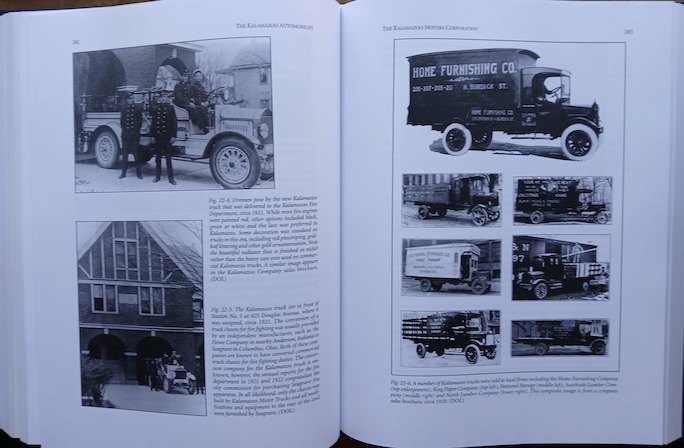
Various-bodied Kalamazoo trucks made by Kalamazoo Motors Corporation 1919–1924.
As if two cars named Michigan, each made by a different company, isn’t sufficiently confusing, the same thing took place with trucks made in Kalamazoo. Each was named, you guessed it, Kalamazoo. Lyon devotes separate chapters to each manufacturer and its product in an effort to sort this all out for his reader with visuals and narrative. Do take note of the concluding 47-page “Summary of Production” appendix for that is most helpful too.
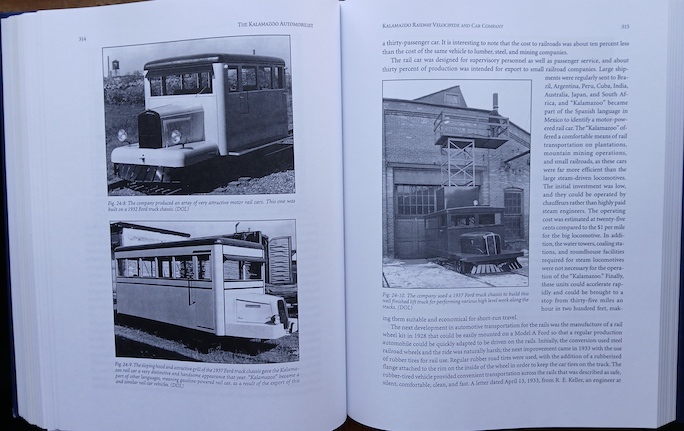
In addition to the cars and trucks made in Kalamazoo were rail-going cars of the Kalamazoo Railway Supply Company. Those shown here utilize Ford-built chassis and engines.
There are chapters devoted to each of the manufacturers and their makes as listed in the opening paragraph. Likely the marque familiar to the greatest number of people is Checker both because of the thousands of vehicles it produced and sold over its nearly 60 year manufacturing lifetime, 1923 to 1982, and its having cars in service as taxicabs just about everywhere. Recounting that history fills the 38 pages of the last full chapter. Anyone not already familiar with the business machinations required to keep the Checkers Cab company alive, these pages make for an eye-opening read. They even involve Errett Lobban Cord.
While Lyon writes in his Preface that “The Kalamazoo Automobilist was written for the people of Kalamazoo” it does, in truth, have a broader interest for it covers specifics not usually included in general automotive histories, mentioned perhaps but not covered in detail. So although out of print, for someone with an insatiable interest in gaining a deeper understanding of life and the development of the automobile 1891 to 1991, you’ll be amply rewarded for making the effort to seek out a copy of this book on the secondary market.
Copyright 2025 Helen V Hutchings (speedreaders.info)







































 Phone / Mail / Email
 RSS Feed
 Facebook
 Twitter