
Skyhookers
An Illustrated History of Hook-on Aircraft and Their Dirigible Motherships
 by William Wolf
“From the First World War until late in the Second, first dirigibles and then large bombers were vulnerable to evolving small, fast, maneuverable interceptors. It was almost essential that during every bombing or scouting mission the long-range dirigible or large bomber was escorted and defended by short-range fighters. However, once the long-range aircraft surpassed the range of the escorting fighter, it was exposed. A solution seemed to be . . .”
This excerpt from the Foreword is admirably concise. It’ll get complicated in no time.
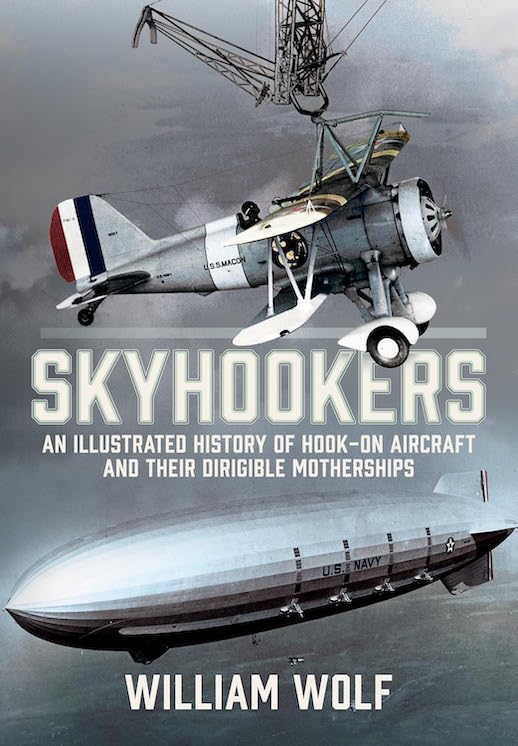
If you’re approaching this topic without any prior knowledge, ask yourself under what circumstances one aircraft (that has its own motor) would ever want to be connected in flight to another. Is this exercise for the benefit of the one being carried (aka the parasite) or the carrier (aka the mothership)? Presumably, the “carrying” is a temporary state which means the two (or more?) flying bodies have to be able to disconnect from each other, in flight, maybe also reconnect later, again in flight. It implies that the two flying bodies have different flight characteristics and operational capabilities, each doing something the other cannot. What? Why? How? Let that cover photo sink in for a moment.
There are answers in this book. But it helps to think of such questions before you pick it up—because then you’ll be primed to look for specific answers, which will then make you aware that this book does not make it easy to find any. Or understand them.
It looks self-explanatory for about a minute and then the head-scratching begins.
Partly, that’s because an author who has dozens of aviation books under his belt is deeply immersed in matters that a lay audience is only encountering for the first time, which more often than not results in a certain disconnect. Occupational hazard. This is where an editor earns his keep. If there is one. Long story short: this is an interesting and under-served topic but the way it is presented here will “hook” neither the lay reader nor the expert because it contains or presumes too much for one audience and too little for the other. Still, a necessary book!
Let’s establish first of all that Wolf, a dentist who retired early in order to devote himself to aviation research, accumulated one of the largest private archives on WWII aviation history. In other words, no shortage of primary sources from which to piece this story together. His tens of thousands of books, photos, and microfilms have meanwhile (2023) been acquired by the National Museum of World War II Aviation.
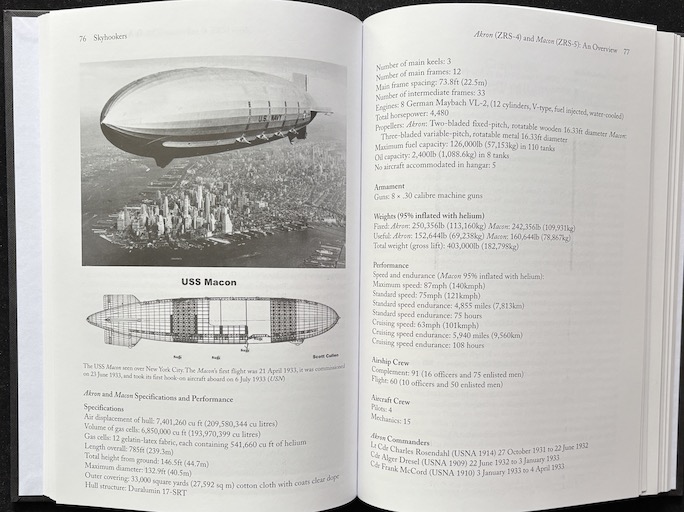
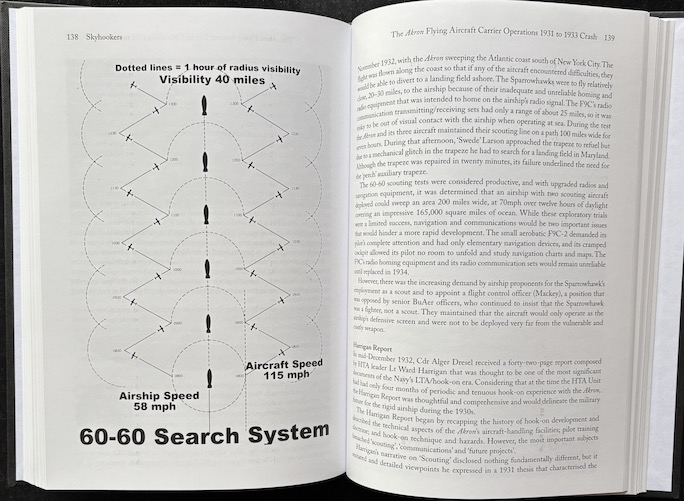
An example of the specs provided.
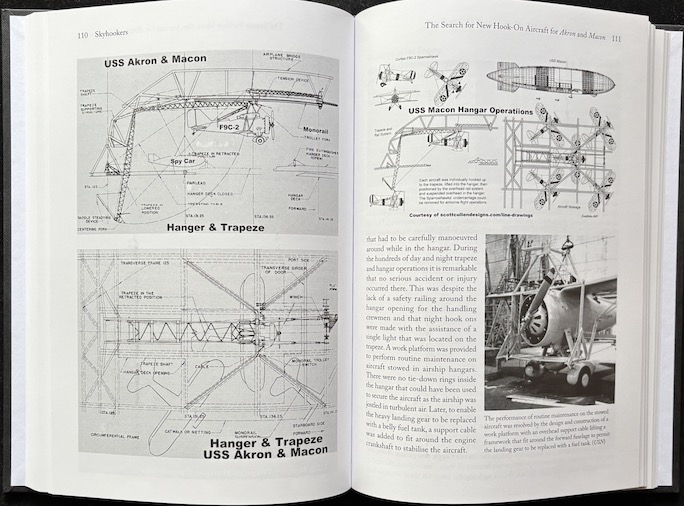
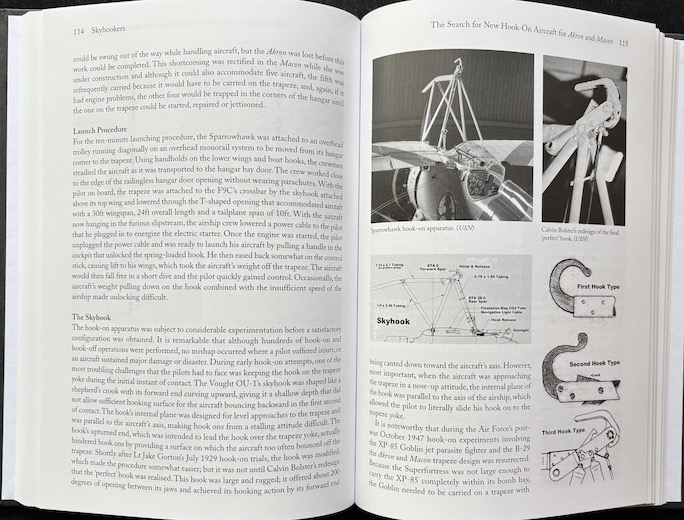
The book is divided into three principal topics, the focus in each case being on airship/aircraft composites: pioneering efforts, British projects, American projects. The book has all the building blocks the studious reader requires: index, bibliography, tables, specs. There are plenty of photos and some drawings but many of the former are generic images of apparatus in flight, and most often in the separated condition, with too few images of what release and retrieval actually looked like. True, this is an unrealistic expectation to have because who would have been in a position to photograph such things? It does mean that the technical drawings (or in some cases annotated photos) carry the burden of making clear that which the text struggles to describe in words—the precise operating principles and aerodynamic parameters. Again, just look at the cover photo, or the several pages we reproduce here to appreciate what an unusual scenario skyhooking represents. On the upside, the illustrations are not bundled into stand-alone sections in the book but placed near the body copy they go with.
The story concludes in 1935, with the PBY Catalina flying boat ending “the [U.S.] Navy’s golden age of flying airship aircraft carriers.” Is that the end of skyhooking? Assignment: research satellite-tether space launch systems, or an altogether different approach of connecting one thing to another (in an aviation context), the Fulton STARS.
Copyright 2026, Sabu Advani (speedreaders.info).













































 Phone / Mail / Email
 RSS Feed
 Facebook
 Twitter