
Getting into Racing, A Beginner’s Guide to Circuit Racing
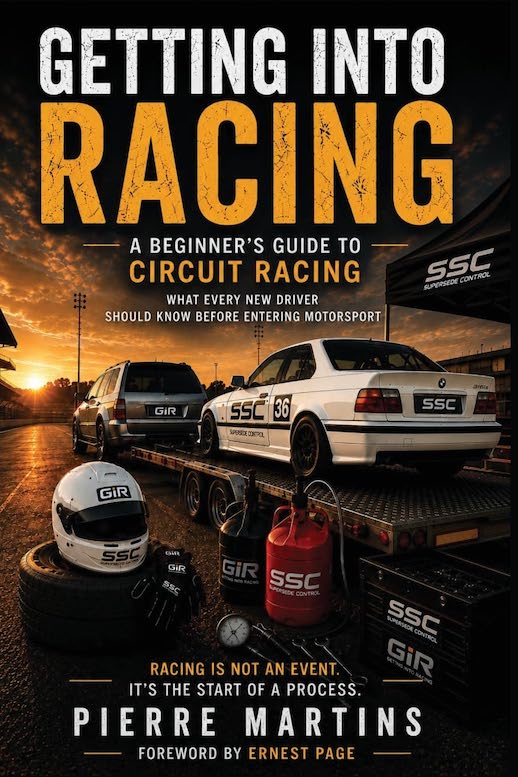 by Pierre Martins
Taking up motor racing can often be an emotional impulse rather than a decision. The word “decision” carries connotations of consideration, options, and rationality. Although these should precede a move into the sport, I suspect that most of us simply had a dream, and before we knew it, we had a car and a shiny new race helmet. As the author states, this book wasn’t written to discourage dreams. What it does is reveal the options and the practicalities. It provides food for thought and consideration that will help newcomers to the sport make sensible choices. It could well save you from an expensive mistake.
As Martins states at the end of the book: “Getting into Racing was written to help newcomers understand the realities of motorsport before committing significant money and energy to the sport.”
Pierre Martins is the South African racer, test driver, performance evaluator, coach and instructor who wrote the recently reviewed Supersede Control. As the subtitle informs us, this is a beginner’s guide to circuit racing. It’s a hefty tome of some 395 pages. But as with his previous book, it is easy to read and reference, with wide spacing between sentences and large print, making it easy to absorb the book’s message and ideas.
The book’s primary audience is people contemplating entering motorsport, and I, having been around the track more than few times, found many practical ideas and tips that will be helpful to amateurs already competing.
The book comprises six parts, with a total of 25 chapters. Parts 1 and 2 cover some of the practicalities of costs, time, risks and fitness. Part 3 lays out the various types of events, categories, and track car options.
I found the chapter “Electric Cars & the Future” particularly interesting, revealing the different challenges involved in driving an EV quickly: managing the battery and energy consumption, dealing with the weight, and monitoring battery temperatures. And, questions like: If you intend to drive your EV at a track day, will there be charging infrastructure at the track?
The later sections include: people and relationships, the buy or build question, safety equipment and the mental approach to competition. There’s advice about using your everyday car for track work. There are tips for those who plan to buy a racing car, plus tips around purchasing safety equipment and budgeting for your season.
There was the risk that this could have been very dry reading, but the author has avoided that by interweaving stories of his personal experiences and those of other amateur drivers. As he has raced motorbikes, karts and track cars, he has a wealth of experience and knowledge. He has made mistakes and has seen others make mistakes, and he shares these so that his readers can avoid repeating them.
This book is full of practical, down-to-earth advice. For example, we’ve all been tempted to throw money and time at car upgrades while chasing faster times. Martins doesn’t beat around the bush: “Sometimes the best upgrade is inside the driver’s head. Track time remains one of the best investments you can make.”
As he did in his previous book, the author has provided clear paragraph headings and concise summaries at the end of each section. Black-and-white photos and sketches complement the text. Spending $35 on Getting into Racing will be a sound investment. It could save you many, many times that amount.
The book is printed on demand by INGRAMSPARK in the country of order.
Copyright 2026 Peter Hill (speedreaders.info)























 Phone / Mail / Email
 RSS Feed
 Facebook
 Twitter