
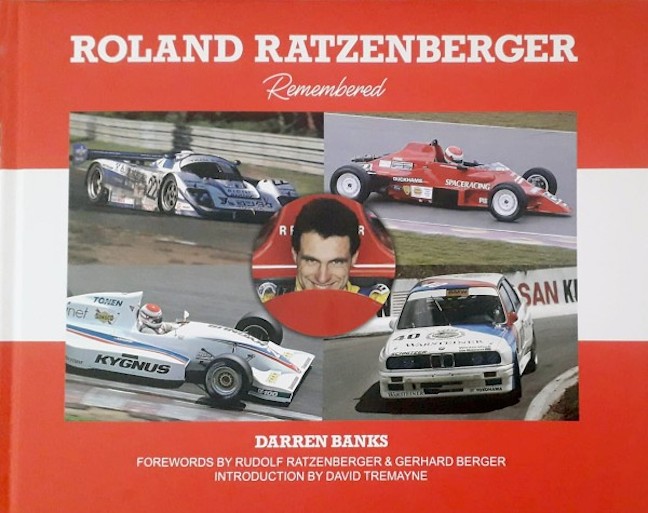
Roland Ratzenberger Remembered
by Darren Banks
“Although some dates and memories have faded over the past thirty years, I remember one notable thing Roland once said to me. He was convinced he would end his days in a racing car. Very sadly he was right.”
—Thomas Danielsson, F3 rival and Japanese Group A teammate
On 1 May every year, the same well-meaning sentiments appear on motorsport forum posts commemorating the anniversary of three-time world champion Ayrton Senna’s death—“Don’t forget Roland!”
There is no risk of our ever forgetting the death of Roland Ratzenberger at Imola, not in spite of Senna’s death but becauseof it. The 1994 San Marino Grand Prix wasn’t motorsport’s blackest day, because the carnage of Le Mans 1955 and Monza 1961 (inter alia) far eclipsed it in the number of fatalities. But for many of those watching the Imola race on TV, it was a traumatic reminder of how dangerous motorsport was. Older viewers already knew how no driver was exempt from the risks, especially if they’d lived through the cruel spring and early summer of 1968. In successive months Jim Clark, Mike Spence, Ludovico Scarfiotti, and Jo Schlesser were killed. In Clark’s case especially, many had felt that, like Senna, he was almost immortal.
But by 1994 deaths in Grands Prix were rare. Riccardo Paletti had been killed 12 years earlier at the start of the Canadian Grand Prix, and Elio De Angelis had lost his life in a testing accident at Paul Ricard in 1986. But poor Paletti (like Ratzenberger) was almost unknown to the F1 audience and De Angelis, although a Grand Prix winner, wasn’t killed on live TV. But the impact of Imola 1994 was seismic, resulting in immediate changes to the specification of F1 cars and an enduring and ongoing focus on driver safety. Its legacy can be seen in a host of measures, including fast and well-equipped safety cars* and in the F1 car halo (titanium safety structure) which saved Romain Grosjean’s life in 2020.
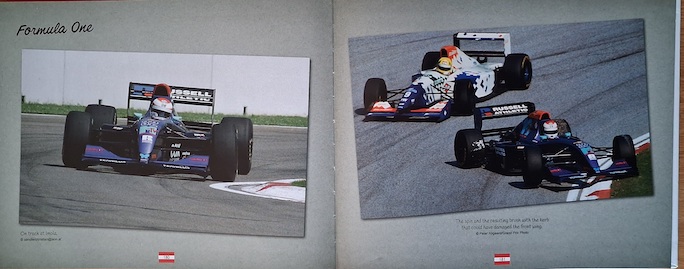
F1 in Simtek at Imola.
Forgive the lengthy preamble, but it’s important to understand the full context of this book’s creation. And it is to the credit of two contributors, David Brabham and Mathias Brunner, that they also address the key reason why Ratzenberger’s memory is kept alive. As his Simtek teammate Brabham bluntly puts it, “With Roland and Senna dying on the same weekend, it has kept Roland’s memory alive more than if it had just been Roland. Otherwise, people would have moved on and forgotten about him by now. Roland’s memory keeps ahead of a lot of drivers who don’t get talked about because of the Senna connection.” This might sound harsh, but he’s right. With that qualification, does the book do justice to the memory of the Austrian driver?
The answer is a definite yes. The book follows the model publisher BHP used for Tom Pryce – Memories of a Welsh F1 Star by Those Who Knew Him which we reviewed in 2021. There is no central narrative, because this isn’t a biography but an anthology of memories from those who knew Roland Ratzenberger. It’s no bad thing that the passage of over thirty years has given the words of so many an elegiac tone. But even when Roland was alive, few people would have had a bad word to say about him. I’m also delighted that relatively little space is devoted to Roland’s Formula One career. It’s almost parenthetic, not just because of its short duration, but because the Ratzenberger story was about so much more than life as a Grand Prix also-ran.
There are about 80 contributions to this book from those who knew Ratzenberger. The fact that they are in no discernible order just adds to the pleasure of connecting dots.
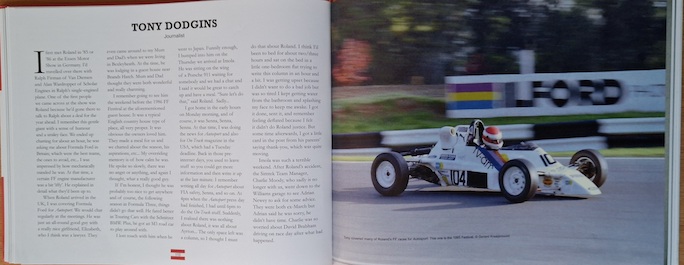
Formula Ford Festival, Brands Hatch.
The landscape-format book is a relatively short 182 pages but it succeeds in painting the picture of a short life, well lived. There’s a diversity of contributors including fellow F1 drivers such as Heinz-Harald Frentzen, David Brabham, and Johnny Herbert. But I found the memories of the lesser-known figures, who had punctuated Roland’s career from club racer to F1 driver, offered better insight. Unlike some of his peers, the young Austrian did not have a meteoric rise from junior single-seaters to Formula One. It hardly helped that his family had no interest in motorsport, and their modest lifestyle prevented Roland being the beneficiary of any financial largesse. But in the 80s the first rungs on the single-seater ladder were still relatively affordable, certainly compared to today. Would Lando Norris or Ollie Bearman even have touched the hem of Formula One without the rich parents who were able to support their careers? Running a season of UK Formula 4, probably the closest thing in 2026 to a junior formula, costs about $500,000. But Formula Ford 1600s were widely available for very modest amounts in the 1970s and 80s, and FF1600 racing, especially in the UK, was the most common starting point for a whole cohort of F1 drivers, including Senna, Mansell, Button, and Fittipaldi. The showpiece event, then and now, is the Formula Ford Festival at Brands Hatch (and I’m writing these words the day before the 2026 Festival). Roland Ratzenberger famously won the 1986 Festival and entered the consciousness of many British racing fans. It also helped that Roland Rat was then a popular figure on British daytime TV (I know, the past is another country) and the book evidences how Roland the driver was able to exploit Roland the rodent puppet for publicity purposes—and vice versa.
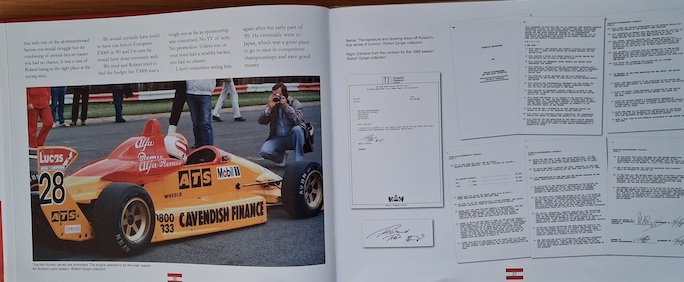
Formula 3 in 1988. Note the contract with Madgwick Motorsport, a mere 6 pages.
The Festival victory helped propel Roland to higher formulae and, after an unsatisfactory stint in UK Formula 3, he followed the well-trodden racers’ path to competing in Japan. This was not only lucrative, but it also endowed him with valuable experience in racing higher-powered race cars in Group C and Formula 3000. Like a number of other drivers, it appears that the greater the power available, the more it gave an opportunity for Roland to shine. There are some lovely anecdotes by members of the Japanese racing community, relating to Roland’s adventures both on and off the track.
It was still a big leap to Formula One, even with the kickstart from the big money that a European driver could earn in Japan in the early 90s. But Roland also had a secret weapon, and her name was Barbara Behlau. She was a Monaco-based sports manager who was also a personal sponsor of Roland’s Simtek. Sadly, Ms. BehIau died in 2006 but how I’d like to have heard her reaction to this eyebrow-raising gem from Mika Salo: “Roland had to bring some money for the drive and told me he knew where he could get some but had to … I’m not sure I should say what he had to do to get the money, but he got money from Barbara … When I saw him in the Simtek jacket I was laughing like hell, I knew he had done the deed. The things you do. It’s 100% true.”
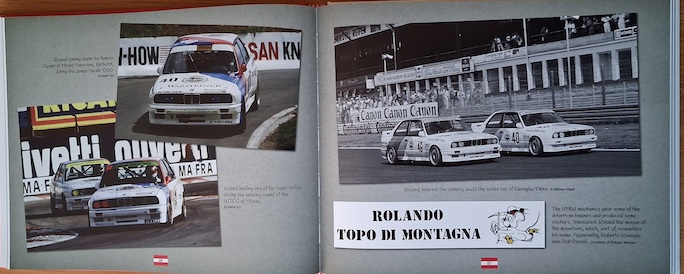
Touring cars – BMW M3.
While this is the most startling revelation in the book there’s so much more to enjoy, and the excellently chosen photographs complement the prose. The pictures showing the early episodes in Roland’s career have an endearingly naive charm, back when he was just another broke young driver trying to make the big time. The picture this book paints is of an impecunious, hard-working and charming man, who rarely lacked female company, and was universally liked by his peers. How good was he? He had enough talent not to disgrace himself in Formula One but the consensus seems to be that Grand Prix racing would not have become his natural environment. Let’s leave the last words to journalist/friend Gerhard Kuntschick: “I don’t see him progressing to a top team and winning Grands Prix. He would have been a very good midfield driver and stayed in Formula One for two/three years. With his technical ability, he would have been sought after as a test driver … Maybe he would have had the role Alex Wurz had years later … Alex was never the team principal but he was the mastermind behind Toyota Gazoo Racing and coached the drivers.” And that would have been no disgrace, right?
- *the safety car at Imola was an underpowered Opel Vectra
Copyright John Aston, 2026 (speedreaders.info)





 Phone / Mail / Email
 RSS Feed
 Facebook
 Twitter