
Robert and John Pitcairn: Titans of Rail, Oil and Glass
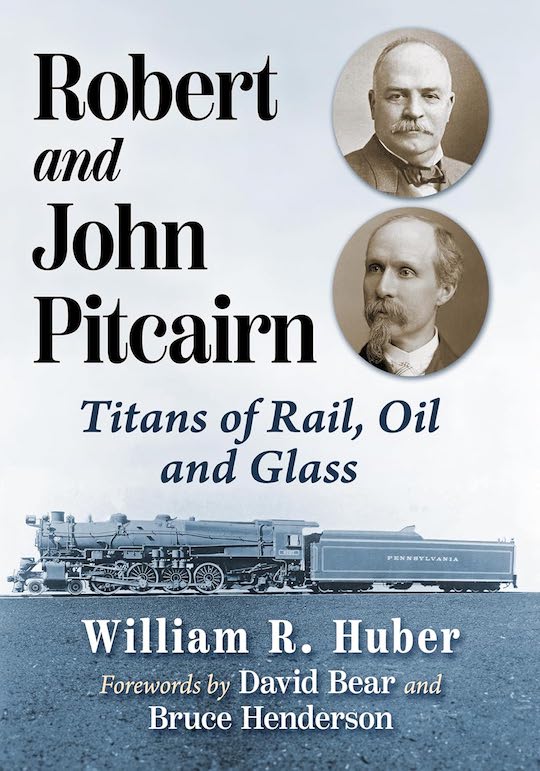 by William R. Huber
The beginning chapters introduce us to men of Scottish origins, the Pitcairn brothers and their good friends, brothers Andy (as letters reproduced later in the book prove he was called by them and himself) and Thomas Carnegie. What is so striking is their humble—near poverty—origins paired with incredible work ethics from a very young age. How does such come about? Simply, it is often that if you wanted to be clothed and have food on the table, you worked for it and from a very young age. Contrast that to young people of these times who, unless born into a family that earns its living as a family unit, rarely are active participants contributing to the family unit’s welfare much less its monetary well being.
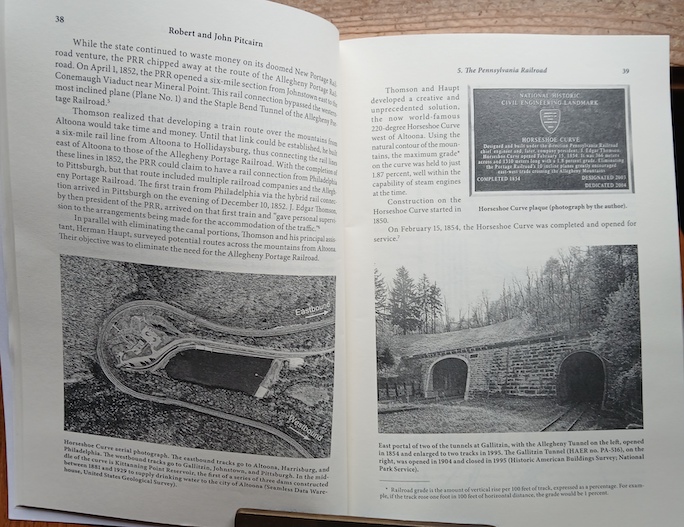
It had yet to be renamed Pennsylvania Railroad when it employed 17-year-old Andrew Carnegie followed by another 17-year-old, his friend Robert Pitcairn and opened a section from Johnstown eventually continuing to Philadelphia. Facing page, commemorative plaque explaining by “using the natural contour of the mountains, the maximum grade on the (220-degree Horseshoe) curve was held to just 1.87 percent.” Although railroads have changed markedly over the decades, this Horseshoe Curve “remains the indispensable east-west link for freight and passenger rail traffic” to this day.
This is Bill Huber’s fourth book, all published by McFarland. While a reader does learn about the lives of the brothers named in the title, the book is filled with more wide-ranging history that ultimately does tie back to the Pitcairn brothers and extended family. I confess though that it did make this commentator think a more fitting title might have been The Lives and Times of Robert and John Pitcairn.
All of Huber’s books provide historical background-lending context that enlarges the story told in his biographies of George Westinghouse, Adolf Sutro, and Charles Schwab. With this one it feels as though he’s taken an even deeper dive into writing historical background and/or aftermath of events. In the words of the writer of one of the book’s two Forewords, Huber “identifies and follows seemingly disparate threads, then combines them into unique and insightful narratives. He writes with the perspective of a trained engineer, the attention to detail of an investigative reporter, and the sense of wonder of a naturally curious storyteller.”
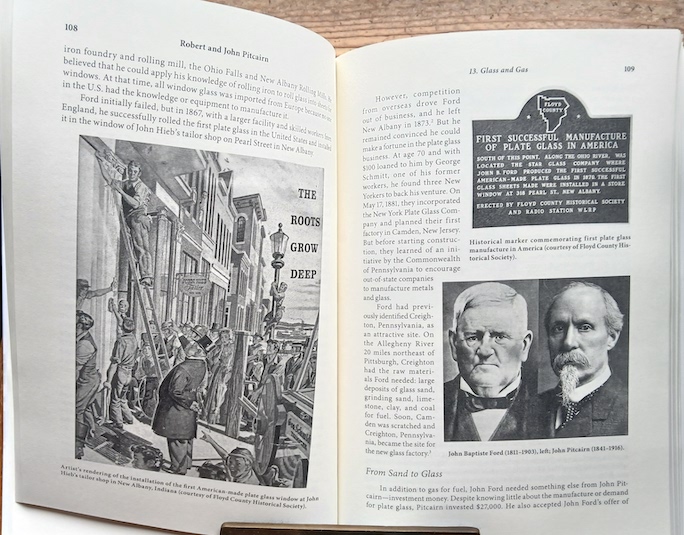
Plaque and a drawing commemorating first-ever installation of a plate glass shop window created by glass maker John Ford (1811–1903 on left) with monetary support from his investor John Pitcairn (1841–1916).
Because faith was so important to both Robert and John there are 20 pages or so explaining “the teaching of Emanuel Swedenborg, a Swedish scientist, philosopher, theologian, and true polymath” including how Swedenborg’s “New Church” doctrine differed from Evangelical Christianity and how that branch of believing developed and morphed once established in America. Both Robert and John were raised in that New Church faith and John remained true and devoted to it his entire life while Robert and his neighbors “attended a Sunday school that had been established” and met in members’ homes. As their numbers increased, they opted to “erect a building for Presbyterian worship.”
Woven into and between these histories and others are the stories of the Pitcairn brothers and the industries and companies they developed and worked at or for while not losing track of their good friends and equally accomplished titans, the Carnegie brothers. Two chapters (20 pages) are devoted to explaining the origins of the labor movement in America as a resultant of the Great Railroad Strike of 1877 which took place while “Robert Pitcairn was superintendent of the Pittsburgh Division of the Pennsylvania Railroad . . . and played a prominent role in every aspect.”
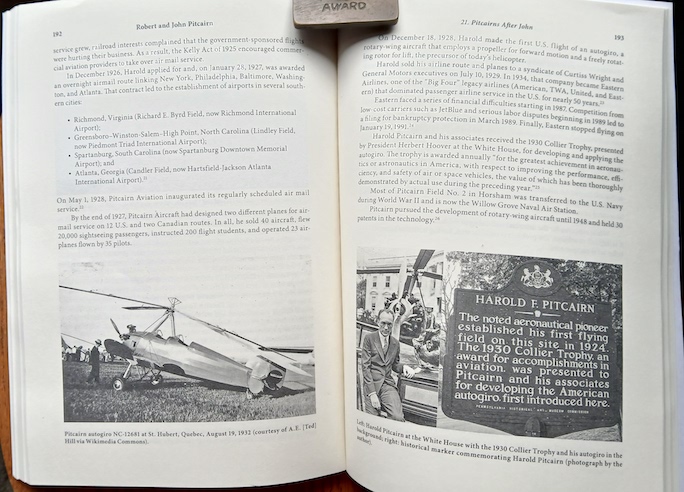
Commemorative plaque to aviation pioneer Harold Pitcairn, John and Gertrude Pitcairn’s youngest son (1897–1960) with, on facing page, the autogiro he developed and built—significant as it was the first rotary wing aircraft. That acorn didn’t fall very far from the tree but did choose a very different field of endeavor!
Two chapters (27 pages) explain embankment dam construction in order for the reader to understand the underlying cause of the May 1889 Johnstown Flood which also involved Robert Pitcairn, Andrew and Thomas Carnegie, Andrew Mellon and others who were subscribing members of the private club that by then owned the dam. In another place Huber explores how families handle inherited wealth over ensuing generations from both statistical and mathematical perspectives. Unsurprisingly some approaches are more successful than others.
The appendices add still more. The first is four pages of family trees that Huber constructed individually; one each for Robert, John Jr and Gertrude, another for the descendants of John and Gertrude and another for Robert and John’s brother Hugh. The second appendix is quite special as it describes a visit Bill and Angie Huber made to Bryn Athyn, the community the Pitcairn’s commissioned Olmsted, Olmsted & Elliot to design and developed for them. It is where the Pitcairn’s homes—mansions in truth—are all located; Cairnwood with its garden, carriage, and green houses, Cairncrest, the Glencairn Museum, and others. Bill and Angie’s visit culminated with attending a recital performance by Pitcairn descendant Elizabeth Pitcairn playing her Stradivarius (and by that you should easily perceive her level of musicianship). She was accompanied by pianist Dr. Louise Thomas and cellist Gjilberta Lucaj and they performed “selections from Beethoven, Elgar, Saint-Saëns, Gershwin, and Mendelssohn.”
Expand your knowledge and awareness. Choose any one of—or all—of the William R. Huber-authored biographies. You’ll not be disappointed.
Copyright 2025 Helen V Hutchings (speedreaders.info)
 RSS Feed - Comments















































 Phone / Mail / Email
 RSS Feed
 Facebook
 Twitter