
Lancia Stratos Zero: The Eternal Futurist
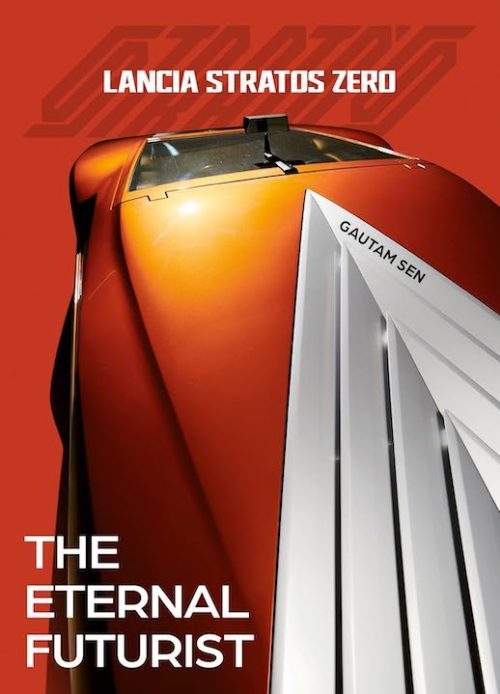 by Gautam Sen
“And that was when Gandini spoke up,” recounted Panicco. “You know, he said very little, he hardly spoke. But then he said, ‘Why don’t we make a mid-engine Lancia?’ And we were all looking at him, and saying, how can we make a mid-engine Lancia? ‘Well, we take a coupé, and we make a mid-engine car,’ said Gandini. Then Gandini added, ‘we have made the Miura, the Marzal, the Carabo and now we’re working on the Urraco and the Fiat X1/9. We are the only ones in the world to have done so many mid-engine cars, so why not a mid-engine Lancia?’”
Seems straightforward enough. The plot thickens a few sentences later where we learn that Bertone expected Lancia to have no interest in this and in fact actively oppose it—so Bertone simply showed up with the Stratos at the auto show without saying a word to Lancia. Drama. But we must interrupt this thought to first establish the one thing a reader of this review will be itching to know asap: this is a good book, it is the only one on this subject of any depth; moreover, you could not hope to assemble this rich a picture from other published, scattered sources because author Gautam Sen does have special access and connections. You could stop reading now and place your order. Or . . .
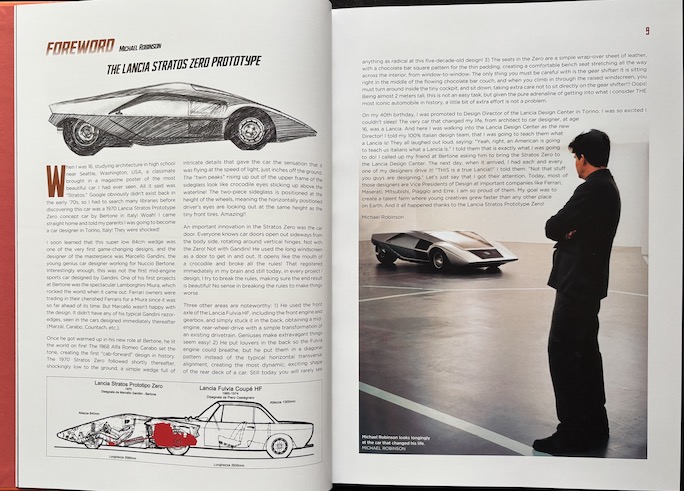
The book says in several places that the Stratos had an influence like no other concept car. The Foreword by Michael Vernon Robinson who once held the position of Design Director at Fiat and Lancia makes that abstract thought concrete.
To resume: it will take another 50 pages to learn that the parties did eventually meet (“a scene right out of a movie”) which is an important point of history because it will eventually lead to “the king of rally cars,” the Lancia Stratos HF Rally. The text helpfully tells us this will happen in chapter 13. Well, it would be helpful if we knew what chapter we are currently reading! Alas there are no chapter numbers, not in the Table of Contents, not in the running heads.
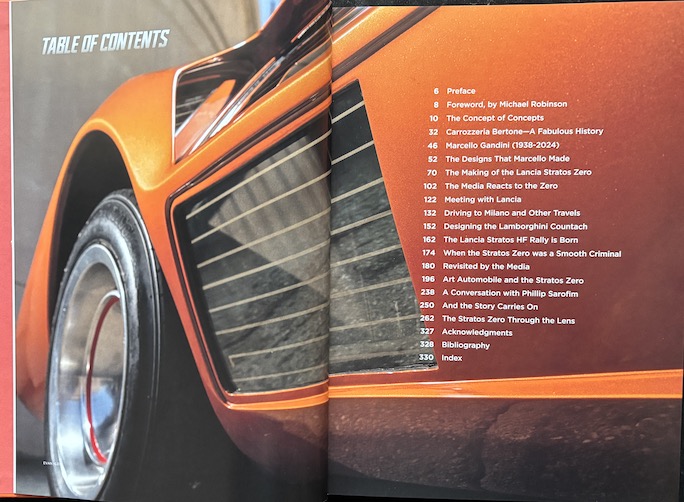
Worse, if you return to the entries on the TOC, you will find the HF will be covered in what would be the 10th chapter not the 13th. While the book does have an Index, nicely divided into categories, it would not help you piece this storyline together or reconstruct it later: you have to read the book consecutively and actively remember things (or take notes) and be on alert when/if a thread gets picked up again later on. It ain’t easy to work with this book! Moreover, even if you trust that the author will connect the dots in his own time, you have to realize that there will remain some issues that simply do not get wholly exhausted; while minor, at least in the present, that lack of clarity will bog down readers in the more distant future. Two examples: the full story behind Bertone parting with the car after keeping it for decades, and the bigger story behind the person who bought it and his connection to the next owner.
So, a quick sidebar: picture this—there’s a kid whose soul is stirred by a dream car. Now picture this: the kid does well in life and acquires the means to indulge his passions. And now picture this: the dream car comes up for sale, unexpectedly and for the first time ever. You can guess how this plays out. But there’s more. Another kid, some years younger, has the same dream and also a successful life path—and then the one kid ends up passing the baton to the other!
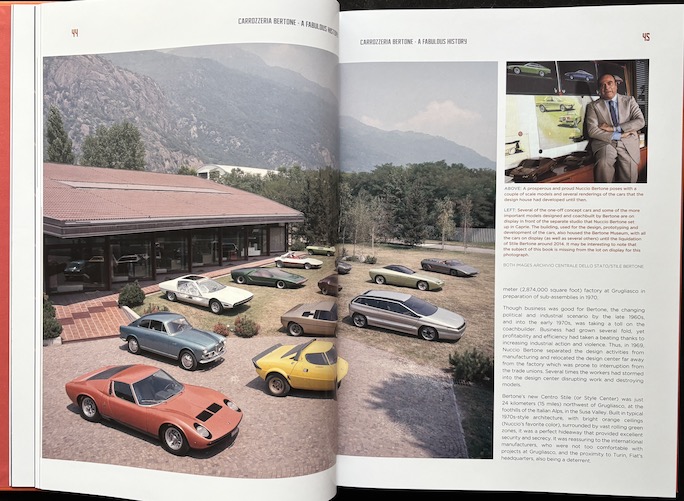
The Bertone Museum is where the Stratos (not included in this photo) lived for decades before circumstances forced its sale in 2011 along with five other museum cars. That auction is where Dr. Thomas Mao jumped at the opportunity to buy not just a dream car but “his” dream car. Why it sold significantly below its auction estimate is not discussed. The current owner (b. 1986) also followed that auction but did not then have the means to bid but instead asked to be put in touch with Mao to convey his interest if ever it were to come to market again. What the book doesn’t say is that both lived in the Los Angeles area and so had opportunity to cross paths.
You can’t make this stuff up! But, in the book, these storylines have not been fully run down in a way that obviates the need for further digging. One single page of text could have accomplished this. [1] And it matters because if it weren’t for people like those two, cars like the Stratos would only exist in the pages of books and not in the real world where people can see and hear and maybe even touch them.
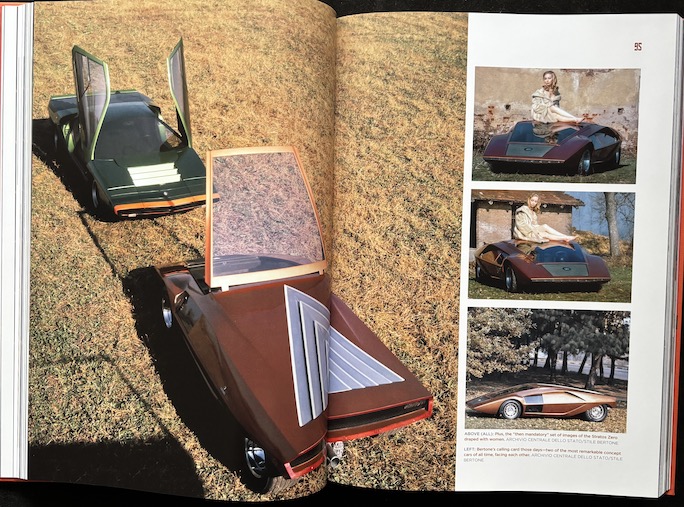
Using the woman sitting on the car for scale it’s hard to visualize current owner Phillip Sarofim (who is of average height) praising the Stratos for its ease of ingress—hoisting yourself out of the recumbent seats is a different matter—and the “incredible storage area behind the hinged seats” that accommodates a “spare tire plus two proper weekend bags.” If you don’t recognize the green car top left you need more books. Actually, this one says quite a bit about other concept cars.
This book is intended as a tribute to both the car and to its designer, Marcello Gandini. That it should have been written by Sen is no surprise at all, not only because to him the Stratos is a car that changed his life but because he has circled the topic of car design and especially Gandini design in numerous books. If anything is surprising it is that no other writer has beaten him to the punch because a book about such a singular car would so obviously be filling a hole in the literature and practically sell itself.
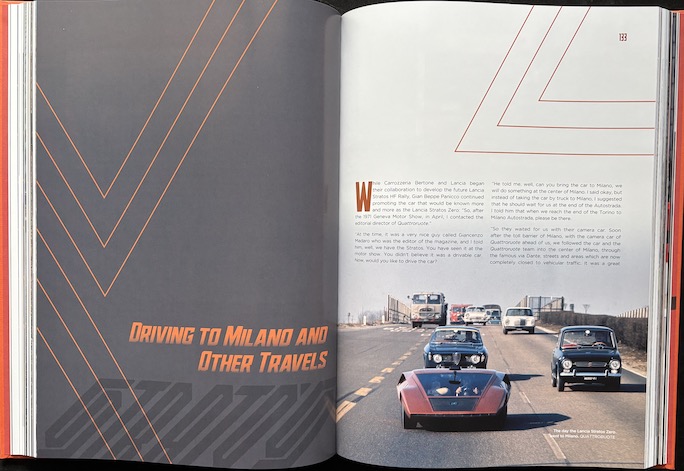
If you’re reading this book at a desk it’s probably the standard height of 29 or 30”. The Stratos is 33” at its highest point.
The first dot in Sen’s telling is to explore what a concept car is and does, in a chapter (which would be Ch 1 if it had a number . . .) cleverly titled “The Concept of Concepts.” Then coachbuilder Bertone is discussed, then Gandini and his oeuvre, which sets the scene for exploring the thinking behind the Stratos. The caveats above notwithstanding, this book will hit all the necessary notes and so fulfill any book’s primary objective: advance the body of knowledge.
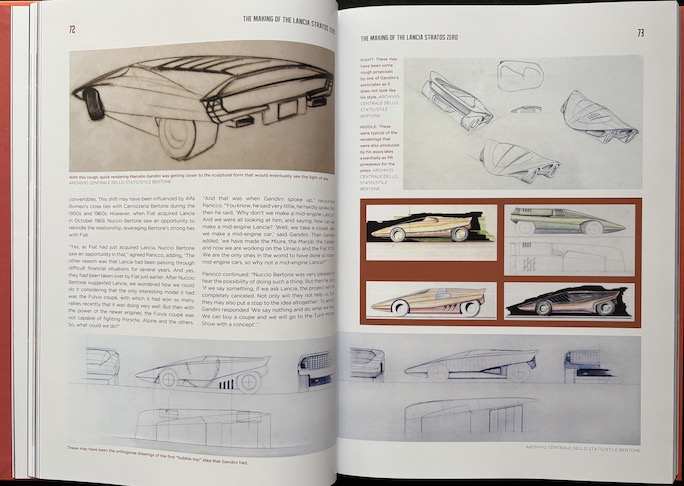
Would you believe, there exists a car even lower than the 34″ Stratos? That’d be the 29″ Probe 15 made by the Adams brothers in Britain.
- A good example for why it matters that a book record the fullest possible story: A Stratos Zero once appeared in a music video. Not “the” Stratos Zero but “a” Stratos Zero. Forty years later, all sorts of nonsense sprout on the Interweb because no one who doesn’t try very hard can piece together what really happened before the trail went cold. This book devotes several pages to this, and sorts it all out. QED. Also, for the doubters, the fact that Sen allocates space to even such a minor matter establishes that he doesn’t “overlook” anything but, rather, that he must have a reason when something isn’t fully dissected.
Copyright 2026, Sabu Advani (speedreaders.info).
 RSS Feed - Comments










 Phone / Mail / Email
 RSS Feed
 Facebook
 Twitter