
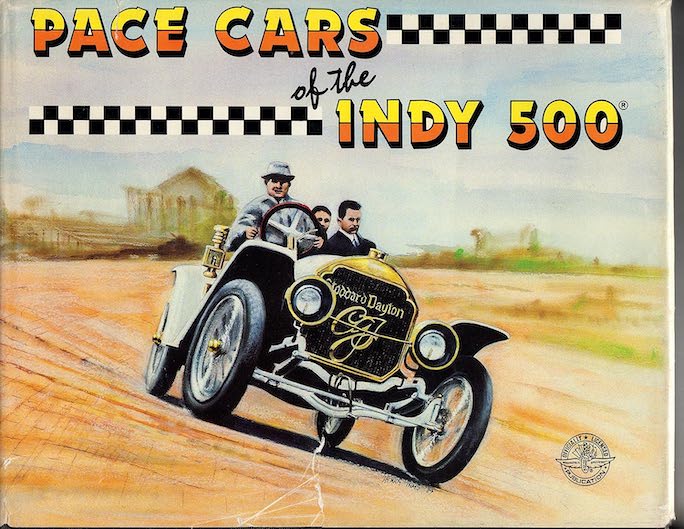
Pace Cars of the Indy 500
by L. Spencer Riggs
“The original term for pace car was pacemaker or pacesetter. The more modern ‘pace car,’ although used as slang for years, came into official usage in 1965. . . . The pacemaker came into being in order that anxious drivers might have their speed held in check at a uniform pace. . . . The pacemaker kept down the squabbling, accidents and promoted safety on the course.”
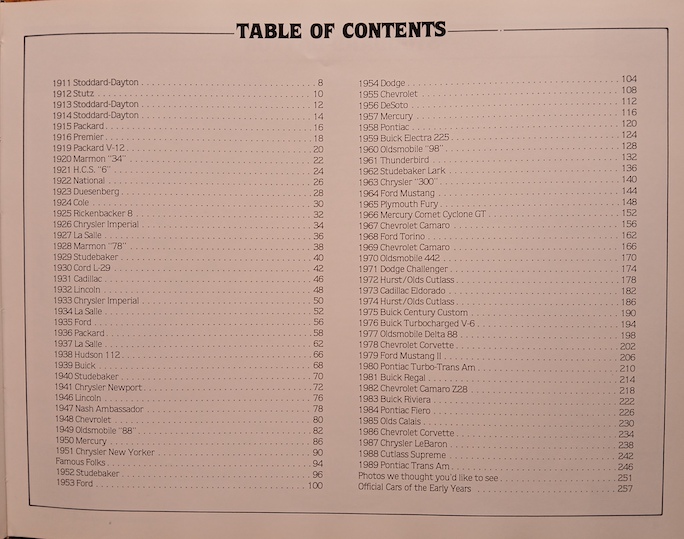
Prior to John Aston recently telling you about Rick Shaffer’s It’s… A… New Track Record! there have been only two really reliable Indy 500 references. One is The Indianapolis 500 Chronicle. This book is the other one. As is true of Chronicle, even with the publication of Shaffer’s book, this one remains a seminal Indy 500 reference in that Shaffer’s book covers just the single 1962–1972 decade while, as you can see from this book’s Table of Contents (below), it presents all pace cars 1911 through 1989.
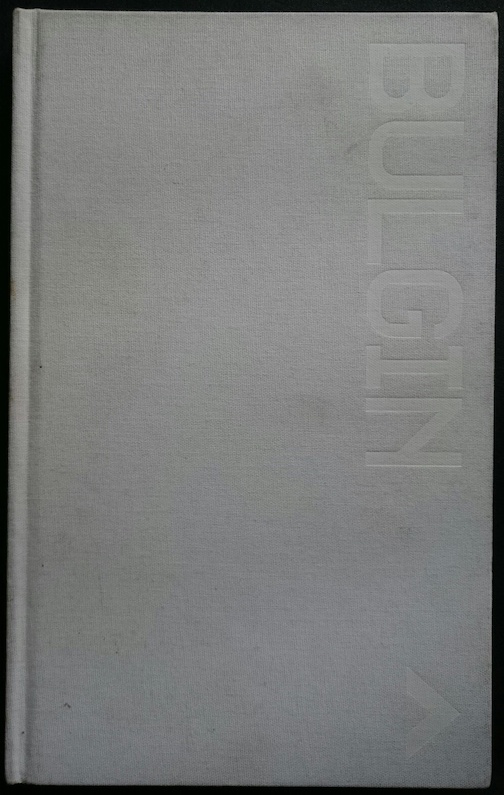
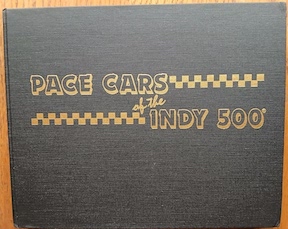 Thanks to the internet-provided aftermarket, copies can still be found. But, should the copy you finally settle on be sans its dust jacket, here’s a look at what the cover of the book—handsome in its own right—looks like.
As its title suggests, this is a very focused book featuring each year’s 500-mile race pace car from the first in 1911 to a year prior to the book’s publication date. For each pace car there are at least two facing pages; words on the left and a good full-page, photo of the car on the right.
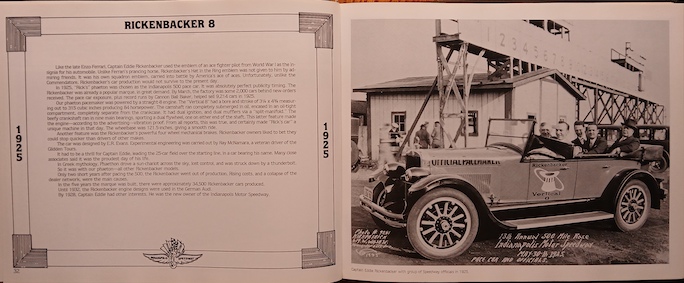
No surprise, there were fewer available images for the early years of 500s. Then too, many of those earlier pace cars also were from makers that wouldn’t long remain in business such as the one shown for 1925. “Only two short years after pacing the 500, the Rickenbacker went out of production. Rising costs, and a collapse of the dealer network, were the main causes.” Three years later Captain Eddie “was the new owner of the Indianapolis Motor Speedway.”
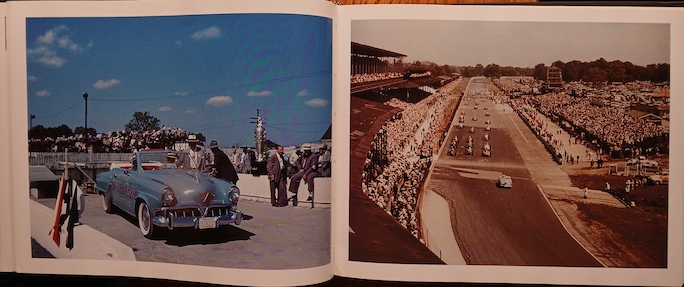
 Several of the 1930s years featured more pages than just two as well enabling more to be shown than just the portrait of the pace car. By the beginning of the 1950s color photos start to make their appearance too as seen in this next page pair from 1952 when Studebaker paced the race with its Raymond Loewy-designed Commander. “It was the firm’s centennial year as a producer of vehicles and the golden anniversary of the automotive divisions.”
Random trivia: Parsons is the first driver to have his name misspelled on the Borg-Warner Trophy.
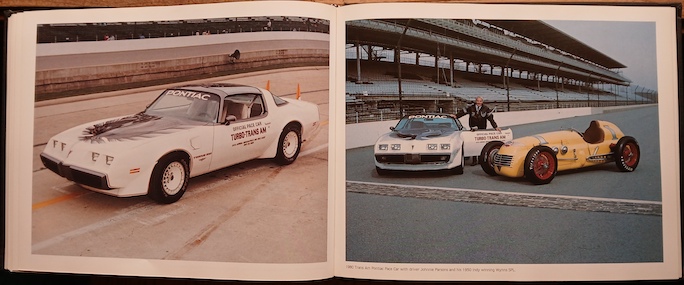
As the number of available photos for any given year became still more numerous it became possible to show more photos of race day atmosphere and faces of those familiar to many who were in attendance. The page pair above from 1980 features racing great Johnnie Parsons with the pace Pontiac Turbo Trans Am alongside the car in which he had won 30 years earlier, the Wynn’s Friction Proofing Special. Quite a contrast between his two rides!
This is the book to have to see and read about 73 Indy 500 pace cars with three bonus chapters offering photos of some “Famous Folks” whose images are captioned so you won’t be guessing in case you don’t recognize a face, “Photos we thought you’d like to see” also captioned so no guessing here either, and “Official Cars of the Early Years” likewise all nicely identified.
Copyright 2026 Helen V Hutchings (speedreaders.info)
 RSS Feed - Comments







 Phone / Mail / Email
 RSS Feed
 Facebook
 Twitter