
Hero Found: The Greatest POW Escape of the Vietnam War
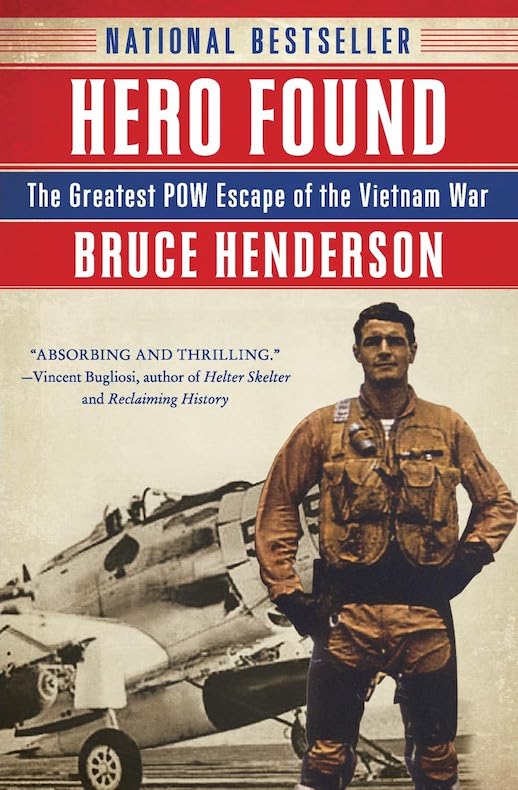 by Bruce Henderson
“Dieter Dengler had no business surviving his ordeal as a POW . . . The death-defying experience shaped his later life. Although it was not the kind of thing he ruminated about, the proof is there: those who knew Dieter agree that no one stuffed as much living into every hour of every day as he did. ‘One thought is with me always,’ he often said. ‘That I am alive and a free man.’“
Those of you reading this who are familiar with the writings and books of Simon Winchester know that virtually everything he pens is—well, pick your own favorite superlative for all aptly apply. Thus for Winchester to write that the author of this book, Bruce Henderson’s writing is so riveting that he “didn’t even stop for coffee during my reading: it was so classically unputdownable” is notable indeed. Your reviewer had the same experience reading far, far, far into the night.
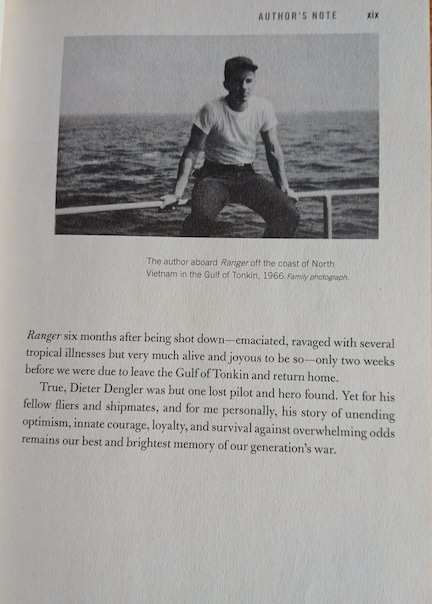
Author Bruce Henderson in 1966 aboard USS Ranger in the Gulf of Tonkin off the coast of North Vietnam.
The story Henderson relates in Hero Found is powerful. Ironically—or perhaps not—Henderson and the subject of this book, Dieter Dengler, were peripherally connected serving aboard the same aircraft carrier in a similar timeframe prior to and after the most dramatic events told of in this book took place.
Henderson had “volunteered for two years of active duty [that brought him] June 1965 to the aircraft carrier Ranger (CVA-61) . . . while serving aboard ship as weatherman (aerographer’s mate)—taking observations, plotting maps, and launching weather balloons—a pilot came into my life.” That Spad pilot is the man about whom this book tells, Dieter Dengler.
Too, the pages are filled with a myriad of aircraft, many of which are now considered classics themselves such as the capable and patient trainer built by Beechcraft and designated T-34 Mentor by the Navy. More powerful and the next step in Naval pilot training to be mastered was the North American T-28 Trojan.
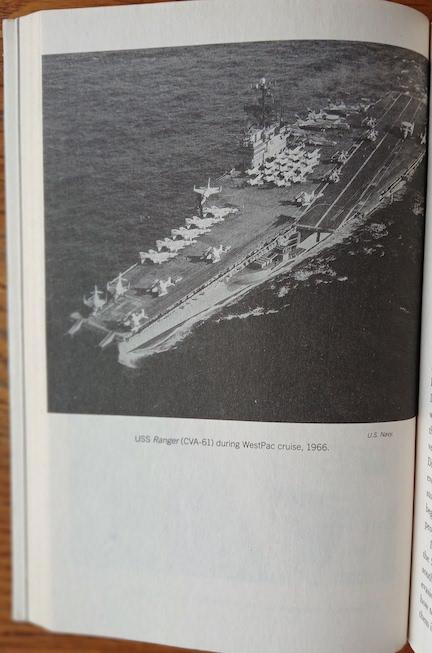
The Ranger with a full flight deck during 1966 WesPac cruise.
Many aspired to go next to the fully combat capable Douglas A-1 Skyraider. They’d been perfected just as the second world war wound down and in intervening years jets had come along but those big, powerful “Spads” were still the “cat’s meow” to the men who piloted them as well as to many on the ground who viewed those planes (and the men who flew them) as “always heavily armed and ready to mix it up, Spads ‘put the fear of God’ into anyone on the ground wanting to do harm.”
A few jets do populate the pages including the Douglas-built A-4 Skyhawk and the McDonnell-Douglas F-4 Phantom. Two other birds, both non-combat but so important to the lives of combat flyers, told about are the Forward Air Control (FAC) Cessna L-19 Bird Dog and the Search-and-Rescue (SAR) Sikorsky HH-3E twin rotor helicopter fondly called Jolly Green Giant.
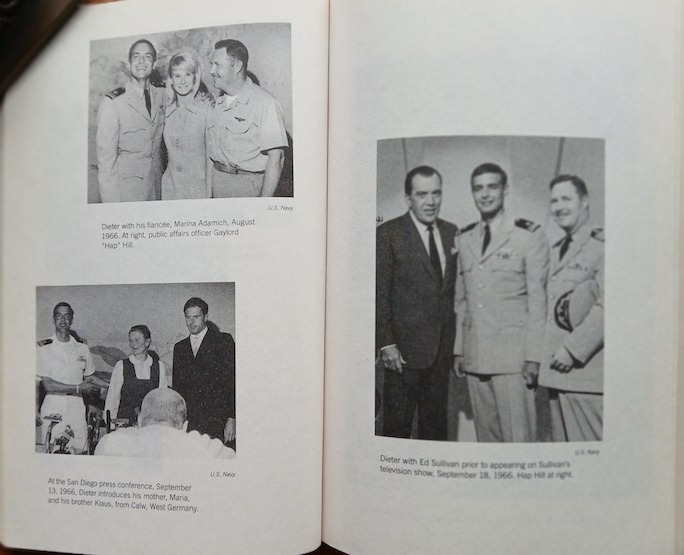
Dieter Dengler, center on righthand page, prior to appearing on the Ed Sullivan (left of Dengler) Show after recovering from his ordeal. Facing page, top l–r, Dengler, fiancé Marina, and the public affairs officer who accompanied Dengler. Bottom Dengler (l) introduces his mother and brother.
All these figure in the story central to the book that relates the life and experiences of the man named Dieter Dengler. It’s clear to this reader that a man of lesser resolve, determination, and resilience might not have survived the ordeal he did. Henderson tells Dengler’s story fulsomely, literally from birth to grave (1938–2001) and all in between. The chapters describing the months spent as a prisoner of war are particularly challenging and disturbing to read as Henderson doesn’t mince words or soften any of the horror of those seemingly interminable days and nights.
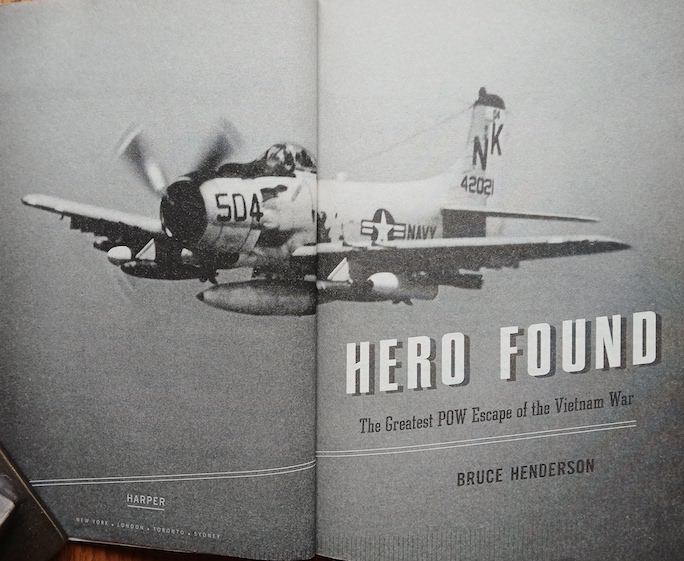
Title page because it’s such a fine photo of a Spad in flight, armed, and ready for business.
As Henderson writes, “True, Dieter Dengler was but one lost pilot and hero found. Yet for his fellow fliers and shipmates, and for me personally, his story of unending optimism, innate courage, loyalty, and survival against overwhelming odds remains our best and brightest memory of our generation’s war.”
Copyright 2025 Helen V Hutchings (speedreaders.info)



























 Phone / Mail / Email
 RSS Feed
 Facebook
 Twitter