
Citroën DS Decapotable: Eclipse of the Sun-Goddess
 by Stuart Ager
“Little did I expect a story about a car to include topics as diverse as Chaos Theory, Doctor Who, Lady Chatterley’s Lover, the significance of French presidential limousines, Peter Cook, the beginnings of the EEC, Gerry Anderson, Cold War tensions, film censorship, J.G. Ballard, The Beatles, Ralph Nader, North American aggression, French grandeur, British decay, Common Market politicking, industrial rivalry … and Katie Price.”
As a Londoner baby-boomer in the late-1950s/early-1960s, “Bliss was it in that dawn to be alive/But to be young was very heaven!” Amongst the very many advantages we had over Generations X/Y/Z were:
Unleaded petrol fumes rotting our brains, passive smoking rotting our lungs, winter smogs killing thousands, dog excrement on the pavements and recreation areas, widespread domestic and child abuse, widespread racial intolerance, priest child abuse (including at the grammar school I subsequently went to), a mere two TV stations, four BBC radio stations (little of whose broadcasts catered for teenagers—you might try your luck with the varying reception on Radio Luxemburg and the American Forces Network) etc. etc.
What we did have were cars that you could readily identify from a hundred yards away. You didn’t need them to come close to see the manufacturer badge on the grille/hood/bonnet (and don’t get me started on today’s SUVs). Foreign cars were easy to spot, and if not, my trusty Observer’s Book of Automobiles would quickly yield an answer. There was no mistaking Citroëns, and in particular the futuristic DS that was regularly seen on London roads. The DS Decapotable (convertible/soft top/droptop) was a much rarer beast. Which brings us neatly to Stuart Ager’s book—and more baby boomers.
Unlike the authors’ other books, the DS Decapotable isn’t the main theme of this book. Instead it is a vehicle (excuse the pun) linked to the progression of major industrial, political and cultural changes from the 1950s to the 1970s. And the leitmotif appearing throughout the book is the chaos theory quotation by Edward Lorenz: “does the flap of a butterfly’s wings in Brazil set off a tornado in Texas?”
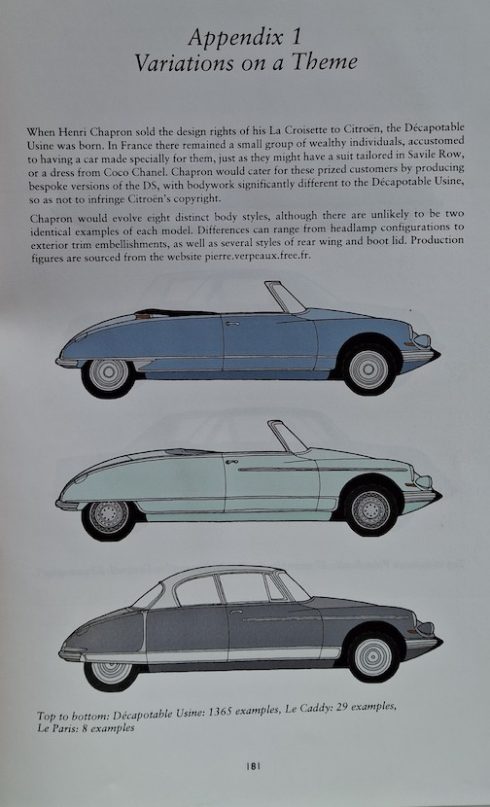
Henri Chapron variations on a theme.
The 1950s brought an intense competition between France’s two major car manufacturers—Citroën and Renault—and over time this became personal between the respective heads of the companies. Renault, aiming at a working class/socialist customer base, believed in getting a new car quickly (and cheaply) to the marketplace to get a quick return on investment. On the other hand Citroën (aiming at a middle-class/right wing demographic), determined to invest more time and money at the outset, for a better design with costs being amortized over many more years. What was the better approach? As the author posits, all one had to do was predict the future correctly …
Citroën certainly appeared to see the future in 1955. The release of the Citroën DS was a major step forward in engineering design, with a revolutionary and unmistakable body shape. It was a bestseller and all that was lacking from the range was a convertible. This was for high-level political reasons and as the readers of Ager’s other titles will know, politics was (is) never far from French automotive strategic decisions. Design and manufacture of a convertible was outsourced to coachbuilder Henri Chapron. In 1958 his masterpiece, the DS Decapotable, was first shown. But at the same time a Brazilian butterfly was flapping its wings. Volvo had developed the three-point safety belt, ignored at the time by the rest of the automotive industry. And in 1960 the UK introduced mandatory testing for cars (at that time) over 10 years old—the MOT test. More wing flapping.
At the start of the 1960s the rivalry intensified between Citroën and Renault. French President Charles de Gaulle’s international ambitions and the Common Market allowing (mostly) tariff-free trading between partners all swayed manufacturer’s decision making. Collateral damage from this included the closure of the Citroën factory in Slough, England (incidentally the same town where Ford GT40s were assembled).
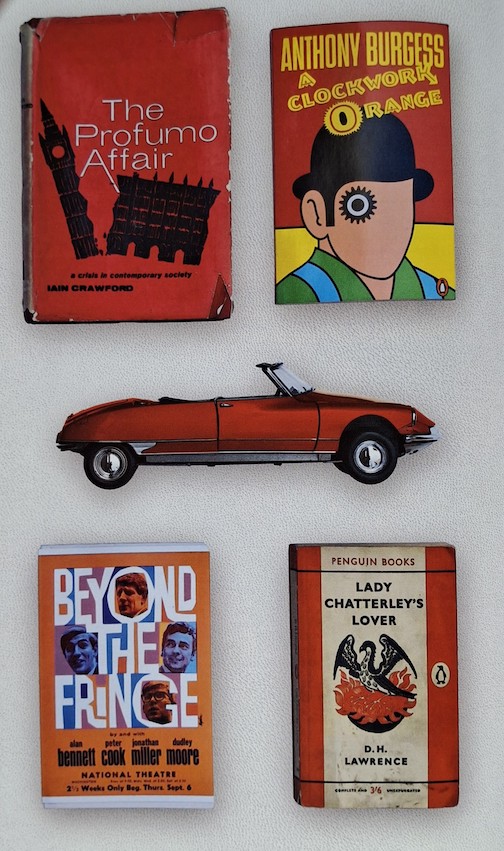
The 1960s and a time of change in the UK.
A rather larger wing-flap occurred in 1966. The UK MOT timescale was reduced to covering 3-year-old cars, and crucially for the Decapotable, three-point seat belt mountings had to be fitted to new cars (but seat belts didn’t have to be installed …) The Decapotable did not have a B-pillar on which to mount the top of the shoulder belt. No matter, because of the small numbers involved, Citroën just stopped selling it in the UK. A final few did eventually slip under the radar, we will come back to these.
Another even larger wing-flap in 1966. Gianni Agnelli took control of Fiat. Highly ambitious to extend the vast Fiat business empire in Italy, he looked further afield. One of the ventures was to become an increasingly large shareholder in Citroën. Citroën’s longer-term strategies and Agnelli’s drive (another poor pun) for instant profits did not sit well together.
Ultimately in 1971, a King Kong-sized butterfly spelt the demise of the Decapotable. The fallout arising from Ralph Nader’s book Unsafe at Any Speed changed the landscape of car safety design. The Decapotable was never going to meet the new safety standards and after just 1,365 examples built, it was dropped from the product range.
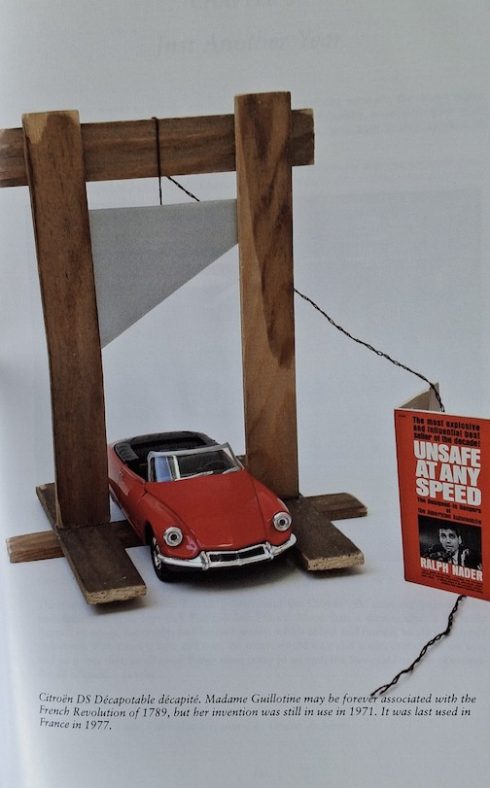
The end.
This is not quite the end of the story in the UK. In 1978 UK MP Alan Clark, a car fanatic, imported a Decapotable that had been constructed in France originally as a DS in 1973. Due to a sleight-of-hand with the paperwork, possibly aided by his clout as an important politician, MOTs were not a problem.
Stuart Ager’s day job is running a Citroën SM and DS specialist company, Andrew Brodie Engineering. He was intrigued when starting to service Decapotable chassis number 1577 as to why it was “obliged”’ to leave the UK in 1968 and be exported to Malta. He and now we know the background to this.
The Decapotable was a victim of the butterfly effect. The DS soldiered on until 1975. So it was in production for 20 years, quite a good prediction. Citroën alas was not so successful in predicting the future of the rotary engine, nor the changing faces of French politics. You will have to read Ager’s book on the Citroën SM to find out how these panned out. Renault was triumphant, for the time being.
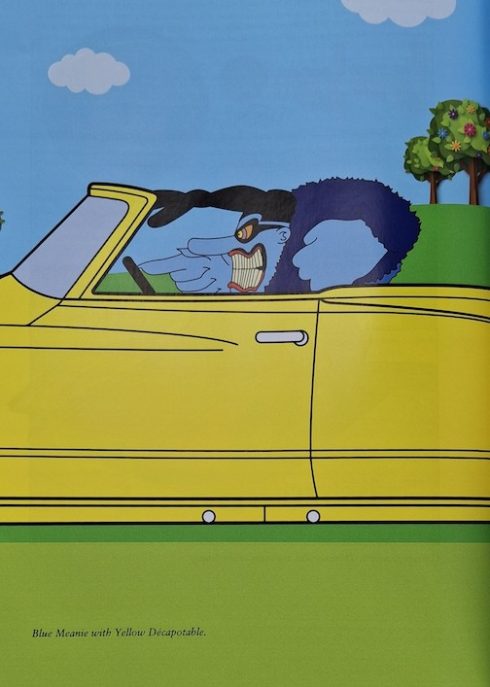
Decapotable and a Blue Meanie. Beatle baby boomers will know what but not necessarily why.
As with all of Ager’s books, you will not find a straightforward motoring-related history here. European and world politics play a major part, as do UK cultural references for the period covered. Non-UK readers may need the help of Google to understand some of the more obscure citings. Occasionally you may pause to reflect on some observations, for example “Every life saved by Ralph Nader on North American roads was spent by the US Government in Vietnam.” Offset to these are the many occasions that make you smile, including the quirky illustrations. Ager produces a list of cars taken out of production due to safety legislation. Tucked amongst venerable vehicles such as the Daimler Majestic Major, the Hillman Minx, and the Humber Sceptre is Slough’s very own Ford GT40 MkIII, although I suspect Ford were not too concerned. Oh yes, three-point seat belts finally had to be fitted to new cars in the UK in 1983.
This book differs from the others Ager has written in that as stated earlier the Decapotable is not the lead character in the story. Many more makes and models fell foul of changing safety standards. And the author himself makes more of an appearance, most literally in the form of a rather Impressionistic portrait of him and #1577. He finishes the book on personal musings on how different butterfly wing flaps might have resulted in a different car industry.
I used the word “marmite” in my review of a non-related Brodie, the David Brodie autobiography. It reflects that as with the UK savory product, Stuart Ager books also tend to be either highly liked or disliked. I thoroughly enjoy his books not least because they make you think and introduce you to areas you may have been unaware of. Which brings me to an Ager gripe. As usual the book contains an index and comprehensive bibliography. I am now trying to track down an affordable copy of Alan Friedman’s Agnelli & The Network of Italian Power to add to my already oversized library.
A coda to my baby boomer musing. In late 1962 an earworm debut record reached the lower end of the UK Top 20. It was recorded by a group calling themselves the Beatles. And in June 1963 I attended my first full motor race meeting‚ at my local circuit, the Crystal Palace. On the bill were current F1 World Champion Graham Hill, future F1 World Champions Jim Clark and Denny Hulme, future F1 GP winner Ritchie Ginther, and Le Mans winners Roy Salvadori and Richard Attwood. Things were starting to Boom for a young Londoner.
This the author’s third of four books to date, all reviewed here.
Copyright 2026, Paul Lea (speedreaders.info)





















































 Phone / Mail / Email
 RSS Feed
 Facebook
 Twitter