
Curves: 15 Perspectives on Car Design
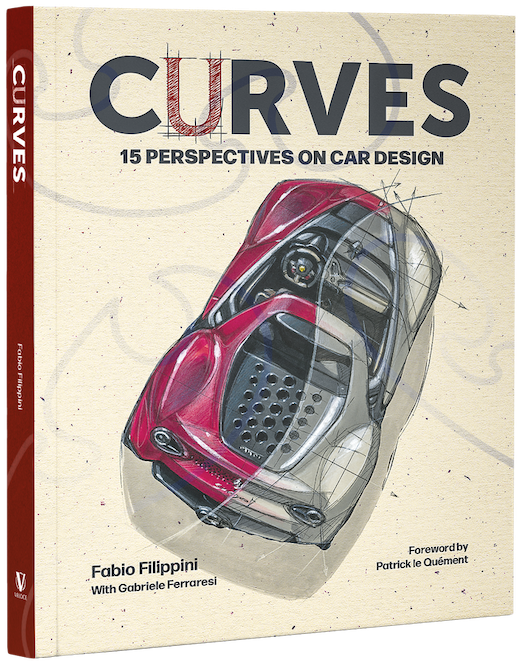 by Fabio Filippini
“Specialising too vertically in one area—anything—and knowing everything about it—is fundamentally bad, dangerous even, for creativity”
—Filippini’s echo of Rudyard Kipling’s 1891 quotation ‘What should they know of England, who only England know?’”
“I don’t know much about art but I know what I like” is a credo that celebrates ignorance by making it a virtue. And I am guilty.
Because I can spend an hour drinking in a Vermeer yet grow bored of a Rembrandt in minutes and be stifling a yawn at a Constable in seconds. I couldn’t tell you why, any more than I can explain why Joni Mitchell’s “chords of inquiry” are so distinctive, nor why an Alfa Romeo Duetto makes me smile but a Lamborghini Urus provokes a sneer. But I’m sure that the author of this stylish and high-quality hardback could explain exactly why an E-Type Jaguar’s hips are so sexy but those on a Peugeot 504 trigger memories of the fat girl at school whom no one ever asked out.
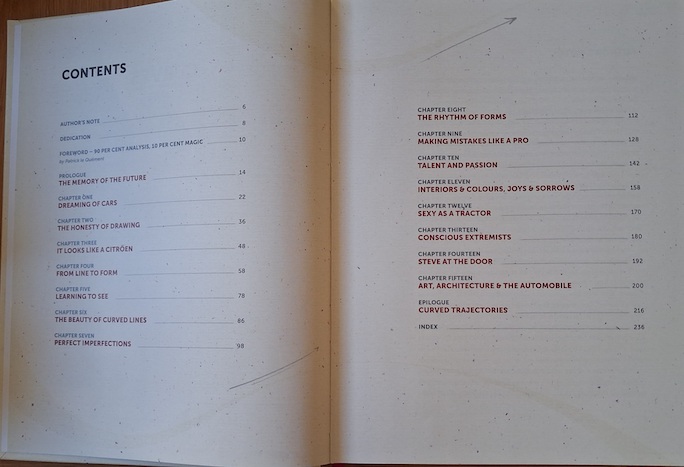
Contents page. The chapter headings are the clue to this book’s erudition.
The author is Italian—of course he’s Italian—and he knows so much about the seductive power of the curve that he’s made a living out of creating them, and now he has named his book after them. Fabio Filippini, now living in Japan, was the former Chief Creative Officer at Pininfarina, after spells at VAG and Renault under Patrick le Quément (who wrote the Foreword) and Curves is a delight.
In this erudite but beautifully written and accessible book, he succeeds in explaining (even to a philistine like your reviewer) exactly why, for example, the Alfa Romeo 156’s stylistic flaws do not compromise its appeal. Part of the explanation involves a comparison with the Bauhaus cool of a VW Passat B5, and why the Church of St Bartomeu and Santa Tecla helped the author see how “in that context, between a Baroque church and a Passat, the 156 stood out like a diva on stage.” Crikey.
It is a truth universally acknowledged that baby boomers, especially those in the United States and Europe, had their adolescence soundtracked by the best popular music in history. And if you were a boomer car guy you’ll agree with me that the sixties (give or take a year or two) were also the apogee of much else besides, including car design. The combination of postwar optimism and growing affluence legitimized self-indulgence, teenage kicks, and style for its own sake. Joie de vivre wasn’t served with a side order of guilt or legislative control, enabling artists (there is no other word) like Giugiaro and Gandini to create shapes whose exquisite lines were compromised only by their own imaginations. I maintain that the era which gave us the Ferrari 250 GTO, the Corvette Stingray, the Alfa Romeo 1750 GTV and (sigh) the Lamborghini Miura has not and will never be equalled in the style of its automobiles.
The author (b. 1963) is younger than me, but it was a relief to read that his view of automotive styling’s glory days coincides with mine—hence the number of illustrations of cars from that era in the book. He has a particular fascination with the 512 Modulo, a shape I’ve always found unsettling if not downright sinister. From the far corner of the left field, Filippini describes how he uses the iconography of 2001: A Space Odyssey to explain the 512’s shape to guests visiting his then workplace, Pininfarina. That is an insight I can’t forget.
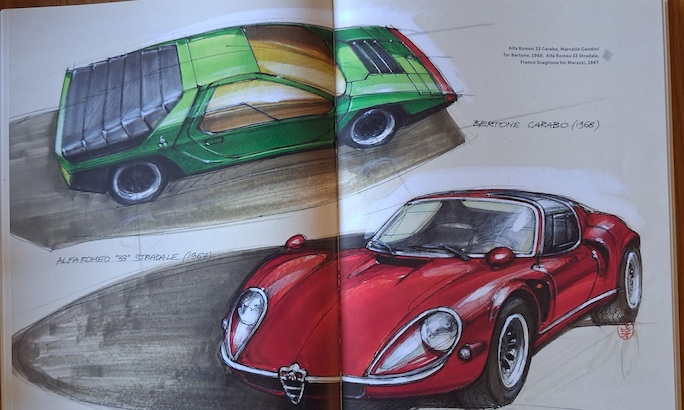
Carabo and Stradale—the past and the future.
I reviewed Stephen Bayley’s excellent The Age of Combustion: Notes on Automobile Design in 2022. Perhaps surprisingly, the usually iconoclastic Bayley shared the widely held belief that the Alfa Romeo 33 Stradale “is the most sublimely beautiful car ever made.” In mitigation, his acid caveat was this rhetorical question: “How can the beautiful be so shockingly disconnected from the useful?” But Filippini’s take on the Stradale is fascinating: “I find this 1967 design to be a formal—and somewhat passé—synthesis of the decade that was drawing to a close. … It was a little late for its time.” Ouch—that blows Fabio’s chances of being admitted to the VIP area at the Villa d’Este concours, and he’ll need a bodyguard at Pebble Beach. Heretic? Perhaps, but I think he’s right, because the sainted Stradale’s beauty was no more than Scaglione’s brilliant distillation of what had preceded it. The Stradale was a climax and its gorgeous last hurrah was the final punctuation mark of its era. But the Modulo, like a personal favorite, the Carabo (which used the Stradale’s chassis, ironically) showed “the start of a new era in world design”.
The author has an affinity for the one-time arch disrupter Citroën, and it’s one with which I empathize. I’ve owned a couple, driven a few more, and Citroën’s corporate chutzpah (or plain Gallic cussedness?) so often convinced me that it was they who were right, and that most other marques remained mired in convention. Look at the drawings in this book of the DS, SM, 2CV, and Traction Avant and tell me I’m wrong. But whatever the designer of the bonkers Ami 6 was smoking, my guess was that it wasn’t Gitanes.
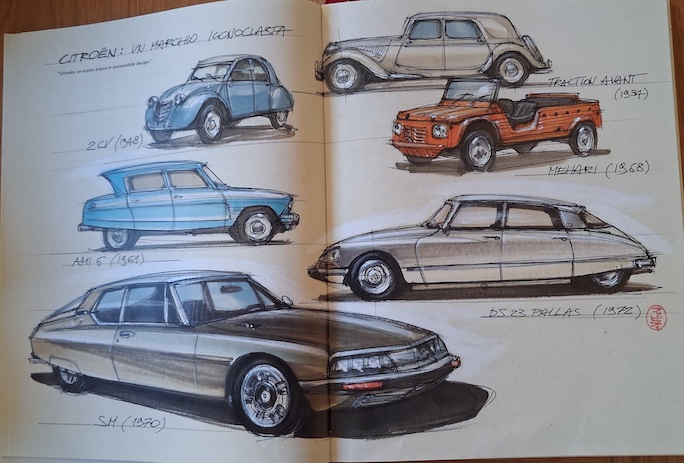
An eccentricity of Citroëns.
The illustrations, incidentally, are superb, and are reason in themselves to buy this book. You won’t find a single photograph but Filippini’s renderings of such a glorious diversity of subjects are a joy. They range from Philippe Starck’s useless but stylish Alessi Citrus Squeezer, to the Dukes of Hazzard “General Lee” Charger, via (you guessed already?) Reims Cathedral and the 1969 Pininfarina Sigma Grand Prix.
There is a British politician who notoriously endorsed the populism creed by saying that “we’ve had enough of experts,” because, presumably, those pesky experts tell us things we don’t want to hear, the stuff that might contradict our own prejudices. Me? I want an expert to do that tricky root canal job, to land the 737 in a crosswind, and to design my next car. I know what I like, but that’s the problem, because it is all I do know. The author dismisses styling clinics and focus groups, evoking Henry Ford’s apocryphal apercu that “if I’d asked people what they want, they’d just have said a faster horse.” Talking of focus, did any European Ford have the extraordinary impact of the 1998 Focus, which so brutally drop-kicked the sclerotic Escort into history’s dustbin?
I loved this book because I’m a tongue-tied ignoramus in the artisanal world populated by Harley Earl’s doo-flunkeys, the Hofmeister kink, and Pininfarina’s BMC Aerodinamica, whose legacy outlived BMC itself by decades. I usually learn plenty from the books I review, but it is rare that a book has made me think so much! I know it’s the law to swoon over a Ferrari Dino 246, I agree with Bayley’s assertion that form does not follow function, but I still need a Filippini to help me to understand why I like what I like.
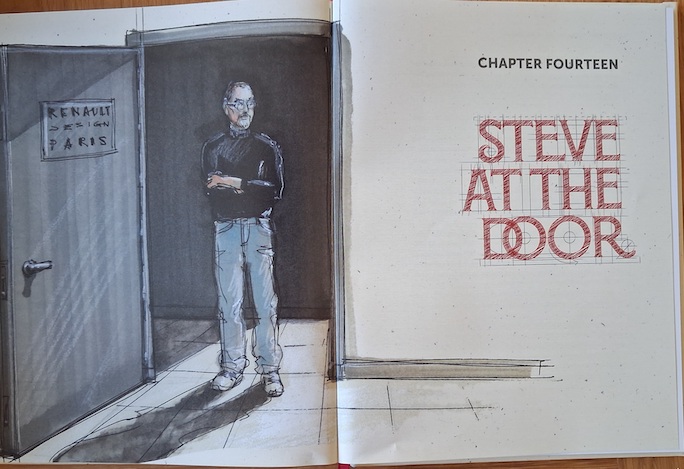
The late Steve Jobs visits Renault Design, Paris 2003.
But I’d have loved even more than the great deal I’ve already got out of this book. I’d have liked more of the author’s take on color, including why it is only Japanese cars that look their best in white. Just look at a Toyota 2000 GT or an Integra DC-2. And what does Filippini think of Easter eggs, those twee little whimsies that some European brands are using to gussy up their dull little SUVs? Many Opels and Vauxhalls have shark icons secreted in unlikely places, presumably to surprise and delight their owners—is this the final proof that we have all relapsed to kidult status? And if the author reads this review, would he agree with me that the NSU Ro 80’s real legacy is not the smooth but flawed rotary engine but the extraordinarily futuristic styling that has influenced almost every European premium car ever since?
The importance of automotive styling—still an evolving art form—cannot be overstated. Rightly or wrongly, we judge cars by their appearance, more than by any other criterion. We may make an exception for the jolie laide (like the 1998 Fiat Multipla) but we are predisposed to prefer the attractive to the clever, unless we can find both in the same package (Guten Tag, BMW i8 and Hi, Jodie Foster). Stylists like Filippini work in a language only they can speak but which nearly all we civilians can understand. Which is why a Macpherson strut can never transcend its function, but a De Tomaso Mangusta speaks a language everybody can understand. And this outstanding book enables us to learn why.
Copyright John Aston, 2026 (speedreaders.info)














































 Phone / Mail / Email
 RSS Feed
 Facebook
 Twitter