
Cobras, The Building of the Leaf Spring Cars
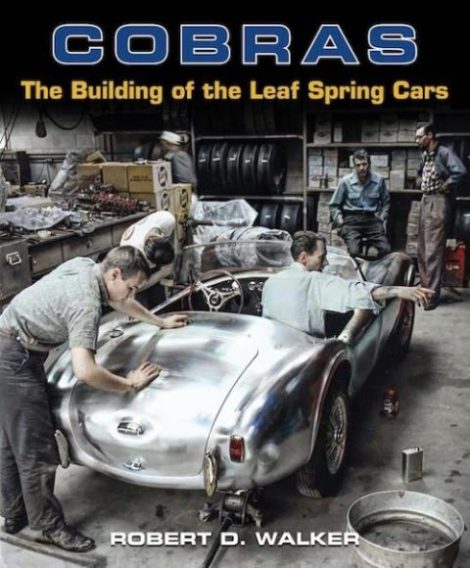 by Robert Walker
“Some of the myths and nuances of Cobra production that are mentioned in several Cobra books have been touched upon by the author, without malice or prejudice. As had long been suspected, some previously reported Cobra components, AC Cars’ construction techniques, and especially completion methods used at Shelby American were found to have often been based on mostly legend, rather than fact. Several of those myths are examined, with corrections presented along with documentation.”
Can you speak with authority on early Cobra filler paint materials and primer colors, or the correct blade length of the “Engineer’s Screwdriver” in the tool kit, or the pressing matter of why some post-production parts retain original numbers but are physically different from the original part?
Probably not.
Probably not even if you have restored a Cobra or three. That’s because experts don’t all agree—and over a dozen in the US and UK helped on this book—and also because expert and layman alike depend not only on the evidence on the workbench but on the reference literature. Wherein lies the rub: author Bob Walker is once again on a quest to rein in “numerous discrepancies and errors found in printed Cobra histories and reference books.” Which, gulp, includes data in the go-to “Leaf Spring Cobra Registry” (2019) maintained by the Shelby American Automobile Club.
Mind you, there’s a lot more in this book than the sorts of things called out above, but unless you own a Cobra or are a restorer, or aspire to either, this $175 book may be a bit indulgent. But if you are absolutely desperate to “justify” its acquisition, consider that it conveys quite a bit of generic information as well, about period manufacturers and methods, about restoration philosophy, about shop standards, even the occasional word about other cars.
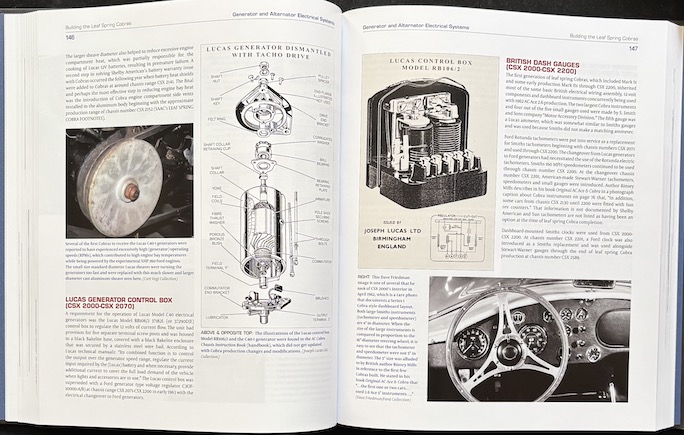
You don’t have to own a Cobra to find this discussion of Lucas electrics enlightening.
With prices for original Cobras straying into the seven figures today it’s easy to forget that back in the day, a base Cobra ($4995) slotted in halfway between a Corvette and a Jaguar XKE. Not cheap but not supercar money. The level of finish was “only moderate at best” and, being built to meet a price point, they were never intended to be state of the art even by 1960s tech standards. Also, nobody—not the original builder AC nor Shelby American—bothered with documenting anything. Early Cobras are now over sixty years old, meaning this book has its work cut out for itself. Walker knows that people who worked on the cars in period are older still so for years he has been interviewing as many principals as he could. He also owns a Cobra and has restored it so he has skin in the game.
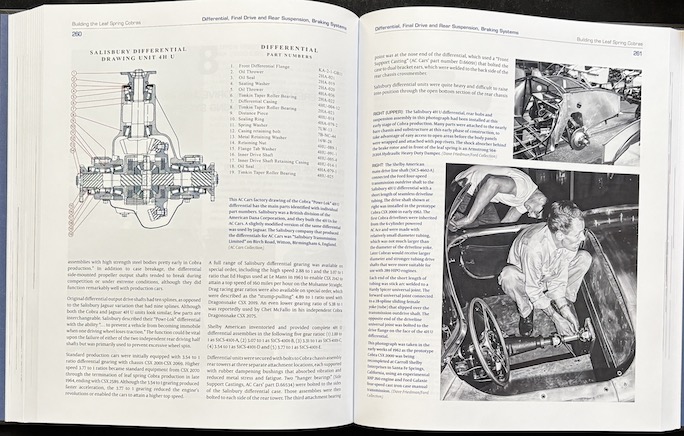
 Leaf Spring means 1962 to 64 / Mk I and II. This book deals only with CSX chassis (#2000–2589), meaning American-spec cars completed in the US, not British or Euro-spec cars that were finished at/by AC Cars which is relevant to know because AC continued some of their leaf spring completion techniques on the subsequent coil spring cars. If Cobras are your thing you may well already have Walker’s previous book Shelby Cobras: CSX 2001–CSX 2125, maybe even his first one, Cobra Pilote: The Ed Hugus Story. If you do, don’t be surprised to find some topics revisited here.
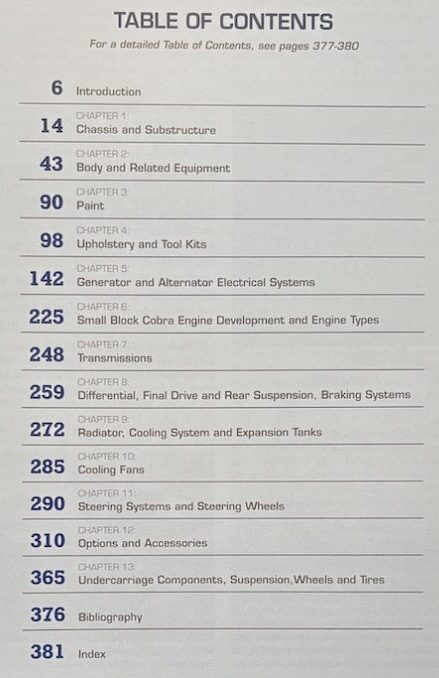
Let’s start with a telling detail: the 1-page Table of Contents at the front of the book says right at the top “For a detailed Table of Contents see pages 377–380.” Bet you haven’t seen that before. And those pages are cleverly placed right before the Index, itself an extraordinarily thorough and multi-pronged “tool” (example below). It’s as if the author (and book designer) WANT you to be able to find what they went to such trouble to put in the book! Gold star.
 The book is divided into thirteen chapters that each discuss specific part groupings or systems. The order is fairly organic, beginning with “Chassis” and ending with “Tire Types and Substitutions.” The level of detail is dizzying and it’s a relief to know there won’t be a test at the end—few would pass!
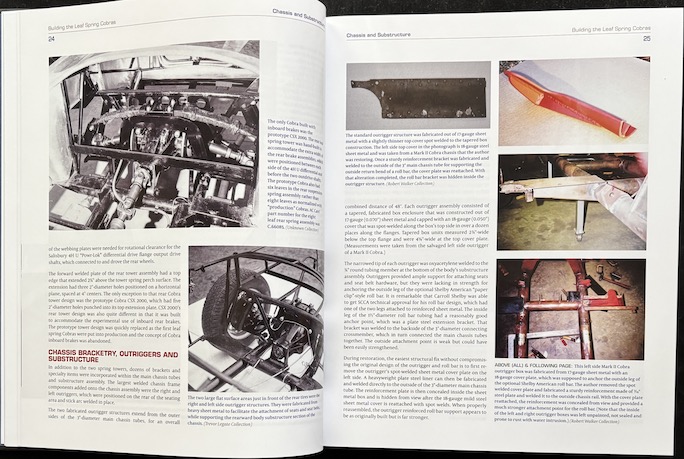
From chassis brackets to steering wheel rivets to grille shapes, what isn’t in this book?
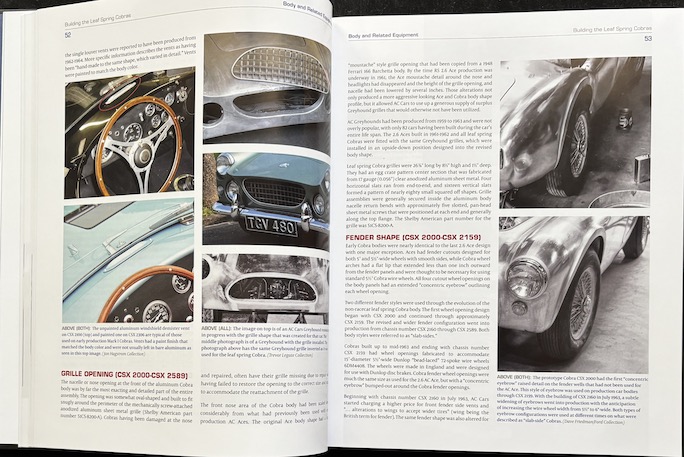
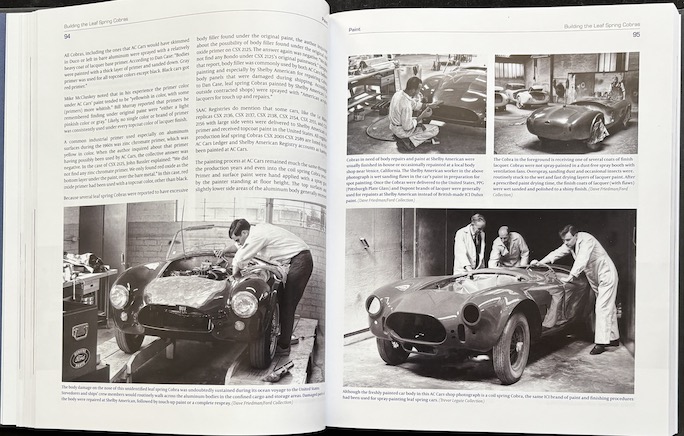
Text and corresponding illustrations are exceptionally well in synch (take the photo above as an example). Period and modern photos from a wide variety of sources are supplemented by technical illustrations and realia. Some of the illustrations are overlaid with callouts to highlight exactly what the captions and/or body copy is talking about, and exploded drawings reveal what is normally hidden from view. No pronouncements are made that are not backed up by fact—which is not to say that Walker isn’t open to the reality that as of yet unknown facts may modify in the future what right here right now is surely the definitive account.
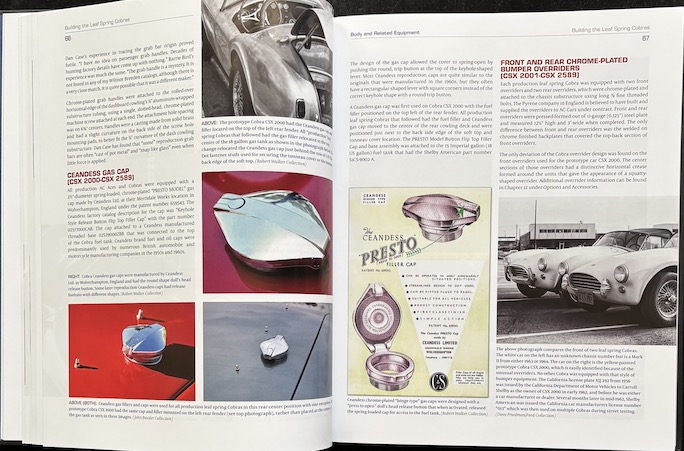
“Good writing” doesn’t just mean clever wordsmithing but a competent grasp of the didactic side of knowledge transfer. Walker once taught journalism at the college level, and if this book is any indicator, his students owe him! We would be remiss not to also praise the ever-high Dalton Watson production values and the book design skills.
Returning to an earlier thought, one can only pity anyone who passes this book up because they think it’s not “for” them.
Copyright 2025, Sabu Advani (speedreaders.info).
 RSS Feed - Comments












































 Phone / Mail / Email
 RSS Feed
 Facebook
 Twitter