
Beetle, Volkswagen’s Little Giant: From Old Reliable to New Sensation
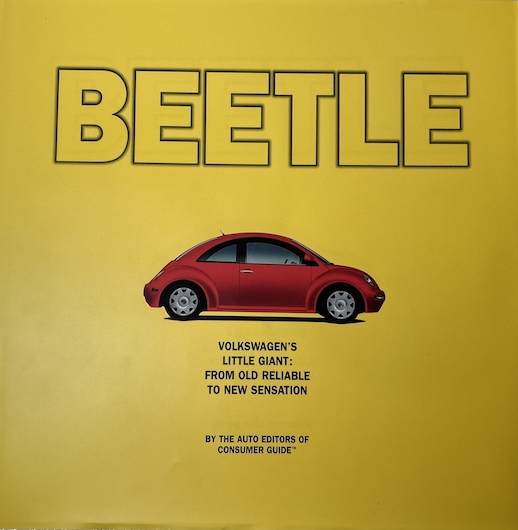 by The Auto Editors of Consumer Guide™
“Why has the Beetle lasted so very long? Perhaps because it sprang from just two minds. Timelessness in any endeavor rarely ensues from committees.”
Publication of this 1998 book had been prompted by the introduction of an all-new Beetle which from today’s perspective we now know was produced from 1998 to 2019. The worldwide production figures in this book start with the 1940–44 KdF-Wagen. 1940 to 2019 is indeed a very long run that even the nearly ubiquitous Model T cannot match.
This book tells the Beetle’s story up to 1998—but not beyond—and does so delightfully in words illustrated with big, bold images and smaller detail ones too. Overall it captivates the charm the Beetle itself exuded—and for those fortunate enough to own one today, still does.
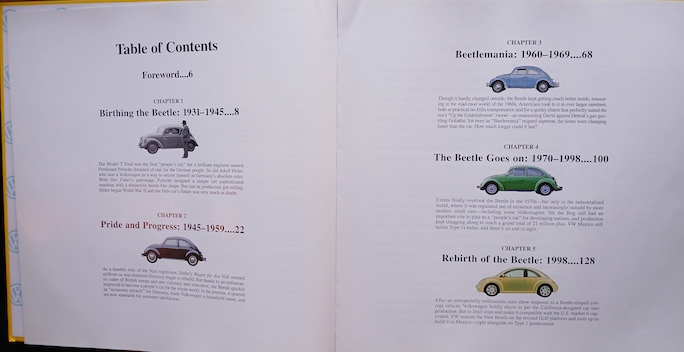
Without getting bogged down in laborious detail the narrative tracks changes made to Beetles year by year. While updates and improvements were steady and significant, outward appearances changed only subtly so no prior model suddenly appeared dated.
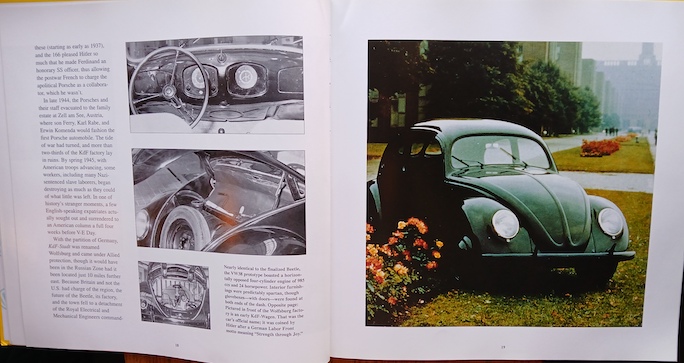
Interior and engine compartment of prototype on left. Opposite an early KdF-Wagen.
“In all, the Beetle took Volkswagenwerk a very long way in a rather short time. By 1960 the company had added plants in Hanover and Kassel, and was shipping Beetles as complete knock-down (CKD) kits for assembly in countries like South Africe (starting in 1951), Australia (1954), and Brazil (1959).”
It wasn’t just the car. It was “bolstered by clever advertising and pioneering sales and service . . . as well as top-notch craftsmanship and customer-friendly dealers.” Those ads were created by Volkswagen’s ad agency since 1959, Doyle Dane Bernbach. If you’re of an age you personally recall them at the mere mention of “Think Small” or “Mass transit” or “No point in showing you the ’62 Volkswagen. It still looks the same.”
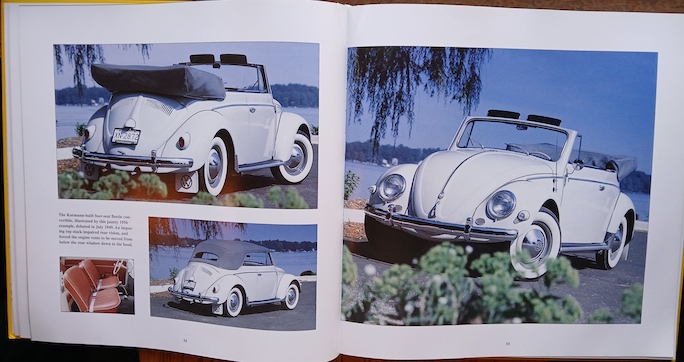
A Karmann-built Beetle’s convertible top folded still stacks so high it impaired rear vision even as it made a stunning presentation.
As the production statistics show by 1997 worldwide production topped twenty million cars. Although production had become greatly reduced following decreased sales, VW and the Beetle weren’t done yet as the concluding chapter, “Rebirth of the Beetle,” relates.
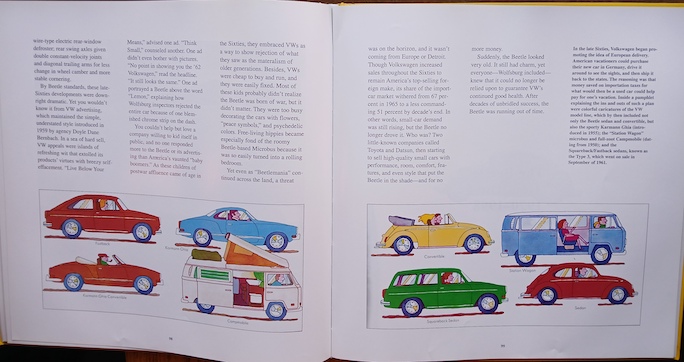
Artwork/drawing across bottom was in a late 1960s pamphlet showing “colorful caricatures of the VW model line.”
“What we now call the New Beetle was unveiled as the Concept 1 during the 1994 North American International Auto Show in Detroit.” It had been conceived in VW’s advanced design studio in Simi Valley, California by two young Americans, J Mays and Freeman Thomas. It would eventually be built on the fourth-generation Golf platform and “share 80 percent of its underlying componentry. But . . . where it could be made better, it was.” Production cars would begin to be delivered spring 1998 and before VW called an end a bit over two decades later, they had upped Beetle sales by another over a million cars. This book did and still does a grand job showing and celebrating VW’s Beetles.
Copyright 2026 Helen V Hutchings (speedreaders.info)
 RSS Feed - Comments





















 Phone / Mail / Email
 RSS Feed
 Facebook
 Twitter