
The Bimota Story
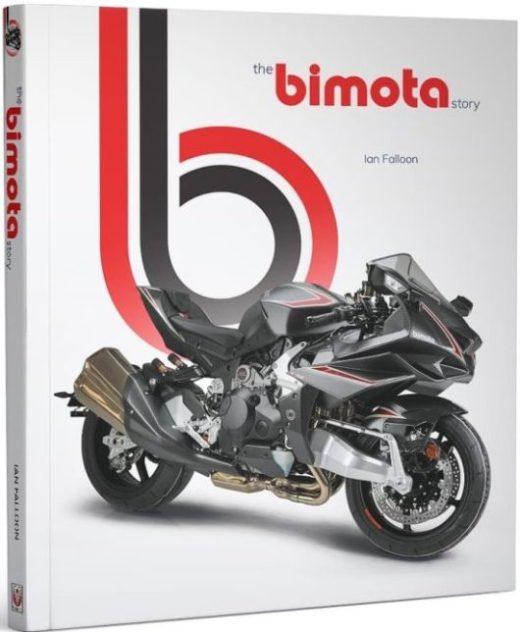 by Ian Falloon
“Bimota is one of the enigmas of the Italian motorcycle industry. Known for spectacular engineering and beautiful execution, virtually from its inception the company’s history has been a Machiavellian saga.”
Bianchi (Valerio)
Morri (Giuseppe)
Tamburini (Massimo)
= Bimota
Puzzling out the name is the easy part; for everything else, see the introductory quote: nothing about this story is easy. And about that name, “Bi” doesn’t even really belong there because he left just when, in 1972, the company decided to fully pivot into motorcycle manufacture, to be known as Bimota Meccanica, and away from their previous day job, HVAC systems marketed under the Bimota nameplate.
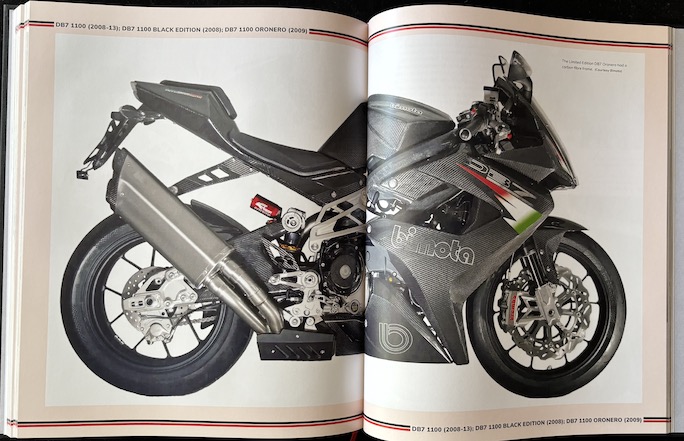
You’ll want to have a good eye for motorcycle engineering and packaging to fully appreciate just how exotic and smartly built this machine is.
Other than than the occasional magazine feature there has not been much stirring in the marque-specific literature for, no kidding, decades, certainly not in English. That alone would be a strong reason to review this book but there’s another. While it may well be peripheral to gear heads it very much pings the SpeedReaders radar: the premium presentation of this book. The publisher is Veloce, in the UK, founded in 1991 and a mainstay in the transportation sector. Competent as the books are, on the design and presentation end they did not move the needle much. But in 2024 Veloce (and the imprints Hubble & Hattie and Earthworld) was acquired by the firm David & Charles, and now fresh money and ideas are going towards designing really quite impressive-looking books sporting larger formats (here 25 x 30.5 cm), custom finishes, book ribbons, collectors (limited) editions etc (the manuals and guides will remain as is). Most of these attributes are present in this book.
 Falloon (b. 1952) is a trained engineer but it’s only due to a motorcycle accident that he took up writing about motorcyccles encompassing both historical and technical topics. He has by now written many books, more than a dozen just for Veloce, and it is the very fact that he knows Italian and Japanese marques so well that he can give Bimota a detailed analysis because Bimota is first and foremost a chassis/frame maker using other people’s motors and mechanicals.
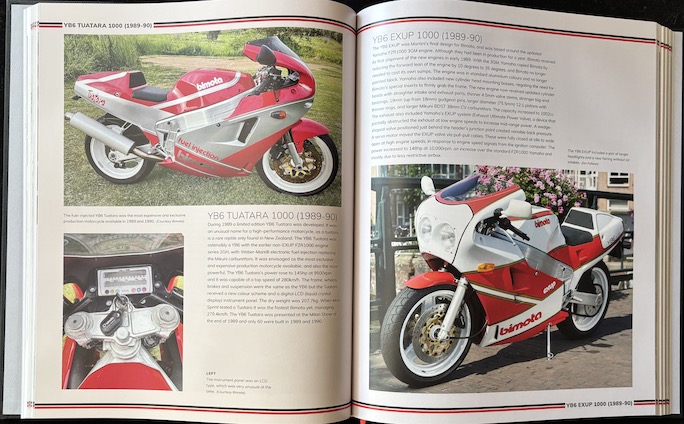
The Tuatara was positioned as the most expensive and exclusive production motorcycle available. If you are a naturalist you may recognize the model name as that of a rare reptile only found in New Zealand and known for having a “third eye” (a vestigial structure not strictly related to vision). This limited-edition YB6 had a highly unusual-for-the-time LCD dash (bottom left).
If the marque is new to you, make a mental note that you could go out and buy a new product by this more than 50-year-old firm right now—in fact 2025 is going to be a particularly good vintage—but you’ll be asked to part with serious money. You could buy a new car for less! What that money buys—see above, “spectacular engineering and beautiful execution”—is what this book is all about. When all is said and done it is truly remarkable how vigorously Morri and chief designer Tamburini held fast to their engineering values and performance goals, and it is equally remarkable that they survived the strictures of being at the mercy of so many engine makers.
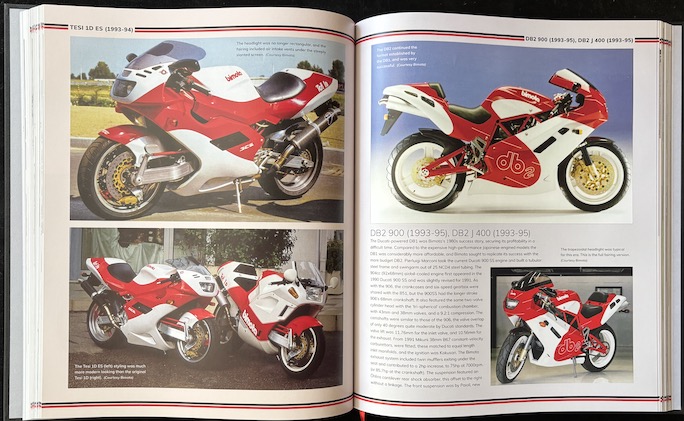
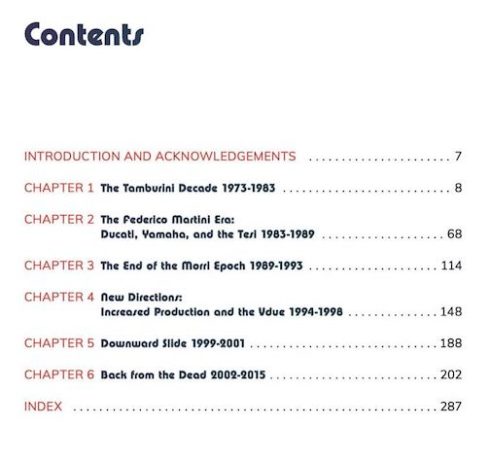 Beginning with the first year of full production, 1973, the book covers all street and racing models up to 2023. There is an Index, yeah!, but it doesn’t break out models and the Table of Contents only gives you year ranges so if you are looking for a specific model among the many dozens made, you’ll have to work for it. Also, page numbers are an almost extinct species in this book and there will be dozens of successive unnumbered pages; they will, however, often, have a running foot (example below) that will, often, call out model designations so not all is lost.
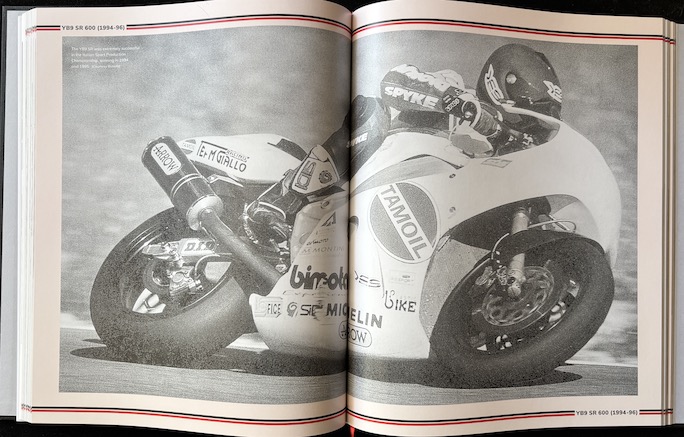
One of the more extreme examples of a poor-quality original photo but obviously the author/page designer ruled it important enough to not only use it but make it the biggest possibly size in this book.
The book is very well illustrated but a note on the Intro page by the publisher begs to be emphasized: “less than ideal” original photos are better than none at all, even if the penalty is occasionally poor reproduction (see above). It does happen often enough, but you have to remember that even where the credit says “Courtesy Bimota” it doesn’t necessarily mean that these are professional grade factory images.
Copyright 2025, Sabu Advani (speedreaders.info).





































 Phone / Mail / Email
 RSS Feed
 Facebook
 Twitter