
Designing Dreams
Essays on the Inside Story of General Motors, Harley Earl and America’s Golden Automotive Age
 by Dick Ruzzin
“The greatest real thrill that life offers is to create, to construct, to develop something useful. Too often we fail to recognize and pay tribute to the creative spirit. It is the spirit that creates our jobs.”
—attributed to Alfred Sloan
The book is aptly subtitled because much of the content has been published elsewhere over the years since its author, Dick Ruzzin, retired from his nearly 40-year-career as an automotive designer with General Motors.
To be sure, every person who worked within GM’s Design Staff in any capacity—most especially once it occupied that magical place whose origins, design, construction and early days were described by Susan Skarsgard in her book Where Today Meets Tomorrow, Eero Saarinien and the General Motors Technical Center—have had similar experiences and stories to tell. But the reality is not everyone is motivated to try to put words on paper as Dick Ruzzin has.
I had no more than opened the box after the book arrived than, upon spotting its cover, went straight to the shelves here to pull my copy of Stephen Bayley’s Harley Earl and the Dream Machine. Not the version reviewed on this site but the original book beautifully produced in 1983 by Alfred A Knopf. It was printed in Italy and featured 19 color images along with the 68 historical black and whites (and does not mislabel a Corvair as an Impala or include any of the other typos the review of the subsequent 1991 version from a different publisher mentions!).
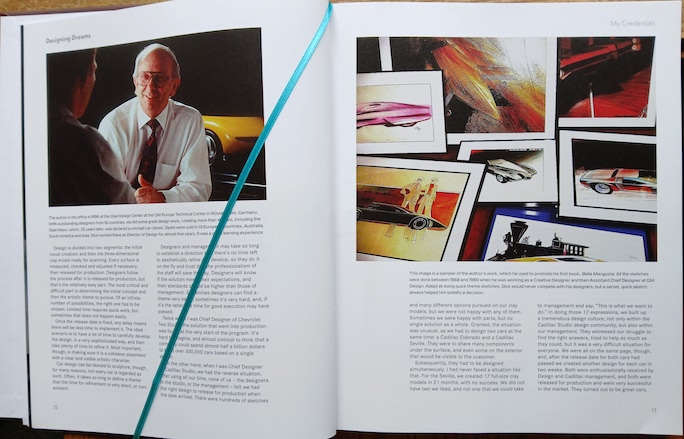
Dick Ruzzin faces the camera circa 1996 on left. Facing page, a sampling of his studio drawings all of which—and more—illustrate the book along with GM images of some of the cars and people told of in Ruzzin’s narrative. Image also shows off the bound-in marker ribbon.
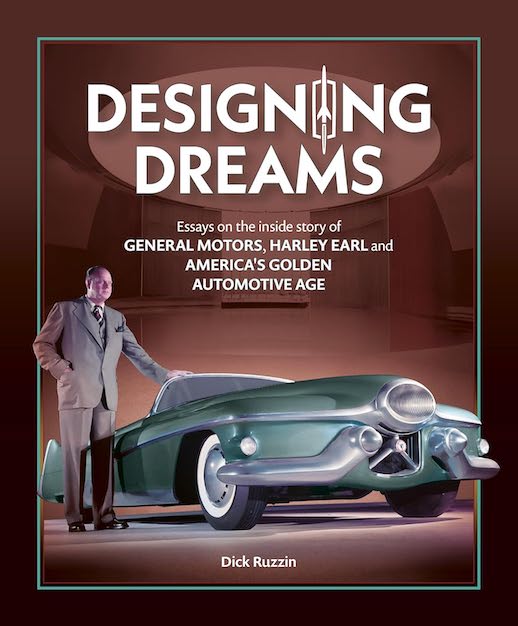
On the cover of that original book is a grand piece of art by Philip Castle showing Harley Earl alongside the 1949-designed LeSabre (production cars were Le Sabre but the concept was LeSabre). It was built as a fully running and operational concept car in 1951. Castle’s painting is so nearly like the cover of Ruzzin’s book which is a photo of that scene. GM retains that one and only LeSabre concept car in operational condition to this day.
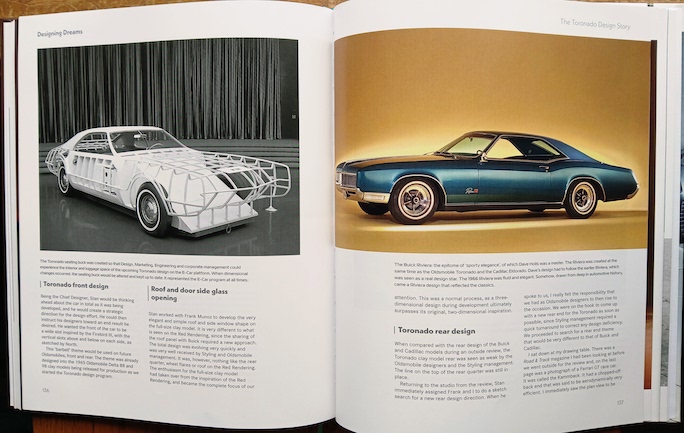
Image on left is a seating buck surrounded by framework indicating Toronado’s exterior dimensions. On the right is sister division Buick’s E-platform Riviera influenced by Dave Holls, a master at creating sportily elegant designs.
The author of this book lived and worked, as said above, in a magical world (observed and confirmed by others too). GM’s design staff worked on a campus that even today is beautiful and no less magical. But Ruzzin hadn’t arrived there straightline as he explains. Once there, though, his career brought him into contact with many whom he writes about such as Harley Earl, Bill Mitchell, Chuck Jordan, Dave Holls, and others.
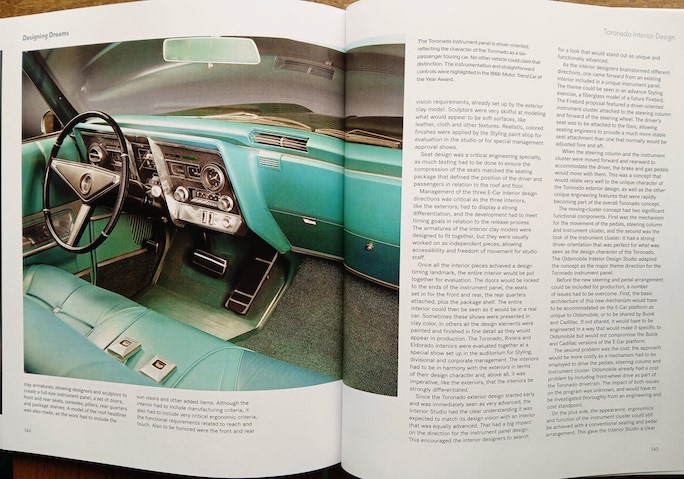
Some details of Toronado’s driver-oriented instrument panel. The flat floor and absence of a center console made a bench seat work well.
Early in his career as a designer, Ruzzin found himself assigned to a studio charged with designing the first generation Oldsmobile that would go down in history as GM’s first-ever front-wheel drive (FWD) personal performance luxury car: Toronado. It was ground-breaking especially as its E-platform siblings, Buick’s Riviera and Cadillac’s Eldorado, would both remain RWD. Today all three are revered and collectible but due to the buying public being sceptical in the latter ‘60s of anything FWD, Toronado’s didn’t sell as well as her siblings, thus fewer first-generation Toronados were produced than first-gen E-platform Rivieras or Eldorados.
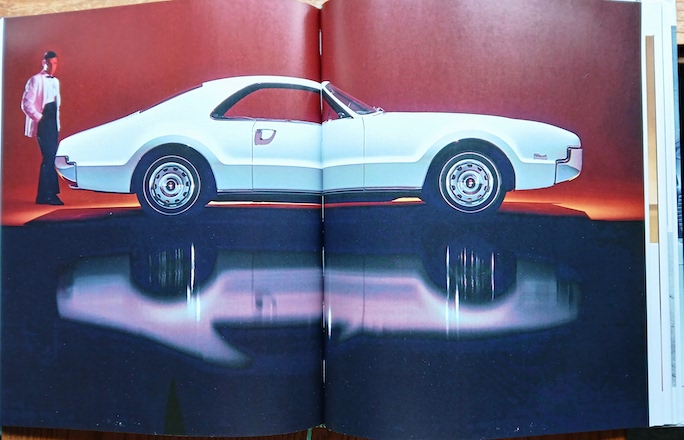
Ad agency image showing off a first-year Toronado.
This book is produced with as careful attention to detail as that original Stephen Bayley Harley Earl and the Dream Machine. Rightly so too for the car that’s at the core of the book—Oldsmobile’s first-generation Toronado—had itself earned the 1966 accolade from Motor Trend which named it their choice for Car of the Year. This hardcover book does justice to the images as well as the text. There’s even a ribbon bookmark bound in toned to match the turquoise of the LeSabre concept car on the cover and the surrounding thin border.
Intrigued by and interested in the conceptual process for Oldmobile’s Toronado? Then, you will find his book particularly rewarding.
Copyright 2025 Helen V Hutchings (speedreaders.info)
















 Phone / Mail / Email
 RSS Feed
 Facebook
 Twitter