
A Century of Concours d’Elegance
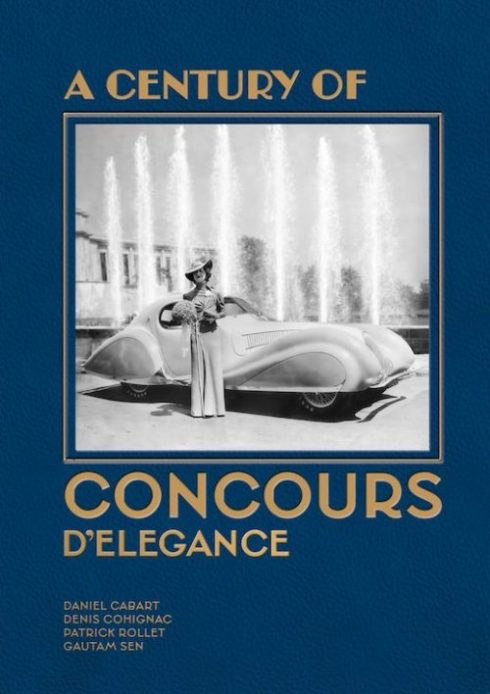 by Daniel Cabart, Denis Cohignac, Patrick Rollet, Gautam Sen
“It was likely André de Fouquières who codified the rules of the concours d’elégance a la française. His judging criteria included the car’s design (typically brand-new), comfort, equipment, and the harmony between the automobile, the presenter’s attire, and accessories. The result was a glamorous platform where automakers, coachbuilders, and fashion houses collaborated to present not just vehicles, but coordinated artistic statements—bringing together the ‘three Cs’: Constructeur, Carossier, and Couturier.”
You’ll quickly spot a fourth C in the pages of this book: chien = dog, one photo caption going so far as to say “These four-legged friends played a crucial role in winning over the jury.” And if you don’t how the French language plays into this story you’ll definitely need this book.
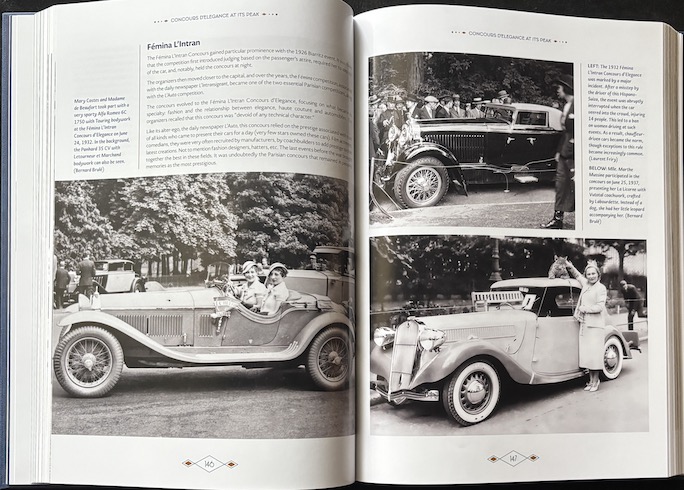
If the dog is indisposed bring the leopard (bottom right).
Just looking at the USA, you could spend every single month of the year concours-hopping. And that’s just the larger events that have more than merely regional pull. Add international events and you have a very crowded schedule. Attendance is growing, even in these financially precarious times … but, the future does not look certain. The Preface and Foreword hint at it, one watchword being “Broadening our base,” a thought that carries added weight because it comes from the pen of someone who would know: McKeel Hagerty, CEO of a company that has taken on the operation of two established, important events (The Amelia and the Greenwich Concours) and who additionally knows the inner workings of classic car insurance and auctions.
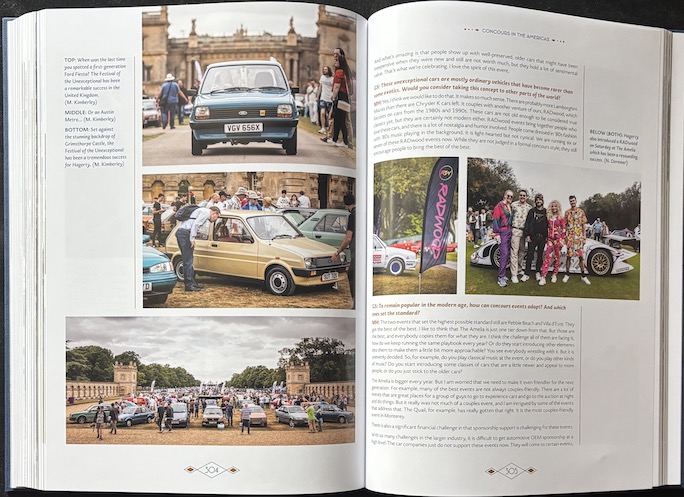
Not everything in this book is ultra-highbrow. These pages discuss the Festival of the Unexeptional (l) and RADwood (r).
Thank goodness a book review only has to concern itself with the properties of the book and not the complex and uncomfortable questions of how or whether a concours advances the human condition. Considering presentation alone, the book certainly does its subject justice: high-level everything: paper, printing, photo reproduction, design. It even comes in two languages (the French version, Un Siècle de Concours d’Elégance, is available as a separate book). Then there are the four excellent authors, all deeply involved in a multitude of car-related activities. (And all but one associated with books we have reviewed.)
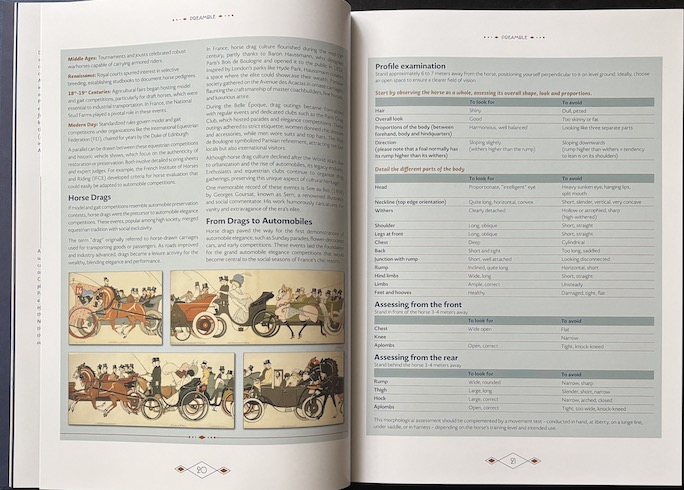
From the judging guidelines (r): “To look for: harmonious, well balanced. To avoid: looking like three separate parts.” Why of course, we’re talking about the horse!
Much like a concours, or car festival or show, this book offers a little bit of everything, from the obvious and expected to the fringe. Among the former: a historic survey going back to pre-car days (i.e. 17th century France), thoughts on the purpose behind such a fundamentally unusual activity in society, descriptions of specific concours, the evolution of the overall idea in a global context. Among the latter: a look at different judging and scoring systems (photos below), the existential question of the difference between a concours d’état and a concours d’elegance (in other words: Condition v Elegance), static v drive-by, and at least occasional acknowledgement of thorny issues such as criticisms pertaining to elitism, trailer queens, the age of judges, bias against postwar cars or closed cars or racing cars or hot rods or motorcycles or unrestored cars or charitable donations … there is no end to the litany of things some find fault with.
There is a very thorough multi-layered Index but it doesn’t reference “general” matters so pen and paper are required to keep track of some things. Example: celebrity Delage owner Joséphine Baker is mentioned and shown more than once in the text, as are her cars. If you forgot what page the one reference to her cherishing and being a dedicated promoter of the brand is on you’ll curse the time wasted trying to find it again. (She was so important to Delage that to this day they carry a line of handbags in tribute to her. [But do you know why they’re named “Freda”?])
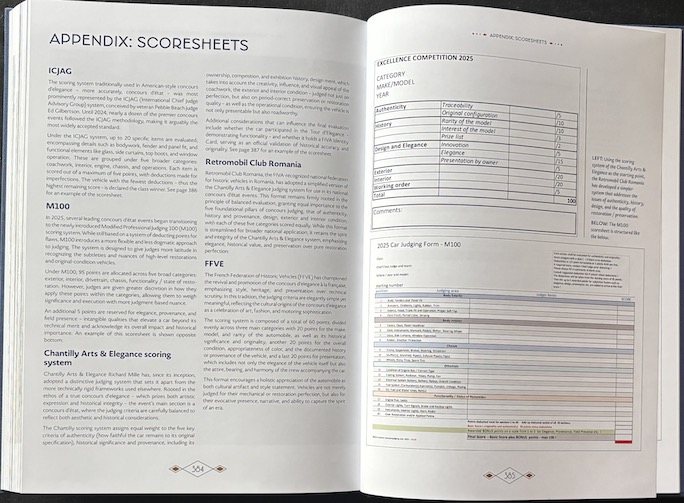
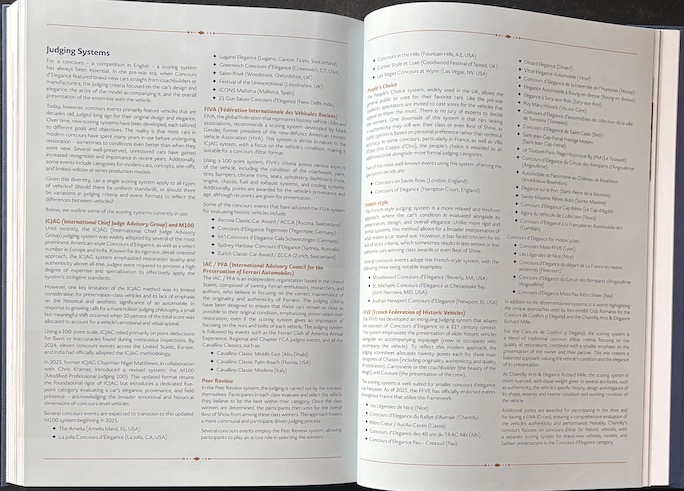
Or, put the words aside and let the photos do the talking. From coachwork to couture the crème of the crop is displayed on these pages. Since color is a primary aspect in the appreciation of both it is regrettable that there is only one single color photo (from 1936, below) earlier than the 1950s.
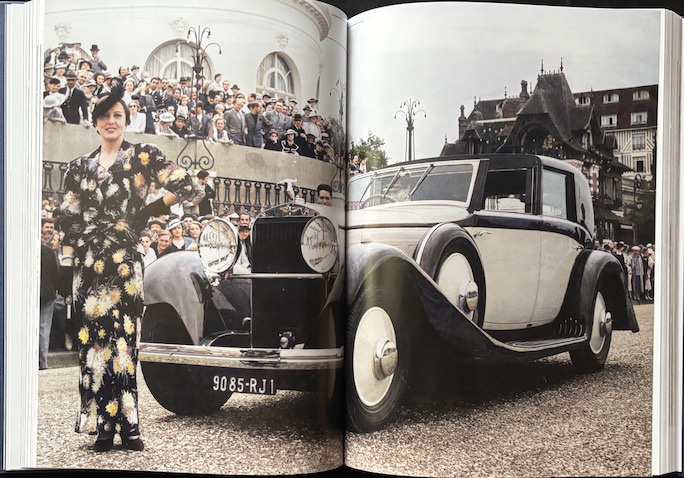
Women often “presented” the car which doesn’t always mean they drove it. In this case it does and one has to applaud Madame Furgerot for the effort of wiggling herself behind the wheel without ruining the folds of her distinctive dress (none of the women in the background wear anything as bold).
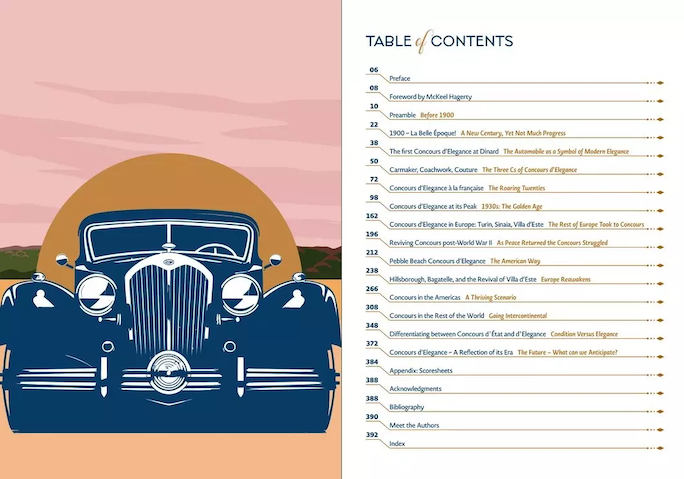
Notice the stepped arrangement of page number and chapter title. Easy enough to execute, hard to think of.
There is very much to discover here. Will the book “broaden the base”? Certainly if you have $150 to spare … which, if it’s any consolation, doesn’t even buy you a ticket to a major concours. Speaking of money, the book doesn’t address something that will surely be on the mind of anyone who wants to be more than a concours spectator: the costs in showing a car, and the expenses a judge incurs on the path of moving up the ranks to get to the majors. It’s one of those “if you have to ask” things.
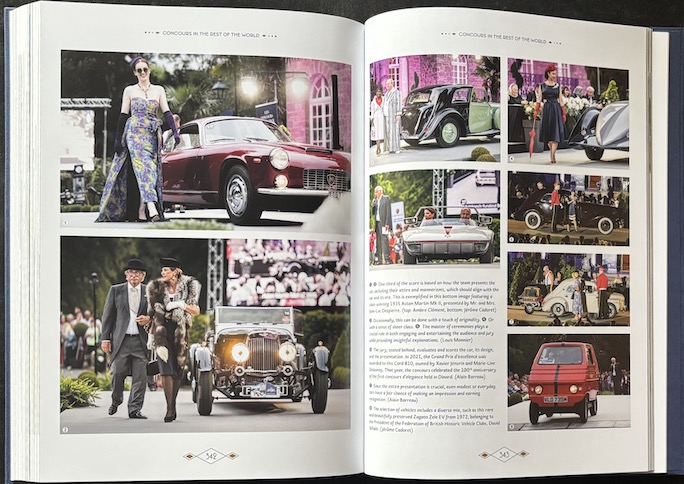
“One-third of the score is based on how the team presents the car, including their attire and mannerisms, which should align with the car and its era.” What would be the appropriate mannerism for the little Zagato, bottom right?
Copyright 2026, Sabu Advani (speedreaders.info).
























 Phone / Mail / Email
 RSS Feed
 Facebook
 Twitter