

Mustang Unbridled, The High-Octane History of Ford’s Legendary Pony Car
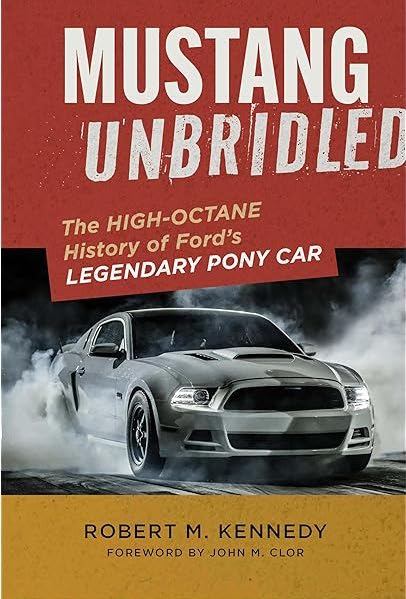 by Robert M. Kennedy
“Even the most jaded critic, hellbent on giving ICE vehicles the cold shoulder, will always be hard-pressed not to grin if taken for a few hot laps in a properly prepped pony car as the RPM, decibels, and g-forces all climb in unison. … And the 2015–23 S550 Mustang, whether a modestly equipped EcoBoost or a highly optioned Shelby, has proven more than capable of providing a very flattering combination of those sensations whether driven at redline on the track, idled down a boulevard, or parked in a collection.”
The first paragraph of Robert Kennedy’s Prologue refers to Ford’s Mustang with, “This sports car was such an enormous success, its one millionth model rolled off the assembly line on May 11, 2017.” But then the very next paragraph’s last sentence says, “This automotive icon of the ‘60s, so perfectly attuned to the time it was launched, yet so timelessly relevant that it remains the number one selling sports car in the world six decades later—saw its one millionth model roll off the assembly line on February 23, 1966!” If one wasn’t reading carefully it’s easily missed that with those first two paragraphs Kennedy is attempting to compare Porsche’s 911 and Ford’s Mustang.
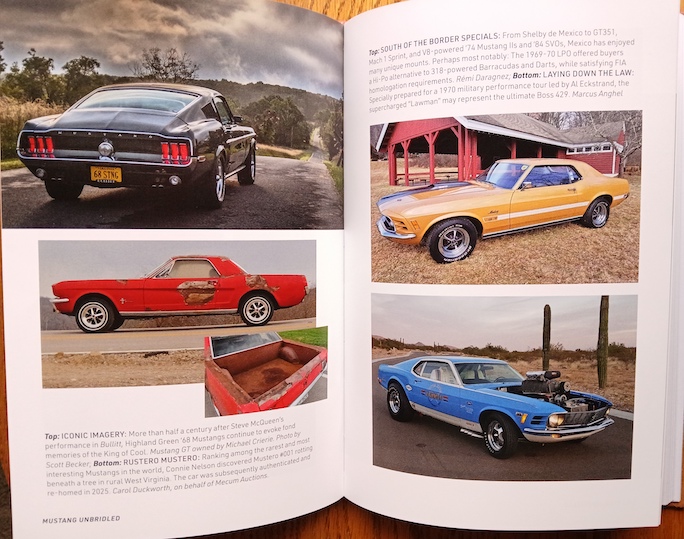
A Mustang oddity is on bottom left. It’s a Rustero Mustero. How these two-seat pick-ups came about is explained in the text. Above it is a ’68 evoking Bullitt memories. Opposite top, a Shelby de Mexico creation; below a specially prepared Boss 429.
Kennedy’s background makes that comparison understandable for, prior to opting to try his hand at automotive journalism, he had graduated from a technical institute and worked at a large Porsche dealership as one of its Premier Technicians. Subsequently his earlier writing attracted the notice of John Clor who by then was an automotive journalist-turned-Communications Manager for Ford Performance. He engaged Kennedy in 2020 to contribute to Performance.Ford.com
Happily Kennedy’s writing is more straightforward in the chapters as he recounts Mustang history chronologically. As there’s no Bibliography it requires one to read that much more carefully to learn Kennedy’s sources as he’d only acquired his first Mustang (used) as a teenager in 1998—a year in which Mustang had already been on the market for over 30 years.
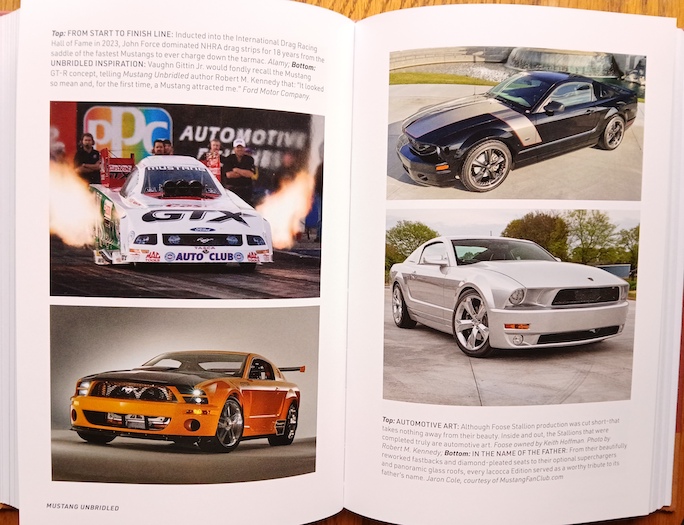
Top left, John Force-driven funny car, bottom GT-R concept, facing page, top Chip Foose-restyled Stallion, bottom, an Iacocca special Edition.
Kennedy did write your reviewer that “Randy Leffingwell’s Porsche: 70 Years book was the inspiration for my Mustang Unbridled book! I was so impressed at how well he incorporated a degree of international politics, monetary policy, currency exchange rates, and other context throughout that I decided to emulate (and expand on) that approach in my Mustang narrative.”
It’s not a total surprise the first chapter is a rather detached recap primarily of Ford history 1863 to 1962. The word choices and approach are such that a young reader possibly being exposed to some of this for the first time might find it misleading or be left with some incorrect impressions. The chapters that follow are each written following a formula or outline. First a year by year synopsis of car offerings with their various changes detailed and the comments of the motoring press of the day. Then some paragraphs on “Special Editions & Racing,” and lastly a few paragraphs under the heading “Retrospectively.”
Where and when Kennedy incorporates what he’s found historically that’s globally or economically relevant, it works. But some of his other comments aren’t as sensitive or generally aware. Granted he has no personal memory of some of the events he’s chosen to highlight—still …
The photographs are grouped together in one 32-page section inserted at approximately the halfway point. I’d not really looked at them until arriving at those pages in my reading. One proved to be most interesting containing information curiously never mentioned in the text. Were you aware a Mustang had been produced in Renton, Washington in the late 1940s? Shades of Selden, the creator, a man named Ray McCarty, had the temerity to challenge FordMoCo for trademark infringement in the mid-sixties when Mustang was released. Just as Henry had beaten Selden, so too did his grandson, Henry II, best McCarty.
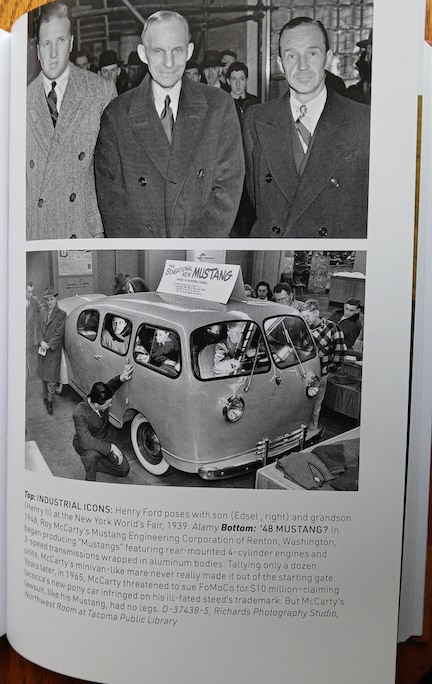
Bottom image is of that McCarty-created Mustang of which only a dozen may have been produced. Top: Henry Ford flanked by son Edsel (r) and grandson Henry II.
There are some unexpected errors that are surprising in that the publisher is not exactly inexperienced but perhaps is hiring too inexperienced proofreaders and/or editors that let a “say what?” error slip through such as Sir Stirling’s given name spelled Sterling and Jack Telnack incorrectly described as an engineer but later correctly acknowledging him as not just “a” designer but Ford’s head of international design.”
And then there’s this: the Index references Martin Luther King, Jr. Alright. In the same sentence Robert Kennedy is mentioned. But he’s not in the Index. Why do it differently? There are lines and page space to spare. That said, it’s unknown which entity handled the indexing function as different publishers do that differently. Some require the author to create the Index, some have a staff member do it, while others actually employ some sort of computer program.
So who is this book for? In truth, anyone who is sufficiently intrigued to buy it. Realistically it’s apt to be someone whose bookshelves aren’t already groaning under the weight of the over sixty books written and published about Mustang to date.
Copyright 2026 Helen V Hutchings (speedreaders.info)



















 Phone / Mail / Email
 RSS Feed
 Facebook
 Twitter