
ERA Man – Historic Racing With W.R.G. (Bill) Morris
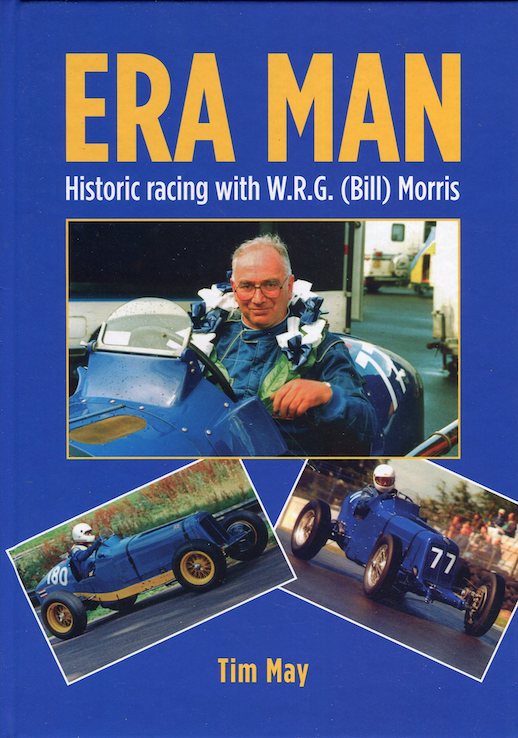 by Tim May
“This book was originally commissioned by my husband William (Bill) Morris in order to record the history of his ERAs R12B and R12C, and to explain why the two ERAs shared the same chassis number and the name Hanuman.”
—Victoria Morris
“ERA” stands for English Racing Automobiles, a rather prissy name for a marque perhaps consistent with a nation then wrestling with conflicting strands: memories of perceived past glories, the Great Depression, and the rise of European fascism.
A guiding force behind ERA, and one of their notable drivers, was Raymond Mays (1899–1980). He had been amongst the first racing drivers to operate as a professional, successfully arranging sponsors and supporters for his activities as early as 1920 when he bought a “Speed Model” Hillman at a “special price” while at Christ College, Cambridge after war service. His efforts were usually successful, at least until his establishment of the much more ambitious BRM (British Racing Motors) Grand Prix marque after World War II.
The thriving Grand Prix racing in Europe from the 1920s was often leavened by supporting races of “Voiturettes” of 1,500 cubic centimeters. One of Mays’ friends was Humphrey Cook (1893–1978), a wealthy amateur racing driver, and he supplied the initial capital for the ERAs, based at the Mays wool-broking site in Lincolnshire. The ERA was designed by Reid Railton (1895–1977) as a rather high monoposto on semi-elliptical springs fore and aft until the later “C” and “D” series which used Porsche independent front suspension. Victor Riley of the family car company supplied the in-line six-cylinder engine, which was developed by Peter Berthon, another friend and supercharged by yet another, Amherst Villiers (1900–91). They were built to “tool room” standards, and Bill Morris said the only Riley bit he found to fit an ERA was the water pump impeller. By May 1934 the first ERA was ready for racing in Britain and on the Continent. Cars were available for customers at seemingly arbitrary prices of £1,100 for the 1,100 cc variant, £1,500 for 1.5L, and £2,000 for 2Ls.
Your reviewer has been fascinated by these charismatic cars for most of his life, and a gleaning of his bookshelf yielded The Story of E.R.A by John Lloyd (Motor Racing Publications, Oxford 1949); Split Seconds by Raymond Mays (Foulis, London 1950); Motoring is my Business by John Bolster (Autosport, London 1958); Racing an Historic Car by Peter Hull (Motor Racing Publications, London 1960); The Racing Fifteen-Hundreds by David Venables (Transport Bookmans Publications, London 1984); Raymond Mays of Bourne by Michael McGregor (published by the author, 1994); and ERA The History of English Racing Automobiles Limited by David Weguelin (White Mouse Editions, London 1980). Each of these offered more than a mere recounting of history, but the book under review is a much more personal account of a life enhanced by ERAs and all the associations involved.
After the destruction of WWII, there was a will of the still youngish survivors to re-establish motorsport, and here the ERAs, all but one of the seventeen A, B, C, and Mays’ personal car which had evolved into the sole D type car built, survived to have new lives, still competitive enough to compete in the first postwar British Grand Prix of 1949. From there it was a natural transition to the races organized by the Vintage Sports Car Club which take us up to the present day.
William Roger Giles Morris was born in London in 1936 but was evacuated to rural Oxfordshire, and his earliest memories of the idyllic countryside of the legendary Wychwood sustained him until his work with the Smiths Industries in the town of Witney enabled him to move back there in 1968 to buy a cottage in the village of Leafield. In the early days of the apprenticeship, he and his friend from Smith’s, David Kergon, saw a small advertisement in Motor Sport for Hanuman II, then resident in Southern Rhodesia, now Zimbabwe. Each had boyhood memories of these single-seater cars originally built for pre-war voiturette racing in 1,100, 1,500 and 2,000 cc form but still quite competitive. Bill’s sister Victoria happened to be travelling in Africa, and was able to verify some details, ascertain that a Lotus was preferred as an alternative to drastic modification to an historic racing car, and a Ford-engined Lotus 18 was negotiated on extended terms to the apprentices through a kind motor racing authority, with the cars probably passing each other on their journeys.
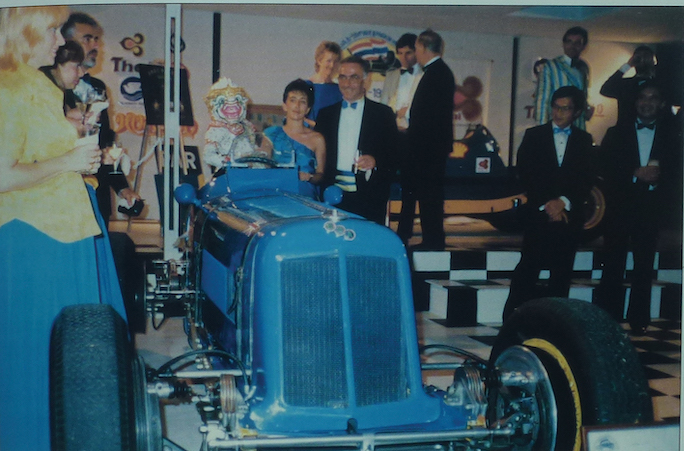
A sequel to the ball-gown color choice; Victoria Morris and friends during a visit to Thailand.
This book had its beginning in notes compiled by Bill Morris, part of which sought to explain the complicated history of the car he and Kergon had acquired, and the surprise addition of the extra chassis which arrived. Here we enter the exotic world of expatriate cousins, the Thai princes Chula Chakrabongse and Birabongse Bhanubandh. Chula had renounced his right to the throne, but his wealth enabled the talents of “B Bira” to evolve from sports to racing cars with the purchase of the second B Type built, R2B, in 1935. The distinctive shade of blue to contrast with the traditional Thai yellow had been inspired by a ball gown worn by a member of London’s milieu and R2B was named “Romulus,” to be joined in March the next year by R5B, of course named “Remus” after the second legendary twin who founded Rome. R2B had the more successful career and came into Morris’ life after he had become known for the quality of his work on the care and feeding of ERAs. After Prince Chula died in 1963, his English widow loaned R2B to the National Motor Museum, but by 1975 the storage under a leak had let water into the engine to do damage as it encountered the exotic fuel residue, so the Chakrabongses’ daughter Narisa commissioned Morris to resurrect her car. The illustrations provided by the high production standards of Tim May’s book clearly show the quality achieved by Morris in his workshop. Your reviewer has vivid memories of an instructive time spent in, around, and under R12B there; the toolroom quality and hand-fettling of ERA’s components which contributed to the reliability of the marque were quite inspiring.
In 1937, Chula’s racing team “White Mouse Garage” bought a third ERA, which was equipped with Porsche i.f.s. to be renumbered R12C, and it was named “Hanuman” after a demon god, but after an accident in 1939 it was rebuilt with conventional beam axle and reverted to R12B. This was what arrived from Africa and is known as “Hanuman II.”
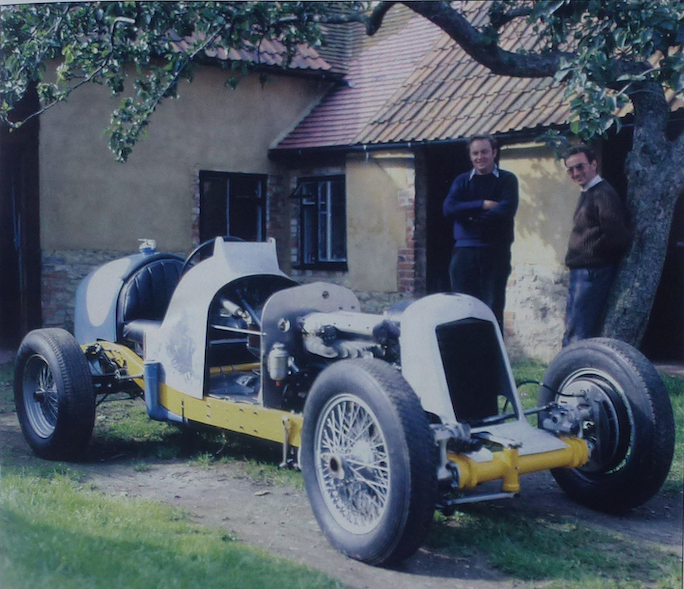
R12C during gestation with co-owners Tony Stephens and Bill Morris.
Many years of effort by Kergon and Morris led to the eventual resurrection of R12C; the unique front suspension units were modified from unused spares for Raymond Mays’s R4D, and damaged parts from Bira’s 1939 mishap were donated by Princess Chula. In 1975 David Kergon retired from the partnership, Tony Stephens took the role as a loan for eventual purchase, and 20 years later Hanumans I and II were swapped again. Railton’s design of a “sit up and beg” driving position, strong torsional rigidity, and the new “balloon” tires of 6.00 x 16″ gave predictable handling with beam axles, but Morris wasn’t happy with the behavior of the i.f.s. on the C series car, and his experiments are mentioned.
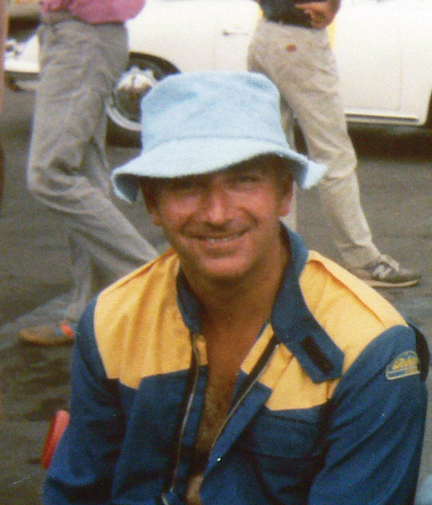
Bill Morris happy on a hot day in racing kit.
Morris’ circle of friends extended from his cottage and workshop in an Oxfordshire village right around the world. The realization in the late 1970s that subscription to a fund bringing Morris and R12B to Australia and New Zealand was the much cheaper option for Antipodeans to experience vintage racing, led to visits and indelible memories. The proximity of Grand Prix workshops in Oxfordshire and the Antipodeans that tended to inhabit them led to some innovative shared technology; this is a subtext in the book. Morris maintained a spirited correspondence as various controversies rumbled, and it is well recorded here, along with enough technical information and images to keep a reader stimulated.
The gearbox ERA used was of the then popular pre-selector epicyclic design, the special close-ratio version built by Armstrong Siddeley and used without a clutch. Careful use gave a full racing season between rebuilds, and Morris in his Leafield workshop became the trusted engineer to maintain them. Riley enthusiasts bask in the reflected glory of their cherished twin-camshafts with short pushrods design being used by ERA, but the modifications incorporated by Peter Berthon were considerable, and Bill said that the only interchangeable parts he had ever found were water pump impellers.
During 1939 the somewhat different E Type ERA was under development. GP1 was completed, GP2 built after the war, and Gordon Chapman worked during the 1960s to restore them both, and in the 1970s Chapman and Morris worked hard on them, with both E Types appearing in June 1984 at Silverstone for the biggest ERA gathering before or since as part of the VSCC’s 50th Jubilee.

The largest gathering of ERAs; Silverstone June 1984 during the VSCC Golden Jubilee.
The pre-selector gearbox was used originally by many car marques, including Alta, Invicta, Talbot, Lagonda, M.G. and Squire as well as by individuals such as Earl Howe in his 2.3 Alfa Romeo, and by the time Morris sold his business he had overhauled about three hundred and fifty of them. He kept careful notes, and for those with a keen eye the reproduced page 3 makes instructive reading.
During his final years, through his friendship with Gordon Chapman, Morris became intrigued by one of the unfortunate dead ends that were part of motor racing history—the Kieft V8 Grand Prix design of 1954. The engine firm Coventry Climax had built a promising engine for the new 2.5L formula but were discouraged by the power figures claimed by the Italian firms, spurious though they were, and development ceased. One Grand Prix Kieft was completed, and with additional parts that had been made, that car and a ferocious 4.5L V8 De Soto-engined Kieft sports car were completed.
To reread this book after ten years is quite an emotional experience; Morris died far too early from a debilitating neurological ailment, and so many of his friends around the world have also departed, including David Kergon and author May soon after publication. Your reviewer is fortunate to have known Bill Morris and to have heard some of his stories and legends. One of these was a visit by Her Majesty’s Customs and Excise representative to investigate the constitution of the racing fuel used, and the fiscal contribution perhaps due. Bill “ran a small cleaning business”, and the conclusion remained amicably unresolved after the shared bottle of whisky.
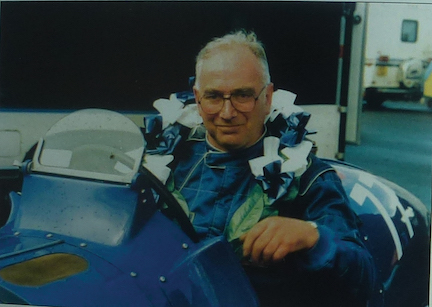
Morris in 1999.
His marriage to Victoria led to a happy time in Australia and Leafield, a clearing in the Wychwood, and his interests in music, theater, local council activity, ornithology, and environmental activity were expanded. Tim May, with the help of Bill’s friends and family, has conveyed the many aspects of a talented man and his life.
As well as the secondhand book market, Bill’s widow Victoria has retained some copies. Her email is vwmorfield@gmail.com. Originally published as a limited print run of 500 with all profits donated to progressive supranuclear palsy (PSP) and motor neurone disease (MND) charities. It sold out quickly and received a second print run of 100 in 2014 which was the 80th anniversary of the ERA race debut.
Copyright 2026, Tom King (speedreaders.info).
 RSS Feed - Comments



 Phone / Mail / Email
 RSS Feed
 Facebook
 Twitter