
Kinetic’s Electric Energy: The Story of India’s Original People Mover
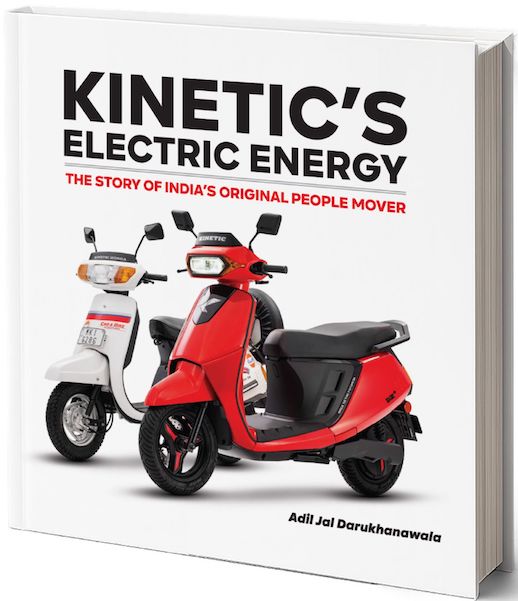 by Adil Jal Darukhanawala
“This book then is about not just three generations of the Firodia family but the story of a pioneer institution that put India on wheels in the simplest and most cost-effective manner possible. This is a story of true grit, hard work, brilliant application of mind coupled to genuine entrepreneurial spirit that gave India affordable excellence on two wheels.”
As if mopeds aren’t already a fringe subject for us, Indian mopeds definitely are. To non-Indian readers the name of this well-established maker may not mean much but even US readers should perk up: once upon a time over 50,000 Kinetic mopeds in kit form came to these shores, and would have continued to come if federal emission standards hadn’t put an end to it. Today, the firm is on the cusp of an electrified line-up so who is to say how far Kinetic’s global footprint will expand. This book brings you up to speed.
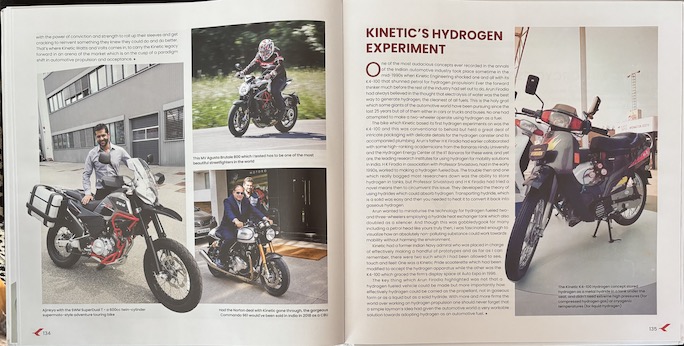
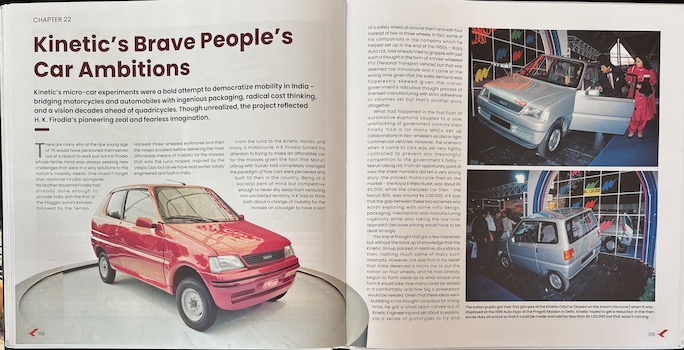
Left page, bottom right: is that a … Norton? How does that factor into the Kinetic story? This was one activity that didn’t pan out but that a deal was even in the works says a lot.
The author, a historian and journalist, is singularly well placed to tell that story because he has been a fixture in various aspects of Indian mobility for decades and thus is well connected. This is his 16th book.
Considering the modern-day size of its economy it sounds odd that India is still officially classified as a developing or emerging economy so exercise the imagination to picture what it must have been like half a century ago when this story gets underway and the trusty old bicycle was the common mode of transportation. This book will introduce you not only to matters of domestic manufacturing or rapid urbanization but also to social issues such as promoting the place of women in a male-dominated society, specifically in regards to female ridership, which is a form of independence.
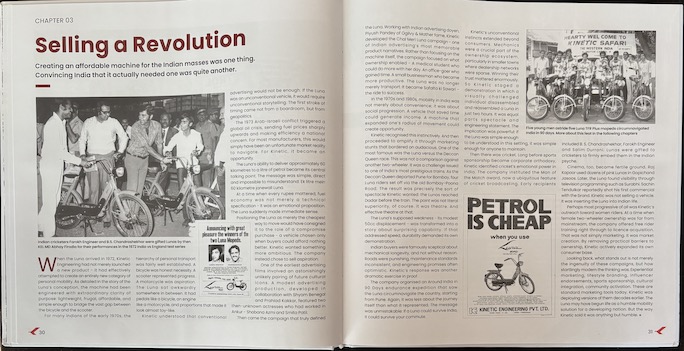 The importance of two-wheeled transport as a stepping stone to a society’s development has faded from Western memory but it’s an underlying and overarching theme in this book, as is the importance of domestic manufacture: “made in India, for India.” The book is relatively light on technical data and construction minutia. It is clearly written for an Indian audience, which is evident not least in the unchecked use of Hindi words—not three sentences into the very first page there is a mention of Atmanirbhar, which even Indians who don’t speak Hindi may not know means selfless. Long story short, audience participation is required.
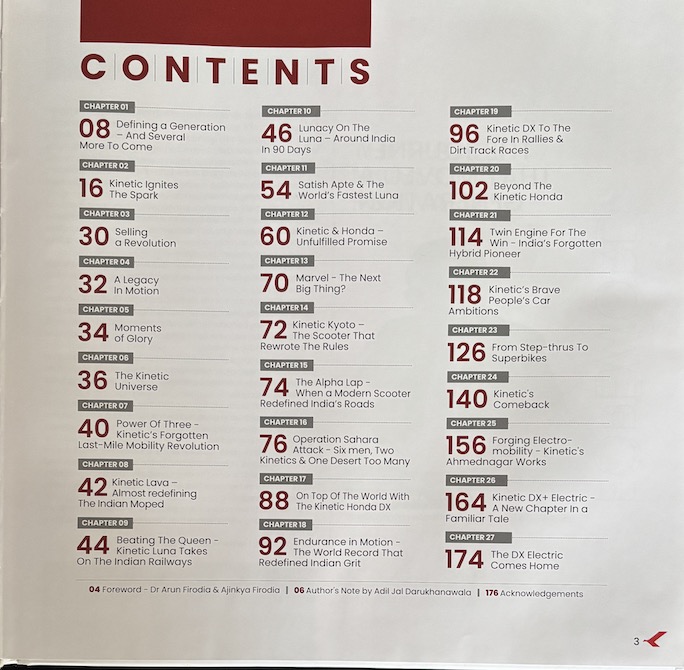
The Table of Contents and the sample pages we include here show that thought has been put into organization and layout; observe, for instance, the separate references at the bottom of the TOC to the page numbers of front and back matter:
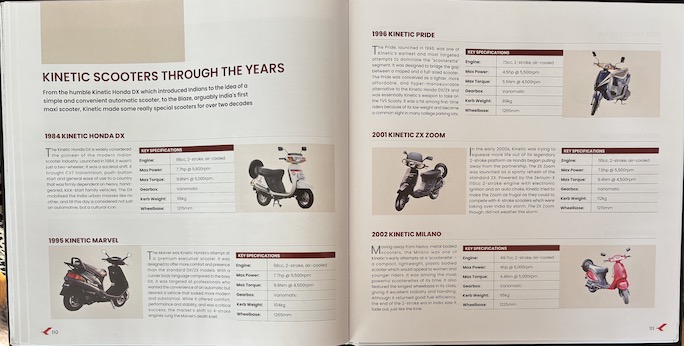
Each segment—moped, motorcycle, scooter—has basic specs and model summaries.
At almost 12″ x 12″ the book is plenty large to accommodate good-sized imagery, which is also reproduced properly sharp. Many of the photos come from rarely published sources, as do the archival documents and obviously the many first-hand accounts of people involved with the brand.
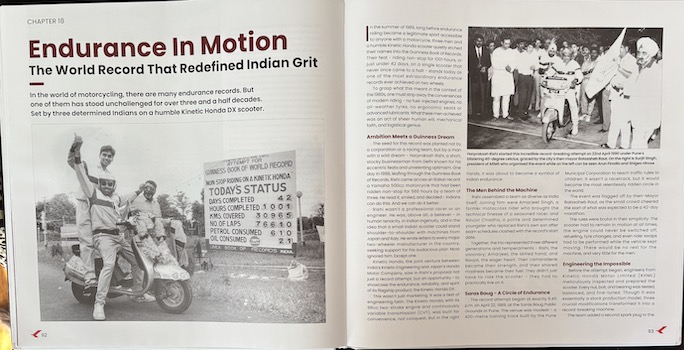
This is just one of the epic stories in this book.
Anyone with an ounce of curiosity will find plenty to discover here. There is nothing not to like in the book; certainly it cannot be faulted if the subject matter may not be universally relevant—or if the book will be hard to find outside its primary market.
Copyright 2026, Sabu Advani (speedreaders.info)










































 Phone / Mail / Email
 RSS Feed
 Facebook
 Twitter