
Lords of Speed: The Great Drivers of Formula 1
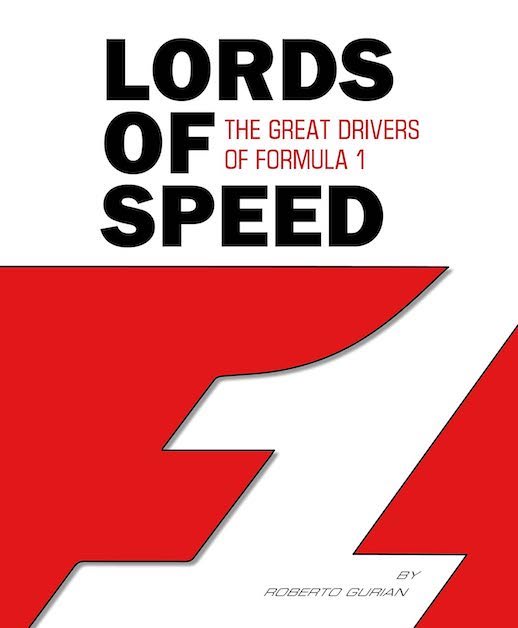 by Roberto Gurian
“It’s no surprise that many of the drivers featured in this book are no longer with us—and for most of them, their deaths were tied to accidents. However, our selection isn’t based on their fates, the circumstances of their deaths, or even their career victories. Among the many who raced and risked it all, we chose those with the most profound human depth, those whose stories deserve to be told.”
That last two sentences are they key to this book and what sets it apart, and what should pique even the well-read enthusiast’s interest because criteria are in play that transcend the realm of statistics and dry fact. If a name you think should be included is missing, take comfort in the fact that the author had to leave some of his own favorites on the cutting room floor in order to keep this book to a specific page length. Really, though, short of writing an encyclopedia there has to be an arbitrary cutoff point.
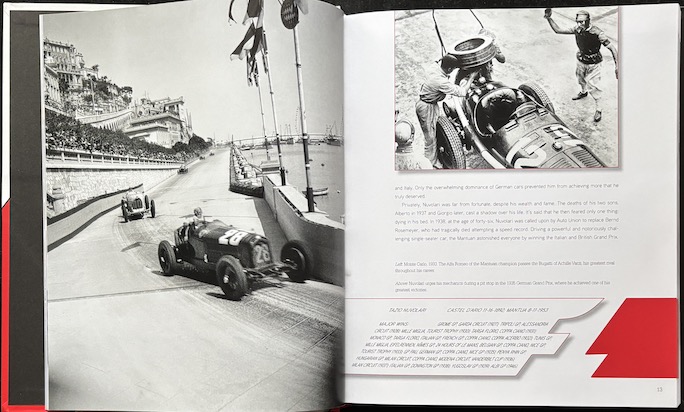
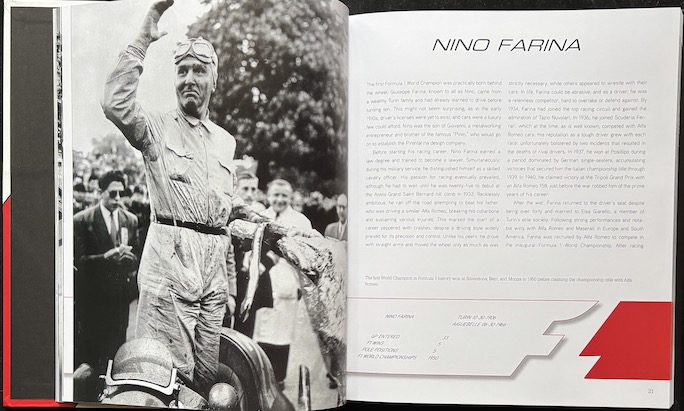
A basic data block records a driver’s place and date of birth/death as well as basic stats such as GP Entered, F1 Wins, Pole Positions, F1 World Championships. Most of these don’t apply to entries such as Nuvolari, above, who instead has Major Wins (by venue/series and date) listed whereas Farina, below, fits all of these categories because he was after all the first-ever F1 World Champion.
This book being published in the 75th anniversary year of F1 almost taints it as being one of those hangers-on that just wants to capitalize on a marketing opportunity. This is not that kind of book—the excerpt above from the Foreword makes that clear! The reference to F1 in the subtitle isn’t helping and is in fact misleading insofar as several of the drivers presented here precede F1 (as we now know it) or made their mark in other series.
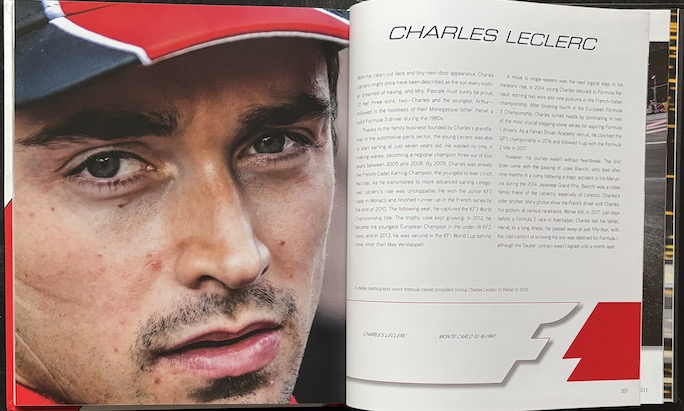
One of the names new to his edition. Why are there no race stats??
Turns out, this isn’t actually a 2025 release but ten years older and is now updated. Both editions contain 224 pages which obviously required omissions to make way for the additions. It takes some sleuthing—or a pretty deep library—to recognize this title as an Italian book called either Vite al volante. Storia e storie dei grandi piloti di Formula 1 (ISBN 9788854028746) in its original 2015 form, or, again published by Edizioni White Star, Formula 1. Piloti leggendari (ISBN 978-8854060647) in the 2025 version which is the one the English edition is based on.
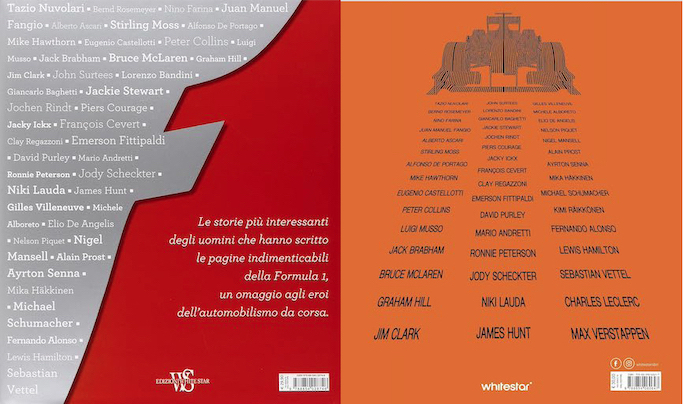
The back covers of the 2015 and the 2025 Italian editions. If you’re bored, compare the lists of names. More importantly, if you’re a designer, compare the two different treatments of basically the same material.
Gurian is a long-time automotive journalist which includes an F1 commentating gig at RSI, the Italian-language Swiss TV channel. It is not clear if the Foreword referring to “us/we” implies more than one content-shaper but if there was a photo editor, that person deserves a shoutout for really knowing where to look for suitable imagery. The photo credits list several dozen sources, often for only single photos (the Rainer Schlegelmilch archive is the biggest provider by far).
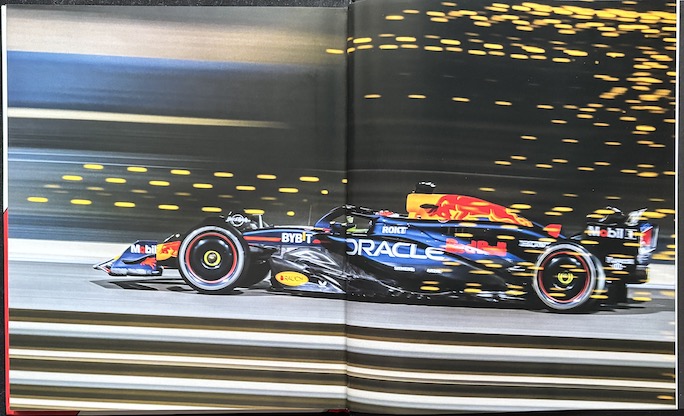
A technically and compositionally noteworthy photo. If you wanted to know who took it you’d turn to the photo credits, armed with the page number the photo was on (below):
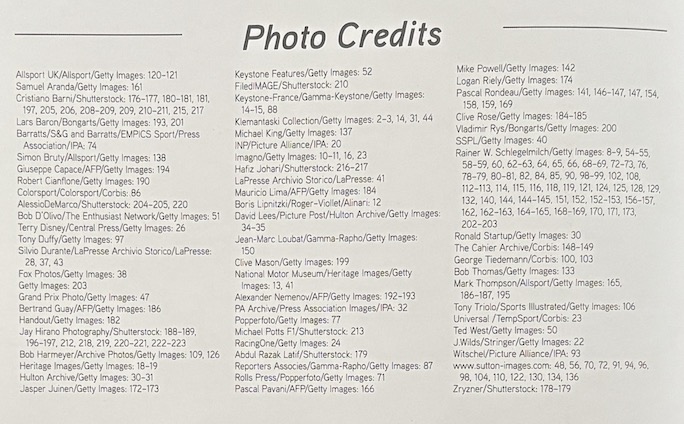
Except, that knowledge won’t do you any good: the photos are not listed in page order but in alpha order of provider surname or archive name so now you have to scan the whole list, usually more than once or even twice, to find that one page number you’re looking for!
Or let’s say you know your photographers well enough to recognize their style and you’re turning to the credits for confirmation . . . now you have to contend with the fact that the list states the given name first even though it is alphabetized by last name. Extra hassle, not nice.
Beginning with Nuvolari and ending with Verstappen, 46 drivers are presented, in what basically qualifies as chronological order of peak year/s of achievement, meaning even the casual/fringe reader will gain some sense of the overall flow of things although this is not of primary relevance to understanding the merits of any one driver. It has to be said, and is not meant as criticism, that Gurian’s strategy of singling out “extraordinary and morally compelling figures” introduces many parameters that seem difficult to fit under one hat, from the dogged absorption of setbacks that would demoralize lesser men—which pretty much applies to any top-level achiever in any activity—to highest-order selfless heroism like that of David Purley who was the only driver (1973) to abandon his own race in order to try to extricate a fellow driver from a burning car.
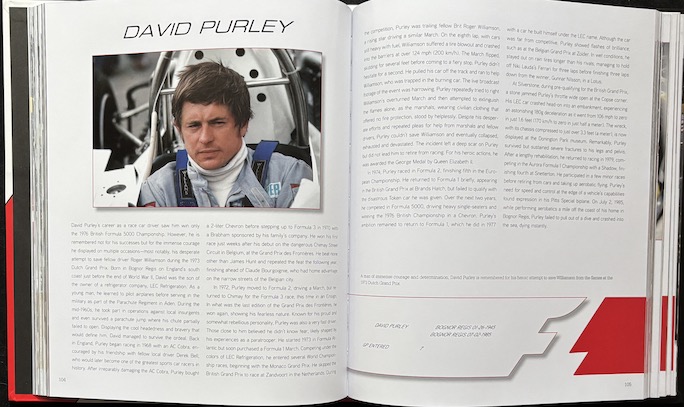
Selective as it is, the book delivers on its primary premise:
“Behind every name in this book lies a story—sometimes incredible and always meaningful.”
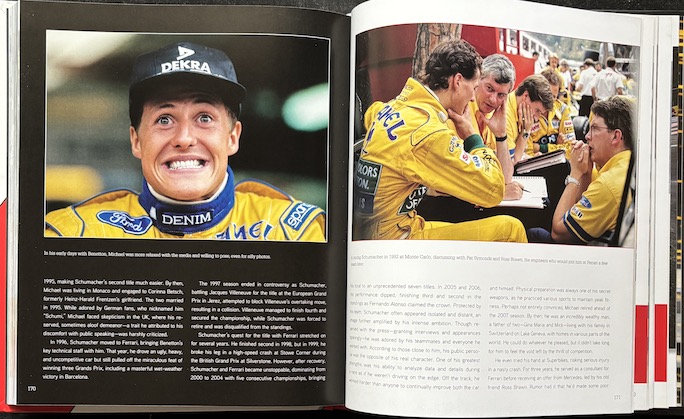
Two well-chosen photos that encapsulate the man’s essence: unbridled joy (l)—even after winning 7 World Championships Schumacher would jump into the air on the podium as if it was his first win—and uncommonly deep analytical abilities (r) and an almost peerless commitment to the teams he worked with. He also developed another characteristic, or allowed it to grow more prominent: a ruthlessly aggressive driving style, which Gurian does not sanitize but also does not dwell on as it is incidental to the main story he is telling.
Copyright 2025, Sabu Advani (speedreaders.info).
 RSS Feed - Comments












 Phone / Mail / Email
 RSS Feed
 Facebook
 Twitter