
Wheels of Change, Headlines from a Village on the Edge of the Motor Age
 by Joe Baldwin with Tom and Bill Overbaugh
“In cities and villages around the world, the start of the 20th century witnessed the rumble of hooves yielding to the revolutionary hum of engines, marking the onset of an era that would forever alter the way we moved, lived, and connected with each other.”
Trumansburg, New York is described as “a small hamlet in the Finger Lakes region of central New York State.” The nearest town of size is Ithaca, known for being the home of Cornell University about 11 miles south of Trumansburg. Today Trumansburg is considered a bedroom community for Ithaca.
Two newspapers served the area, the Trumansburg Free Press and Trumansburg Sentinel. Their archives have been preserved and are the source for this book begun by local historian Joe Baldwin. When Baldwin (1941–2017) passed with the manuscript unfinished, father and son duo Tom and Bill Overbaugh took it upon themselves to complete and publish these memories of the earliest years, 1899 to 1915, of the automobile in Trumansburg.
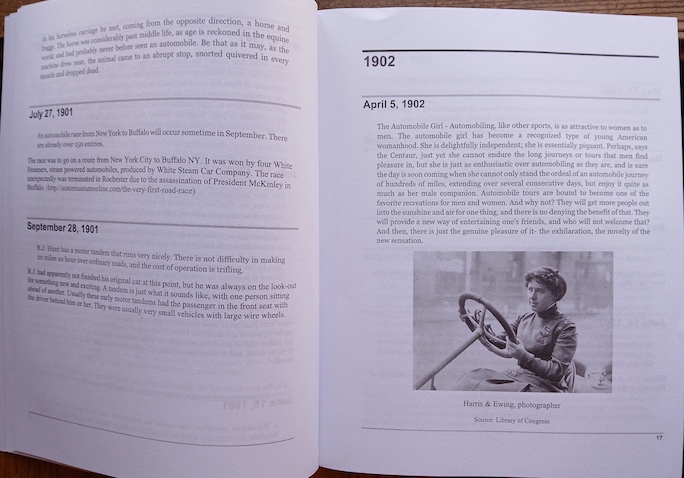
Of the driver we are only told that she is representative of “the automobile girl . . . a recognized type of young American womanhood . . . delightfully independent.” If you knew her name was Joan Newton Cuneo you’d not be surprised by this description although being a bona fide automobile racer she is hardly representative or a recognized type. Also, born in Massachusetts she certainly wasn’t local to Trumansburg nor even New York although she did live on Long Island for a few brief year.
Part of the fun of reading snippets from the turn of the prior century newspapers is the language. A word not commonly used today appeared in the second entry paraphrased as follows: An automobile went through town and scared a horse so that he fell and broke a thill.
Thill in use at the time refers to one of the buggy’s shafts that connect the horse to the buggy. Looking further it has alternate meanings as it’s also the floor of a mine and the name of a village in Pakistan.
On the next page it’s not the language but the thread connecting Trumansburg to one of today’s top 25 auto industry suppliers, BorgWarner. The newspaper snippet reads Messrs. Hunt and Morse returned from New York Saturday night.” Their visit had been to attend the first NY Auto Show with Baldwin then going on to describe that Everett Morse and his brother founded Morse Chain Company which today is a subsidiary of BorgWarner. Six degrees of separation, indeed.
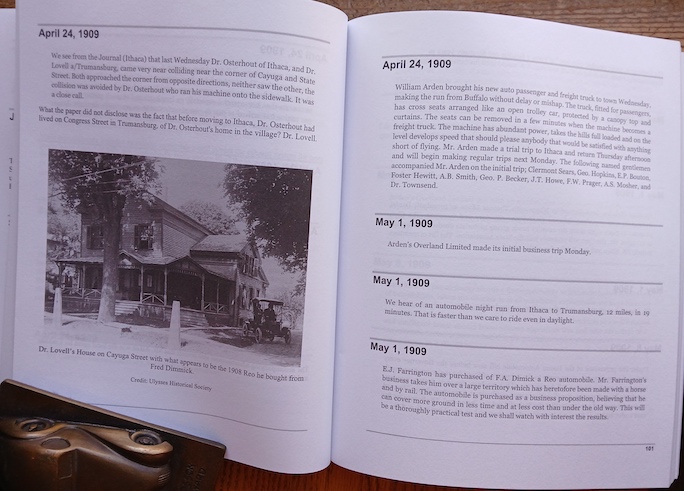
The book’s caption for this image identifies it as a local doctor’s house. Notice the two light-toned columns on either side of the tree out front for tying a horse or a team to.
Page after page, these snippets describe situations that echo ones in another book we told you about not long ago. Trumansburg did indeed wrestle with edicts defining then governing speed and other issues as told of by Kerry Segrave in his book Taming the Automobile.
Wheels contains some typos that truly are just that—Lucille in one place and a few lines later referring to the same lady as Lucile—but one appears to be that of the newspaper being quoted and consistently spells Artic thusly while Baldwin’s comment spells it Arctic. Then there are the snippets and Baldwin’s comments for 1905 on pages 43–68 yet the TOC has no listing for that year, likely because the section break in the body copy hadn’t been purposely made.
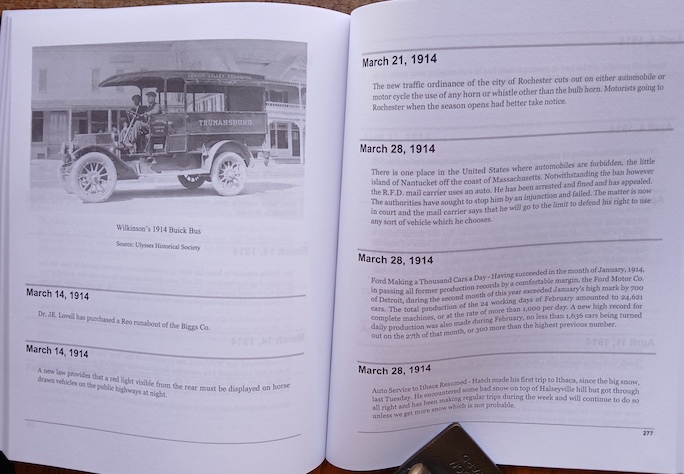
By 1914 the newspapers had learned how to correctly spell Buick. But entry after entry in 1906 and 1907 had phonetically spelled it “beauic” “until someone managed to read badges on the car itself.” This Buick bus has seating for 14 passengers and was used on the route traveling to/fro Lehigh Valley Station.
While none of the cited “oopses” or any of the others encountered on the pages reduce the historic relevancy of the snippets and the Baldwin or later Overbaugh comments, they do insert a “hiccup” or mental interruption in the flow as a reader makes the way through the pages.
Baldwin’s comments demonstrate his knowledge such as the one related to a June 17, 1905 news item noting that a fire in NYC had destroyed the Rainier dealership. Baldwin inserted a few lines of history regarding the Rainier marque adding “the January 2009 issue of Cars & Parts . . . tells of the 1909 New York Herald-Atlanta Journal Good Roads Tour . . . has several pictures of female race driver Joan Cuneo driving her Rainier.”
The potential for Wheels of Change being useful to other historians or researchers is lost as the authors identified each entry only by date with no indication of which publication it originally came from. That relegates Wheels to being a light read transporting the reader back to those years 1899 to 1915 and what it was like to live with and adapt to the increasingly ubiquitous automobile in daily life in the Finger Lakes area community of Trumansburg, New York.
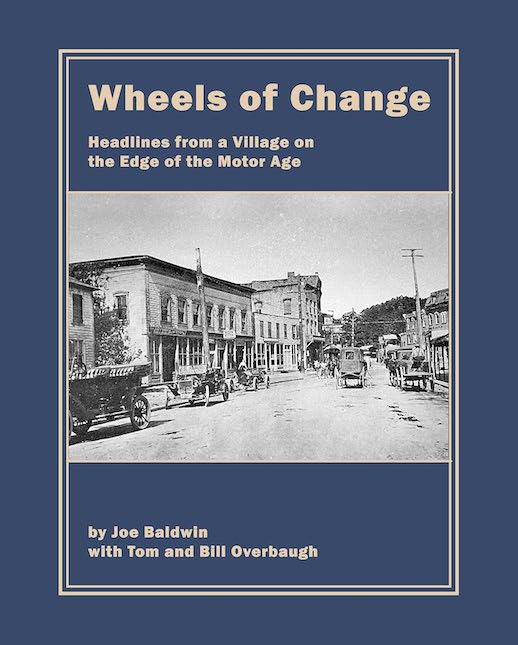
The image on the cover is that of Trumansburg’s main street but the year is not noted. Another similar image from a slightly different perspective is offered on another interior page. It too doesn’t indicate the year though is likely the same timeframe as it shows a similar mix of motorized and horse-drawn conveyances. Your reviewer found the caption rather curious. It reads “Main Street doesn’t look too different today.” Really? Over a century later Trumansburg’s Main Street hasn’t changed noticeably?
To conclude this commentary on a nostalgic read, here’s a blurb found in the October 24, 1914 issue of one of the papers mentioned at the outset: “A number of men have found out to their sorrow that it is easier to mortgage a home to buy an automobile than it is to mortgage an automobile to buy a home.”
Copyright 2026 Helen V Hutchings (speedreaders.info)
Wheels of Change, Headlines from a Village on the Edge of the Motor Age
by Joe Baldwin with Tom and Bill Overbaugh
privately published, 2025
346 pages, 39 b/w photos, softcover
List Price: $20 print, $9.25 Kindle
ISBN 13: 979 8 2650 4825 7
available from https://www.amazon.com/Wheels-Change-Headlines-Village-Motor/dp/B0FRLKHLSP
 RSS Feed - Comments


































 Phone / Mail / Email
 RSS Feed
 Facebook
 Twitter