

American Naval History in 50 Ships: Unsung Vessels from the Colonial Era to the Cold War
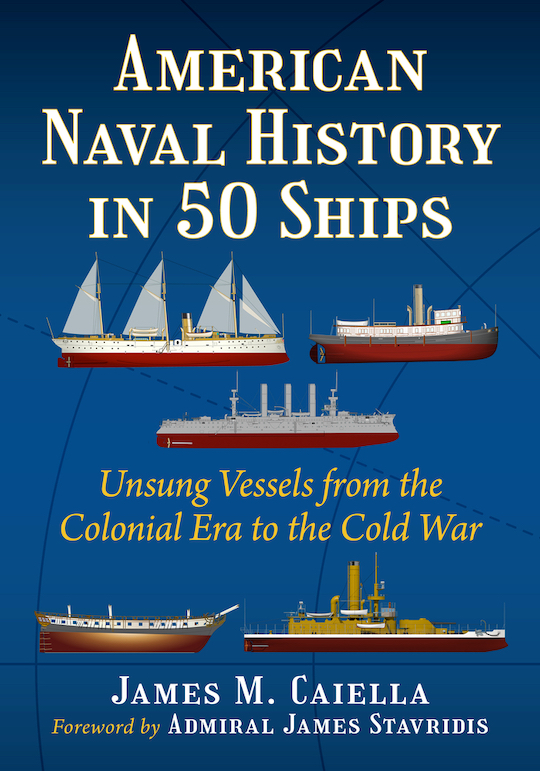 by James M. Caiella
“The continuum from among the very first ships of the Continental Navy to the first of the world’s supercarriers . . .is not only about the literal progression of the ships and their designs and concept changes over time—for ships are nothing more than vessels without the men, and now women, who crew them. The crews are the heroes. They make the vessels heroic ships.”
From its title—well prior to beginning reading—the title intrigued. Then, following the first inspection of pages, so too did the 22 pages of bibliography organized by chapter and only three fewer pages of the end notes, also organized by chapter. Then, oh my gosh, not one but two indices, One is described as general, the other is of ship’s names. Of that latter index, it names on the order of tenfold those indicated by the book’s title that are written about/told of-—and many shown—on the book’s 300+ pages.
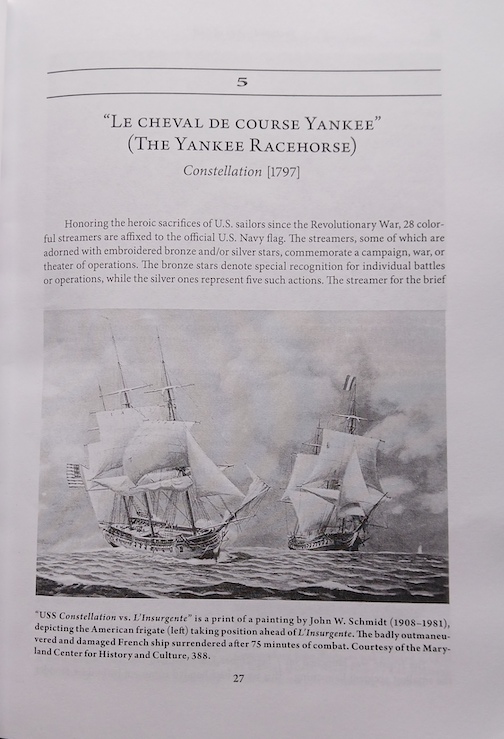
Those ship stories told are arranged chronologically in five sections: “Age of Sail,” “Steam and Civil War,” “Age of Steel,” “World War II,” and “Cold War.” All of the ships shown on the cover are real. That said it is puzzling and interesting that only one comes from an era or section other than “Age of Steel.” The frigate [1] Constellation is also shown more dramatically about to accept surrender of her opponent flying the French flag, L’Insurgente, in the painting immediately below.
The ship top left on the cover is Bennington built on the cusp of sail giving way to steam so she was built and outfitted with both. Beside her is Hudson, a gallant little, at only 94feet in length, tug. Hudson served the Navy and Coast Guard well for 37 years. Middle is Brooklyn, designated by US Navy as Armored Cruiser No 3. She would become “the stage for a political controversy that dragged on for four years” as is explained in her chapter, the 28th. Bottom right is Wyoming described as the last of her type—called a monitor—and in reality had been declared obsolete just a year or so after being built.
Prior to starting reading I’d anticipated finding on the pages being introduced to 100 landmark ships with each representing significant technological or design advances. By the time I’d reached the start of the third section “Age of Steel” the realization came that that is not quite what the book was providing its readers. Rather it was relating some interesting naval histories some of which told of advances, some of miss-steps, and some of just plain goofs (often expensive—some staggeringly expensive—ones at that) over the course of a century of years.
It is likely the ships told about in the eight chapters of the concluding section will stay with you the longest after you finish reading. Partly because they are the most contemporary but also because the stories are among the book’s most emotionally charged telling of heroic crews that, harking back to the opening quote above, render their ships’ names legendary. The most dramatic is told of in the book’s very last chapter with the crew of destroyer escort Kirk “an integral part of the rescue of tens of thousands of refugees in ‘one of the greatest humanitarian mission’ in the history of the US military.”
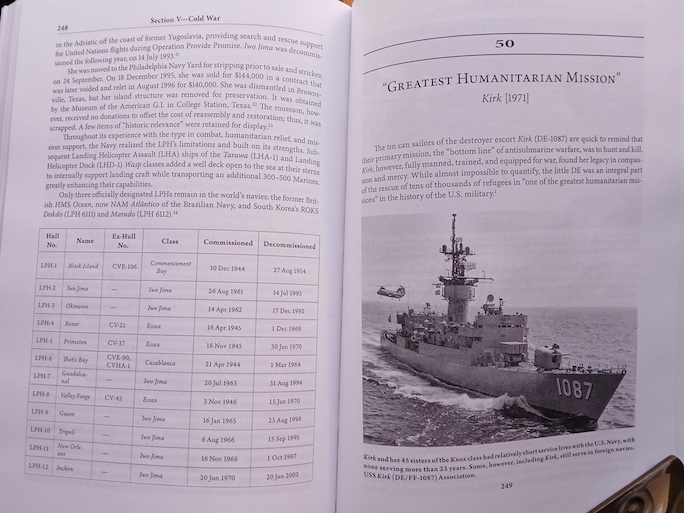
The chart on left page lists various LPH (landing platform-helicopter) ships while the concluding—and very moving—chapter begins on the facing page. Shown is the Kirk which still survives in service with the Taiwanese Navy.
Each chapter had originated as an article this book’s author had written and had been published in the Naval Institutes’ publication Naval History to which James Caiella has contributed in the role of senior editor for a number of years. So while technically Naval History magazine holds the copyright to each of the originals, none are simply republished verbatim. For each Caiella engaged in additional research so articles could be—and were—expanded upon in this book. Hence he says this book has been “a work in progress for nearly a decade.”
In addition to the above described bibliography, end notes and indices, Caiella has also included a most useful two-page table of “Ship Designation and Abbreviation” explanations. His book is a scholarly and interesting work sharing stories of naval (small n) history.
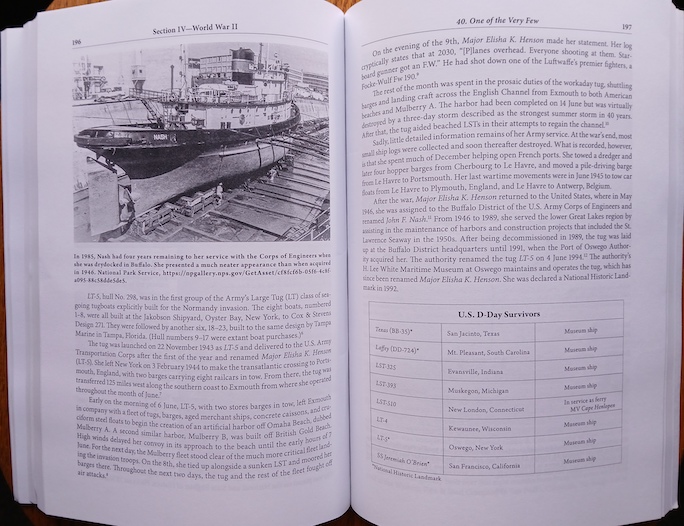
Initially named Henson, Army tug LT-5 was later renamed Nash. She’s one of the few surviving relics from the D-Day Normandy Beach invasion. Today protected as a National Historic Landmark she is maintained at White Maritime Museum in Oswego, New York.
- The definition and description of a frigate has changed over the ages. During Constellation’s era (1797–1854) it meant a fully-rigged, square sail ship built for speed and maneuverability.
Copyright 2025 Helen V Hutchings (speedreaders.info)



























































 Phone / Mail / Email
 RSS Feed
 Facebook
 Twitter