
Formula Atlantic: Tales from the Champions & Top Competitors, 1969–2009
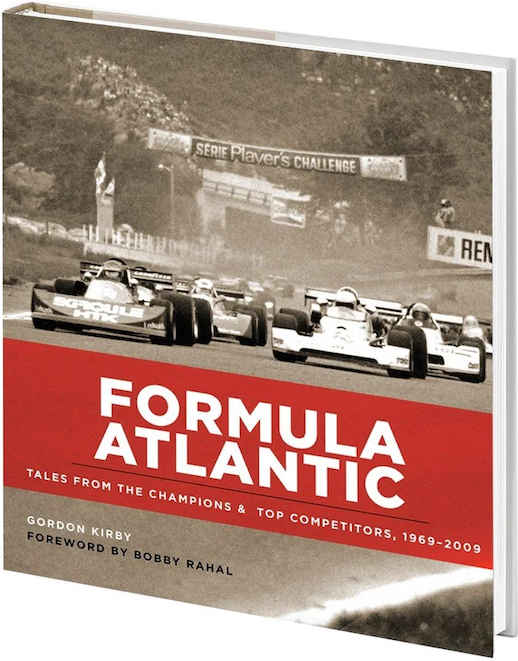 by Gordon Kirby
“The roots of Formula Atlantic go back to the Sport Car Club of America’s creation of a five-race professional single-seater road racing championship in 1967 for a combined field of Formula A, Formula B and Formula C cars. In 1967, Formula A essentially meant F1 (unrestricted three-liter engines at the time), but the series was dominated by the smaller 1,66-cc Formula B cars which comprised the majority of the starters. The inaugural championship was won by Texan Gus Hutchison in a Lotus 41C Formula B car.”
Is your head spinning? And we’re only in the Introduction so cinch that harness!
If you’re among the cohort of newly converted F1 fans you’ve probably never heard your esteemed broadcasters refer to any of the above, never mind that Atlantic was in its day seen as the most important training ground for open-wheel driver development in the US and Canada. It still exists today, but in totally different and very much lesser form.
People with an interest in this now basically forgotten series will know how thin the literature on the subject is, and they will know what a complicated story this was/is, and they will appreciate that someone with the chops of a Gordon Kirby has tackled the subject.
Yes, indeed. But do re-read the subtitle: there’s enough of a hint there that this will not be a first-this-then-that sort of linear blow-by-blow history. Having read the book, which is helped by having an Index although it is only of people, it would be quite impossible, well, difficult at least to pass a test on the subject. Mind you, this is not a shortcoming of the book, or, perish the thought, the author—it’s just not meant to be that kind of book. Also, and again take your cue from the subtitle, Atlantic’s entire life span is covered.
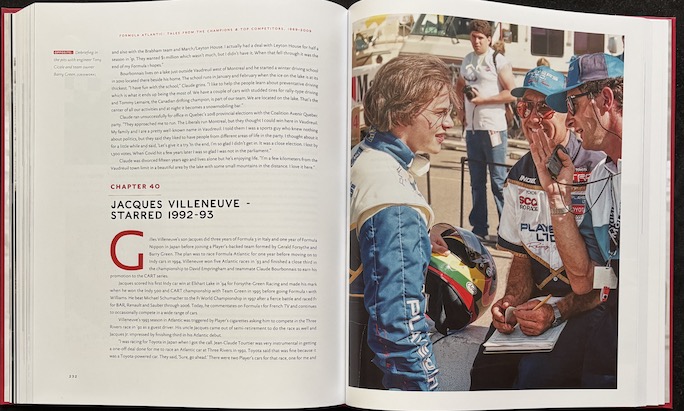
Some names you know, some you probably don’t.
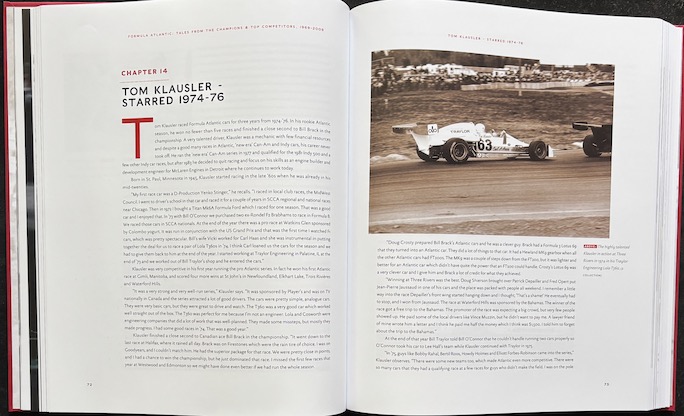
Quick sidebar: this book started as a Racemaker Press project, instigated by its chief Joe Freeman who had raced in Atlantic in its early days (he wrote the Preface here)—suffering a horrific crash that ended his competitive racing and had long-term health effects that finally pushed him into shuttering his publishing house in 2024, whereupon the project passed to David Bull Publishing. This sort of close-nit, communal dynamic is something that comes through in these profiles of some 54 people who left their mark on Atlantic as drivers, team managers, mechanics, organizers, and journalists. Actually, it’s not so much them leaving a mark on the series as the other way around, which is really not the same thing.
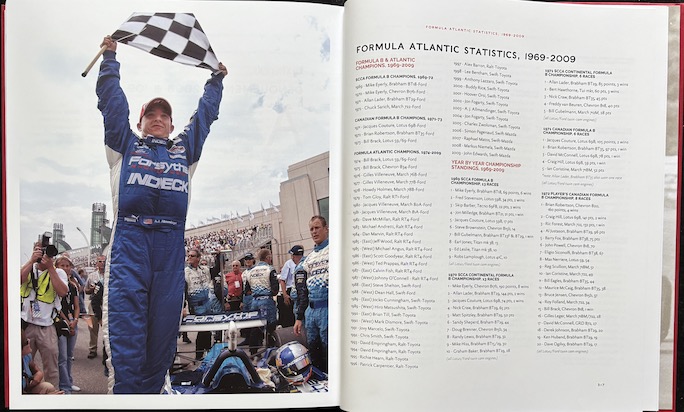
There are several places in the book—the Foreword by Bobby Rahal, the Intro by the author, and statistical tables in the Appendix—where a sort of birds eye picture comes into focus. Quickly you’ll be asking the same question just about everybody in this book raises: why was this important and effective step in the ladder system of North American racing dropped by the sanctioning bodies? If CART and IRL—and the CART/IRL war—are already on your radar you have one smoking gun. There are others, this book doesn’t shy away from unvarnished analysis.
Each chapter is the profile/feature on one principal person, mostly 3–6 pages long. They are arranged in basically chronological order but obviously overlap since many of these folk were active at the same time. Kirby introduces the person and then the exposition takes the form of first-person reminiscences, augmented if needed by Kirby. The quotes are allowed to stand as is, with no editorializing. There is surprising frankness: “Can’t stand the Sky TV announcers”—Allan Larder; “Tony George really hurt Indy car racing”—Claude Bourbonnais; “The Balance of Performance is basically anti-technology. It’s supposed to be a sport where the best win rather than penalizing people for doing a good job”—Nick Craw. You may have different opinions; work it out.
The stories meander all over the globe, everything and the kitchen sink comes up; as to cars, a Tui shares the page with a Crossle or a McLaren, Lola, March. Lots and lots and lots to take in, connecting people and events you recognize from other contexts.
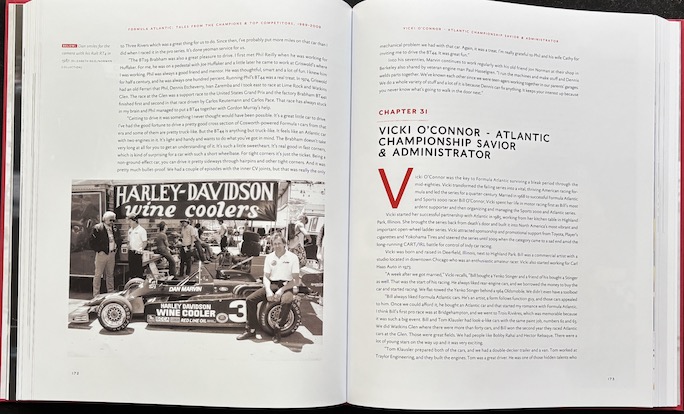
These folks totally know how the sausage is made.
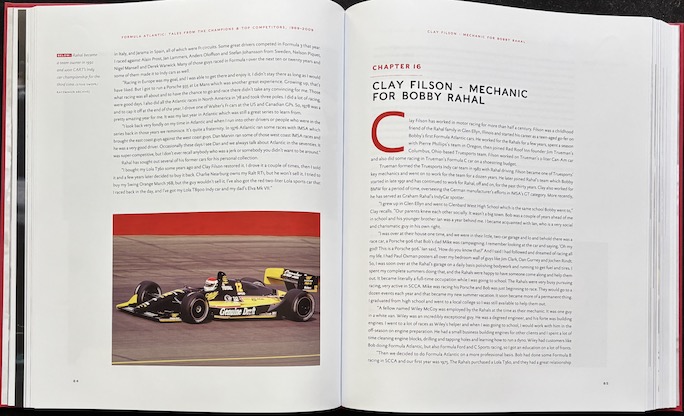
Kirby got his start in journalism right around the time Atlantic took form, starting with Autosport in 1973 as Pete Lyons’ replacement on the European beat. Anyone who is a writer knows that prickly beast called “research.” It is positively intimidating to see what seemingly bottomless well Kirby and friends, all veteran journalists and in many cases book authors, are able to draw from.
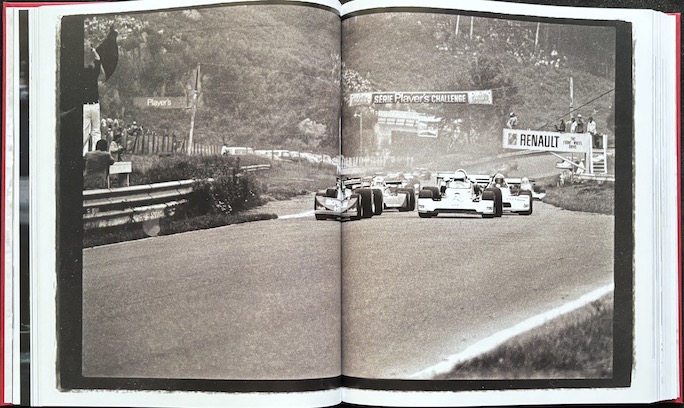
Our earlier mention of Racemaker Press threads the needle for explaining why there are so many images here from the Racemaker Archive, not quite bottomless but very well stocked indeed.
We leave you with an analogy that works for us: this book is not linear but rather like a tree with many branches. You explore one, then double back to the main trunk and continue on, and on, and on. In the best way, this book is quite exhausting.
We don’t like dwelling on MSRP but in a world where everything gets more expensive all the time, the measly $80 David Bull is asking seem like a misprint for this type of “high performance” book (9.5 x 11.5″). If you must spend more, there’s a Publisher’s Edition for $130. Limited to 200 copies it is hand-numbered, specially bound, and personally autographed by Kirby and six participants in the Atlantic story.
Copyright 2025, Sabu Advani (speedreaders.info).









 Phone / Mail / Email
 RSS Feed
 Facebook
 Twitter