
Chrome Colossus, General Motors and Its Times
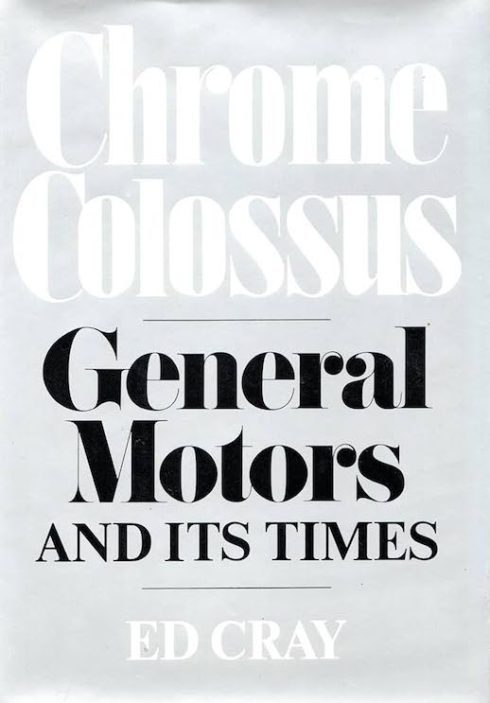 by Ed Cray
This book was proclaimed an “American business and social history” when it was released in 1980. Author Ed Cray indicated he’d been working on it for at least five years. Cray (b. 1933) was a university School of Journalism lecturer and the author of, at that time, seven published books (none of which were even remotely transportation oriented) plus numerous articles. He would go on to have a total of 18 books published prior to his passing in 2019 including biographies of Woody Guthrie, General George Marshall, and Chief Justice Earl Warren; Chrome Colossus remained the only time he tackled the transportation industry.
This volume has resided in my library since, well, for a long time. Yet I do not have a clear recollection of having previously read it. So being curious to see how it stood up 45 years after its original publication—especially given GM’s 2009 implosion and subsequent downsizing—I pulled it from the shelf, opened the cover, and commenced reading.
At the time Chrome Colossus had been written and published, GM was that incredibly globally influential giant that no once could conceive would ever be brought to a point where it would declare bankruptcy. Yet, in retrospect, reading what Cray wrote—his prospective gleaned from congressional and senate hearing testimonies, business journals, daily newspapers, court records, magazine article as well as automotive histories, as his nearly 100-page combined notes, bibliography, and index section clearly show—it shouldn’t have come as any surprise. There truly is no such thing as being too big to fail. The most powerful, influential etc are eventually brought back to reality by their own belief of invincibility.
Cray and his publisher do include two eight-page sections of black and white images. None are remarkable to those well-familiar with automotive literature as all were sourced either from the corporations or other public sources as indicated on the photo credits page. It’s interesting to note however that the preponderance of automobile photos are of teens, twenties, and thirties cars and executives with but one each from the fifties, sixties, and seventies. Yet narrative surrounding those latter eras fill at least one third of the book’s pages. Although it is possible that lack of balanced image representation across all the years is the publisher’s doing rather than the book’s author.
The story Cray tells is of a corporation growing ever larger and more powerful over the decades. His sources are extensive but for his narrative Cray chose to write mainly from the perspectives of those with offices on the 14th Floor, where General Motors’ upper level management was ensconced, or “cloistered” as Cray describes it, rather than from the design or manufacture and marketing and sale of product perspective.
Cray tells of the early pioneers who were as capable of creating product as they were of building a company to marketing and selling. He contrasts their energies and abilities with postwar upper management with officers growing ever further removed from product or customers, choosing instead to focus on affairs of business, especially profits and stockholder concerns of dividends and value per share of stock. Executives promoted were too often unaware of labor issues, much less knowing anything about product design, creation or manufacturing. A number are quoted saying things like “I have never set foot in a single manufacturing plant,” or “Growing up in financial we think we know everything . . . I suddenly realized I didn’t know the first thing about an automobile, let alone the mechanics of meeting a production schedule.” That last from the man named to head the corporation in 1970, Tom Murphy.
Worthy of noting is the book’s 1980 list price, a nickel shy of $15. That alone says a great deal about oh, how the times have changed!
Cray concludes his narrative just as the 1980s begin and his last two sentences indeed portend what the future might hold for GM although it will struggle along, top- and middle-management heavy, for nearly another thirty years. “General Motors’ policies, predicated upon continuous expansion—the philosophical mainspring of the corporation—were inadequate for the new order of things. Bewildered, General Motors lumbered into the future.”
Especially for those born 1980 on, Cray’s Chrome Colossus does a fine job telling the backstory how it all came to be.
Copyright 2025 Helen V Hutchings (speedreaders.info)

























 Phone / Mail / Email
 RSS Feed
 Facebook
 Twitter