
Formula 1 All the Races: The 100 Greatest Races
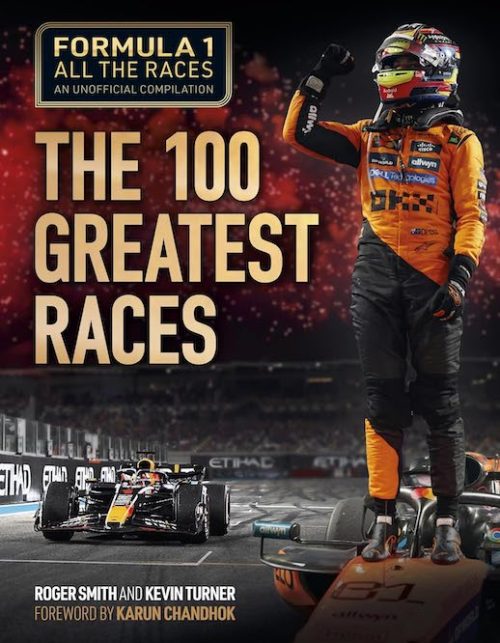 by Roger Smith and Kevin Turner
“Knowing they didn’t need to beat _ _ _ on the road, McLaren opted for a risk-averse strategy aimed squarely at banking the necessary points. Until the rain arrived with five laps remaining, _ _ _ was always on course to secure the title, the outcome, both of race and championship, something of a foregone conclusion. Until, that is, it suddenly wasn’t. This routine race suddenly exploded into an unforgettable finale, one of the sport’s most heart-stopping reversals of fortune.”
Do you know what the missing names are? It’s 2008 if it helps.
Any one of the 100 races in this book could have yielded a suitably gripping excerpt with which to start this review. In fact, more than those 100 would fit the bill, but they’re not in this book, which takes us right into the thick of things: disagreement is inevitable, but not to be shied away from. It is baked right into the premise of this book—as long as it is based on something other than just making stuff up. The authors are clear: “This book is rooted in opinion. Informed opinion backed by knowledge and experience, but opinion nonetheless. And the conclusions drawn from those opinions won’t resonate with everyone.” Both authors have unimpeachable street cred, Turner as editor in chief of Autosport magazine, “that icon of British motorsport journalism,” and Smith as author of a stack of motorsports books.
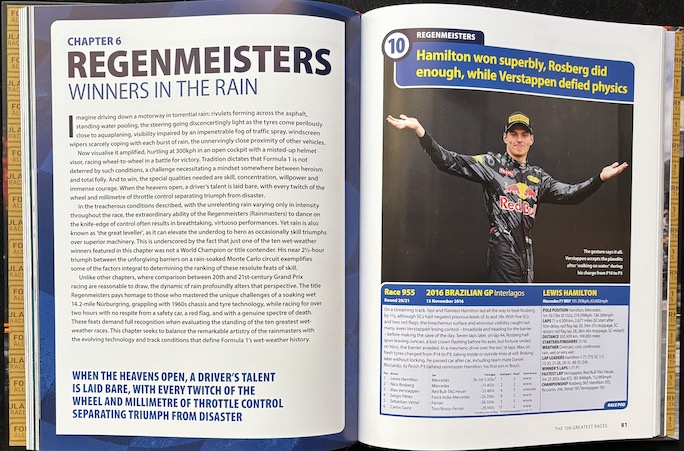
An example of one of the ten themes into which the book is dividided.
While the book has a fine Foreword by former F1 driver and current Sky Sports commentator Karun Chandhok and a fine Intro (unattributed so possibly by the publisher) those wise words above that the authors offer by way of managing expectations, are relegated to the very end of the book—and one can well imagine some readers not making it that far, having blowing a fuse along the way. Although, the mere look of the book and the “All the Races” verbiage in the title ought to have sparked recognition: you know this book, or should. Along with others by Roger Smith they don’t exactly constitute a series but they circle around the same subject/s and they share key features, specifically the innovative “Race Pods” data sets for which the first book in 2012 was shortlisted for a British Sports Book Award. Anyway . . .
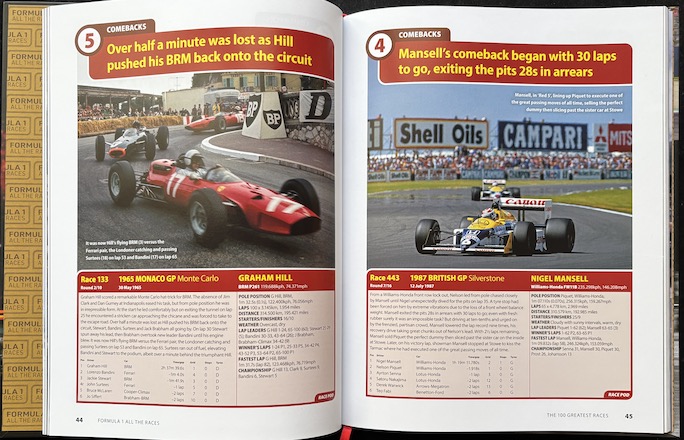
An example of the Race Pods. Everything that matters, and in a uniform format.
Picking one hundred races out of the 1120 between May 1950 and May 2025 (the 75th anniversary if that isn’t obvious) seems not impossible, but ranking them in a defensible order does. Hence the book uses a different approach: establish ten distinct categories or themes—Thrillers, Duels, Comebacks, What the…?, Epics, Regenmeisters, Surprises, Pass Masters, Folklore, and Deciders—and then pick the top ten races within each category. Doable. You’ll see. Even if you don’t agree with everything/anything, you’ll get to exercise the ole memory box big time.
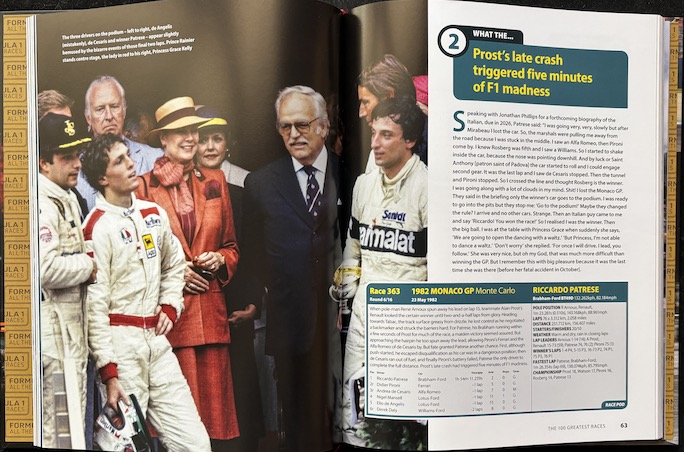
Each theme is introduced by a 1-page commentary about its parameters/criteria. The bottom seven races are then presented in the form of a photo and the Race Pod data set whereas the top three get an additional page of summary (see above) often containing extensive driver quotes. The Race Pods contain a lot of data, in a uniform format, meaning abbreviations are in full force—a page at the back of the book spells it all out.
And just to illustrate that the authors really do have a grasp of the whole picture consider that the very first theme includes events from 2016 (race 994) to 1953 (32). The writing is wholly engaging, the relevant stats well selected, the photos and captions suit the storylines—you will spend hours of quality time with this book, and pinch yourself over its absurdly low price that even buys you a ribbon bookmark!
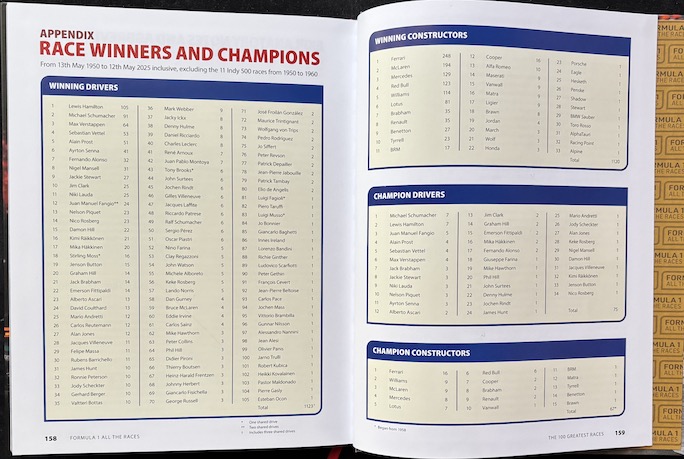
For good measure there’s a handy Appendix. To those who have eyes to see and a mind to use the first entry tells a big story: Lewis Hamilton = 105 total wins. While the talking heads make hay out of the seven-time World Champion’s prolonged dry spell, the reality is he has been on top of that list for a long time. Which isn’t to say he doesn’t want to win more. For comparison: Verstappen = 64; in between is M. Schumacher = 91.
Copyright 2026, Sabu Advani (speedreaders.info).














 Phone / Mail / Email
 RSS Feed
 Facebook
 Twitter