
Citroën SM: Accidental Death of an Icon
 by Stuart Ager
“Many books have been written about the SM, detailing its development, documenting its technological excesses but dodging the circumstances of its demise. How could the most advanced car of its generation be abandoned by its maker, barely four years after its introduction?
Without a satisfactory answer I began my own investigation. What I uncovered was not at all what I expected.”
After a long period when reporting on French politics and politicians was constrained by strict libel laws, in recent years the floodgates have opened (mainly outside of France) on how the interactions of politicians with industry and finance took place. Not to mention the hypocrisy surrounding the sanctity of family life—not that this happens in other countries of course.
Stuart Ager uses his love of French culture and products—including Citroën for the obvious reasons set out below—to lay out an engrossing tale. This is reflected in the bibliography, around a third of the entries being political histories.
The period around when the Citroën SM was in production (1970–1974) was perhaps the pinnacle of French transport technology prestige. The supersonic Anglo-French Concorde (the “e” suffix at the insistence of France) was in flight testing, and the Aerotrain 1-80 had achieved a rail speed record of 430 km/h. Matra had just won the 1969 F1 World Championships (with a bit of help from Jackie Stewart, Ken Tyrrell, and the Ford Cosworth DFV) and would score a hat trick at Le Mans. When in 1972 legendary Motor Sport reporter Denis “Jenks” Jenkinson tested the Maserati-engined SM he stated “It rates at the very top of my list of desirable cars, even above the Dino Ferrari.”
French President Georges Pompidou commissioned two convertible SM limousines; they are still owned by the French State over fifty years later. So what could possibly have gone wrong? As the author goes on to elaborate, just about everything.
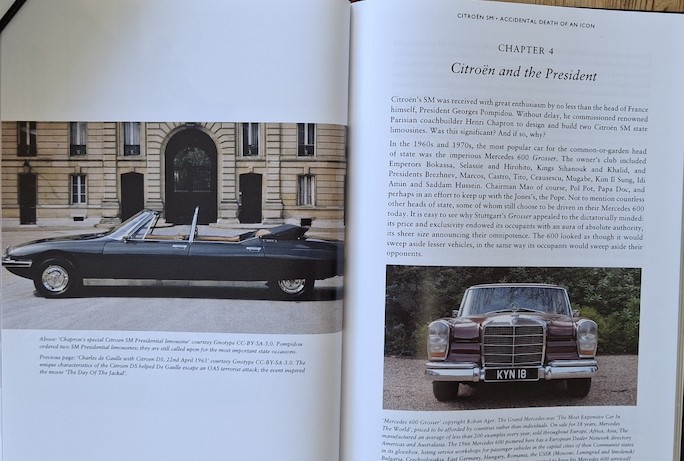
Presidential Transports; no prizes for guessing the French one.
The Citroën concern was not master of its own destiny. It had been bought by the French Michelin tire company when it first went bankrupt in 1934. It was Michelin that allowed Fiat to take a shareholding in Citroën, but only because it wanted to get a foothold in the Italian tire market. The changed shareholding had serious ramifications for Citroën’s ability to control the direction of travel.
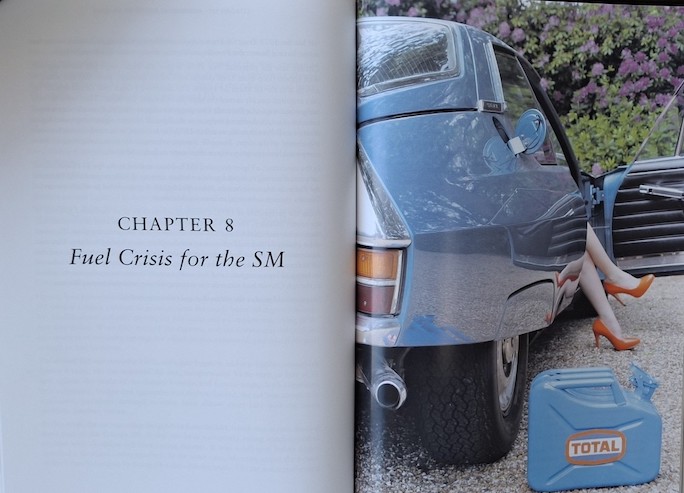
The motor industry also had its very own “dot com” episode. Citroën was a big investor in the rotary engine technology with Wankel/Comotor. The rotary engine concept turned out to be a very expensive dead end. And amongst other body blows were the 1973 oil price increases and the 1974 new US safety regulations, the latter of which killed the SM in the US marketplace.
Citroën went bankrupt again in 1974. So, the story is quite straightforward? No! The author digs deep into the complex story by uncovering unexpected links between apparently disparate events and activities. He also takes us through the murky and corrupt circumstances of “what happened next.”
At the very outset in 1970 there was opposition to the SM, even within Citroën itself by the company president’s second in command. He resigned immediately after the SM launch because of his dislike of the car. He also stated subsequently the SM never made a profit. As the author rightly points out whether a car makes a profit or not will depend on how overheads and fixed costs are apportioned by accountants. Famously Ford reverse-engineered a BMC Mini and stated that each one must have sold at a loss. BMC accountants used a different financial model to Ford.
On his odyssey through this epic, Ager uses images and popular cultural milestones to invoke the era. A case in point is the chapter on the travails with the rotary engine. He links a Citroën short film extolling the merits of the GS Birotor with a 1960s children’s program “The Magic Roundabout.” This originated as a French stop-motion film ostensibly aimed at children but quickly found an older generation reading 1960s hippie stereotypes in the characters. Dougal the Dog (resembling an animated clothes brush) is recast as General De Gaulle, Mr. Zeebedee (a correspondingly animated corkscrew) as Felix Wankel. At the end of the program all the characters climb on board a rotary roundabout. There is some seriously allegorical linking going on here.
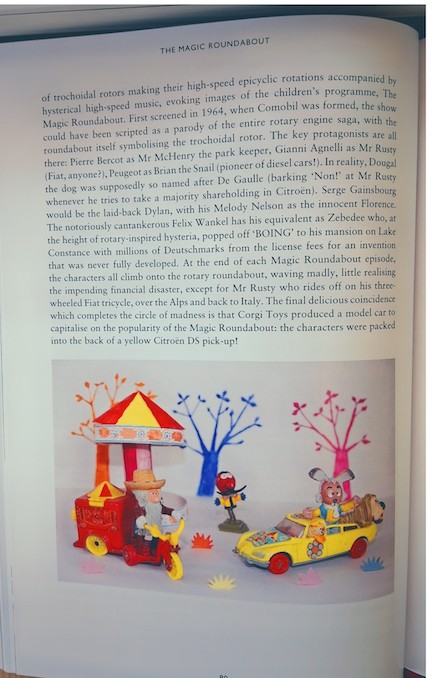
Sharp-eyed readers will note the Corgi model is a Citroën DS pickup.
At the height of Citroën’s problems in 1974, they lost their main benefactor and guardian with the death of President Pompidou. He was succeeded by Valery Giscard d’Estaing, a devious and duplicitous politician even by the low standards of the Fifth Republic. He drove through a merger of Citroën and Peugeot, with Peugeot having the whip hand. Citroën was eviscerated. He also scrapped the Aerotrain.
The author manages a specialist Citroën SM and DS (and Maserati) engineering company. At the time the book was written he had driven over 200 SMs, and at one point owned the last SM manufactured. So it would come as a surprise if he remained neutral in the ensuing struggle. Luckily for us he does not. Swapping to a pantomime allegory he depicts Citroën as Cinderella and Peugeot as a wicked Step Sister. He logically and eloquently savages Peugeot’s paucity of engineering vision and capability. The Peugeot 2.7L V6 engine developed in 1974 “set class-leading standards for low power and poor fuel consumption.” Peugeot engineers “fixed” a vibration problem by retarding the ignition on one side of the engine. Peugeot also allowed Maserati (then owned by Citroën) to go bankrupt and then offloaded the company by paying Alejandro de Tomaso 30m francs to take it off their hands.
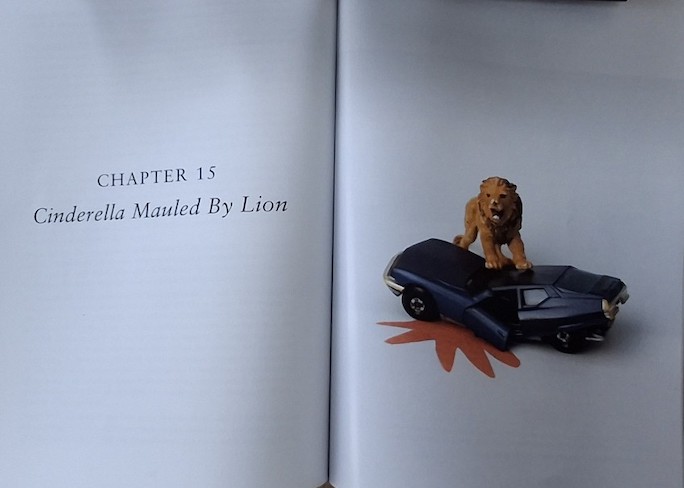
The Citroën/Peugeot “partnership.”
In the end Cinderella did not meet a handsome Prince but eventually managed to live happily ever after. Within a few years the CX—cunningly developed under the radar of the Peugeot accountants—brought Citroën back to what it had always done best, making innovative and popular cars.
The book focuses on how and why Citroën and the SM met their demise. There is technical detail, but it is secondary to the main theme. You will need to read SM: Citroën’s Maserati-Engined Supercar to garner the complete other side of the story.
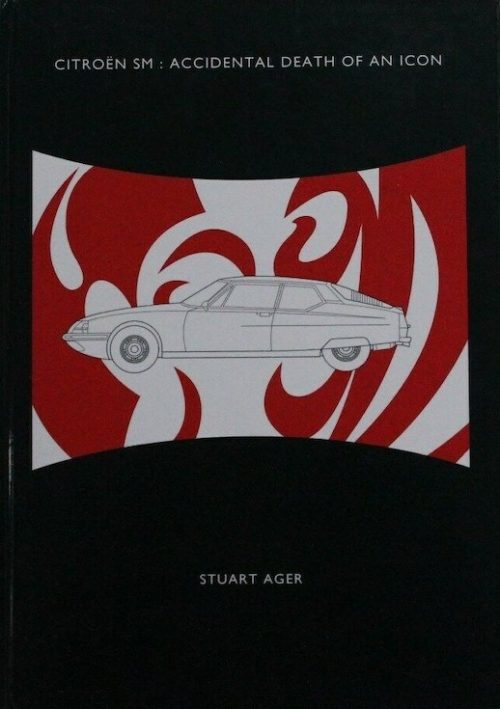
A trademark “Ager approach” to the illustrations (see Games without Frontiers) means that you do not only get photos of cars and people but also specially commissioned artworks and montages to complement the words. The cover is “a Citroën SM with psychedelic relief.”
The bibliography includes Dario Fo’s Accidental Death of an Anarchist. The play depicts how government authorities conspire to pervert the truth. Ager adapts his book’s title to tell a similar story.
When this book was first published, Octane Magazine ran a review in which they summed up the book in three words: “Bonkers but brilliant!” It is impossible for me to improve on this.
Only the deluxe version contains the artwork and is an A4-size hardcover; the softcover is A5. This was Agers’ first book, more are in the works.
Copyright 2026, Paul Lea (speedreaders.info)





















 Phone / Mail / Email
 RSS Feed
 Facebook
 Twitter