
Ford versus Ferrari: The Battle for Supremacy at Le Mans 1966
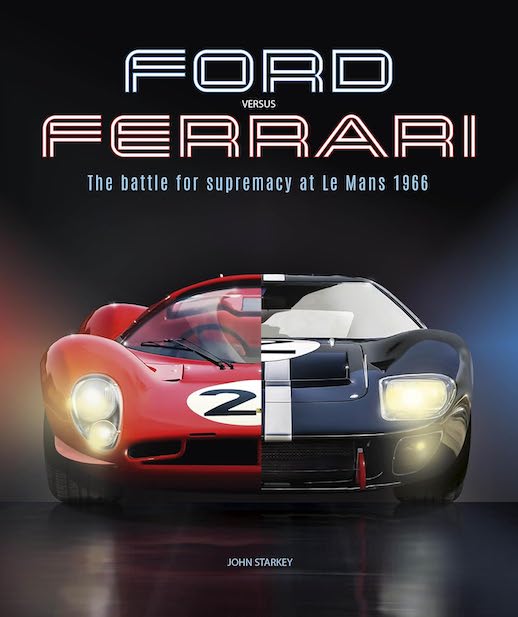 by John Starkey
“I had never been so impressed with a car in my life. … What was the most awesome, though, was to hold it flat upon the banking. It would easily do over 180 mph, and that was the fastest I’d ever been in anything on wheels.”
—Mark Donohue
It’s become compulsory to talk about Artificial Intelligence in 2026. POTUS says AI is a good thing, but some tech bros say that we’re all doomed. That stuff is above my pay grade, so I asked Gemini about the importance of Le Mans 1966 instead. And it told me that Ford’s victory was the fifth most consequential event in motor racing history. We can argue about the ranking, but anybody who was around in 1966 can confirm that the news of Ford’s blue collar team having beaten Ferrari’s automotive aristocracy registered on the Richter Scale. It was headline news in the dailies, and seismic in the weekly racing press. And Ford versus Ferrari is one of a bunch of books written to commemorate the day when Amon and McLaren won but Hulme and Miles didn’t. More on Ken Miles later.
This chunky, compact (128 p) hardback from Veloce tells you what you need to know about how the Lola Mk VI evolved from its genesis in 1963 to the all-conquering Ford GT40. In its Mk II behemoth iteration, the GT40 finally put a big smile on Henry Ford II’s face by kicking sand all over Enzo Ferrari’s 330 P3s at Le Circuit de la Sarthe on the weekend of 18/19 June 1966. And, if you were born too late to savor the drama first time around, you could experience it on the silver screen in 2019, when Brad Pitt and Christian Bale, as Carroll Shelby and Ken Miles respectively, showed how Detroit finally whupped Maranello’s ass (as Motor Sport magazine didn’t put it). It wasn’t a coincidence, I bet, that the first edition of this book was also published in 2019. The new hardback is, I think, a straight reprint of the earlier work. The acknowledgements section seems to confirm this, as the opening words are “The events described in this book took place over 50 years ago,” which at the time of this 2026 edition has increased to 60 years. In other words, buyers should be aware that, unlike the GT40, the Mark II version of this book just has different body work but the same engine.
John Starkey recounts the familiar story (to most of us, anyway) of how Ford’s courtship of Ferrari was never consummated, and how its jilted lover revenge was eventually manifested with the 1-2-3 rout at Le Mans. The author packs adequate detail for freshers in Le Mans studies with mini biographies of the dramatis personae, and not just the big corporate beasts like Enzo Ferrari and Leo Beebe, but battlefield grunts such as Carroll Shelby, Messrs Holman and Moody, and Mauro Forghieri. And there’s a decent introduction to the CVs of key drivers such as Bruce McLaren, Dan Gurney, Ludovico Scarfiotti, Phil Hill, and Ken Miles.
Oh yeah, of course Ken Miles. There’s a thesis waiting to be written on why the internet is awash with conspiracy theories of why Miles was robbed of his rightful victory by the fiendish Detroit suits. I blame that bloody film, which leveraged the “Miles as victim” theme. He was a fine driver, undeniably, and would have earned the win as much as his equally deserving Ford team mates, but the conspiracy theorists ignore one crucial fact: nobody really cares about who is driving the winning car across the finish line in endurance racing, because (unlike F1) what matters is the winning marque, not the drivers. And note the plural—so how come nobody ever says that Miles’ co-driver Denny Hulme was robbed too?
Not for the first time, I’ve been distracted by a Miles diversion, so what about the rest of the book? Pictures first, and the fact that old hands have probably seen them before doesn’t matter much. I’ll never complain about seeing the exquisite lines in rosso corsa of the Ferrari P3 and, lawks, some of the haircuts rocked by old guard luminaries like John Wyer have been extinct for decades. He looks like my father did in pictures taken in the Thirties. But how youthful the now nonagenarian A. J. Foyt [1] looks as he acknowledges the crowd’s applause in ’67. As for the GT40, it still looks as gloriously potent as it did when LBJ (b. 1908) was in the White House. Sixty years on, you can easily tell a 2026 WEC car from a GT40, but the differences are in detail, not in substance. And if you want to know what progress looks like, just look at a car from sixty years before the GT40’s days in the sun—try the Christie V-4 which starred at Goodwood this summer.
John Starkey must have had some tough choices to make in deciding what not to include in this short book. Especially as, despite its “1966” title, it covers the GT40 story from its Lola beginnings to the Ickx/Oliver swansong win at Le Mans 1969. He also touches upon the GT40-evolved Mirage racers and the gorgeously svelte Ford P68 which I saw fail, albeit gloriously, at the 1968 Oulton Park Tourist Trophy.
The book is written in an accomplished and professional style, but with occasional bumps in the road: to say that “Bruce McLaren had been a cripple when young” would have jarred on first publication, let alone now. But enough of the nit-picks—you will still learn from this book stuff you might have forgotten. Try these: the 7L big block V8 in the Mk IV GT40 weighed 675 lb, that’s nearly two Cosworth DFVs or nearly four Coventry Climax FWEs! And the Lola T70 Mk III-Aston Martin, it was just hopeless, right? Yes, except it was third fastest in the Le Mans test weekend of 1967, ahead of the MK IV!
The book ends on a bizarre note with the story, which the author had heard about how, that Ken Miles—yes, him again—had not been killed at Riverside in a testing accident at all. No sir; he was living in a school bus in Wisconsin in 1986, apparently, surviving on the remains of the $2 million payout Ford had given him to make him disappear. Which reminds me of the song by the late and lovely Kirsty MacColl, “There’s a Guy Works Down the Chip [2] Shop Swears He’s Elvis.”
- In this book rendered as “AJ”. Foyt is doing himself no favors by using three different versions, depending on context. See The A. J. Foyt Legacy for details.
- What Brits call “chips” are what Americans call “fries.” Another case of “Potato, potato, tomato, tomato/Let’s call the whole thing off”?
Copyright John Aston, 2026 (speedreaders.info)



 Phone / Mail / Email
 RSS Feed
 Facebook
 Twitter