
First Highways of America
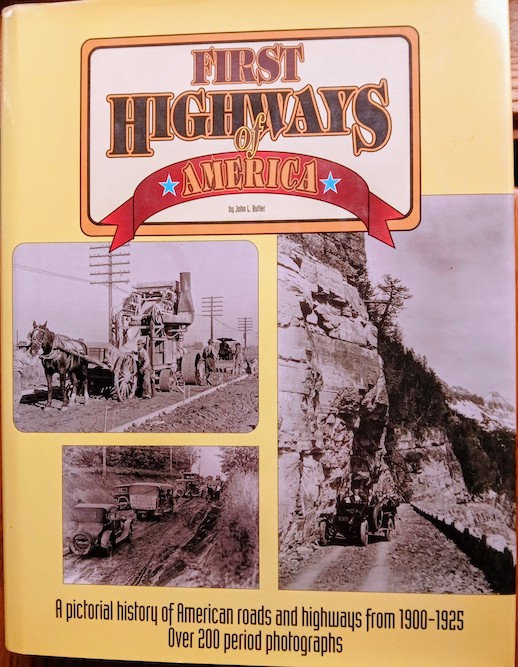 John L. (Lawrence) Butler
“The history of the automobile has been chronicled in great detail. But the highway, the absolutely essential partner of the automobile, largely has been overlooked. … This story of road construction … is an essential part of the whole story of automotive history.”
PREAMBLE: there are always more books than we have time to review so reviewing an old book only years after it came out always begs the question “why now?” In this case, the author died (1935–2026) recently and you’ll want to know about this worthwhile book before it becomes hard to find.
Palaver prevailed as everyone had an opinion on the need for roads. City dwellers had no interest in country roads while country dwellers weren’t interested in roadways until they could actually afford motorized transportation. Then too there was more talk regarding “types of road to be constructed, who should pay for the roads, and where principal routes should be laid out.” One man was prompted to wonder if the seemingly endless discussion and little to no action “would follow the fashion of all fads and become out of date and soon fade away.”

“Automobile drivers soon were well aware that ‘the average automobile is better than the average road,’ even though their average cars in the early years may have had only one or two cylinders and rode on tires without any tread.”
All one need do is look at all the concrete that crisscross the nation today. This wasn’t a fad that would or did fade away. It would, however, require both federal and state governments being involved “in planning and coordination of construction” as this book documents in words and period photos.
At the beginning of the 20th century Europe already had “hundreds of miles of hard-surfaced intercity routes” whereas “roads passable for automobile travel simply did not exist in the United States.” Early road builders in the US faced a problem foreign to the European countries: distance. Some states were “as large as entire European nations. … And with distance came the problem of cost.”

Photos are sourced from everywhere including Honolulu’s Municipal Reference and Records Center (bottom left and on right) and (top right) the Henry Ford.
By no means is this a new book, having been written and published some three decades ago. It is, however, a seminal work on its topic and is supported by a ten-page bibliography and author John Lawrence Butler’s own professional credentials. He spent his 42-plus-year career instructing college students and serving as a university administrator.
Butler discusses types of roads. Broken stone types, not to be confused with those merely graveled, that include macadam—crushed rock rolled to pack—Telford with a bottom layer of hand-laid large rocks, topped with broken stone, then a layer of sand, all rolled and watered, or in some instances oil or tar. Bituminous macadam was the forerunner of today’s asphaltic concrete better known as blacktop. Other types of roads found in towns and cities might be made with creosoted wood blocks, bricks, or cut granite blocks. It was trial and error as road builders learned to provide for drainage, temperature changes and the like by properly preparing the road bed first.
Another chapter deals with the equipment used to assist men with the hard labor of constructing these roads as such were gradually developed—sometimes quite by accident. Such was the case with the rolling tamper conceived, built, and sold by a Californian named John Fitzgerald. He’d just plowed the roadbed when a flock of sheep came along. After they’d passed he invented “sheep footed” rollers as such tamped more effectively than smooth-faced rollers.

Asphalt paving was laid by hand prior to the “hot mix” machines and then rolled.
With another chapter Butler explores the evolution of maps and guidebooks and the final chapter titled “Signs of the Times” introduces the proliferation of highway roadside signs. Some signs, of course, were useful and informative giving directional or road condition information. Others, not so.

Wood plank roads tamed the shifting sands of the desert until the more traditional paved road could be built. Plank roads were usually a single lane with turnouts when cars going in opposite directions met.
The middle 1920s saw the germination of the numbering system we use today in the US to identify state and federal highways. Butler found that Wisconsin may have originated the idea of numbering as a simplified way to designate its highways. But it would take until the mid-1930s signing by Dwight Eisenhower authorizing the construction of the National System of Interstate and Defense Highways to standardize that even-numbered routes (regardless of whether state or national) be those going mainly east/west and odd-numbered routes for those with essentially a north/south orientation.
This book belongs on the shelves of any serious transportation historian as it documents the earliest days of road building in America.
Butler authored two more books, Historic Clarksville (1784–2004) with Charles M. Waters, and Model Ts in Trouble. He owned and restored Model T Fords and a 1950 MG TD.
Copyright 2026 Helen V Hutchings (speedreaders.info)








































 Phone / Mail / Email
 RSS Feed
 Facebook
 Twitter